Ahead Of Rajasthan Polls, WhatsApp’s Training Programme Against Fake News

Aiming to address the challenge of misinformation during the upcomimg Rajasthan Assembly polls, WhatsApp today conducted training for community leaders in Jaipur, in partnership with the Digital Empowerment Foundation (DEF), the Facebook-owned mobile messaging platform said.

The education workshop encouraged WhatsApp users to see themselves as “agents of change” by addressing socio-behavioural change and empowered them to spot false news.

The training will also enable them to differentiate between rumours and opinions; shared subsequent steps to tackle instances of false news and tips to stay safe on WhatsApp.

“WhatsApp is proud to have played a part in helping millions of people in Rajasthan to freely connect with their loved ones anywhere in the world. These trainings are a key part of our strategy to help people stay safe and limit the spread of harmful rumours this election season” said Ben Supple, Public Policy Manager, WhatsApp, in a statement.

The curriculum further delved into how users can contact fact-checking organisations like Altnews and Boom Live to accurately verify information when they are in doubt.

The training was attended by over 100 participants including from local government administrations, law enforcement authorities, college students, NGOs and community leaders who are dedicated to the technological empowerment of their society, especially villages and semi-urban centre.

“While the problem of misinformation is not restricted to rural areas alone, it is the rural population that majorly lacks access to alternative news sources for sake of verification,” said Osama Manzar, Founder and Director, DEF.

“We see education as the only solution to this problem, and we know that when we teach them some basic verification techniques, they’re going to tell at least two other people about it, creating a ripple effect and potentially fighting misinformation.”

Additionally, WhatsApp and DEF will organise workshops as a part of their Community Information Resource Centre (CIRC), where they will conduct training sessions targeted at grassroots communities in rural areas across five states in India, the company said.

In August, WhatsApp was asked by the central government to take steps to stop the spread of disinformation on its platform.

WhatsApp roped in New Delhi-based non-profit DEF and initiated a series of educational workshops in 10 key election states including Madhya Pradesh, Chhattisgarh, Mizoram, Rajasthan and Telangana.


Note: RSS Feeds taken from Respective Websites.

The Remotest Villages in Rajasthan Are Getting Education, Thanks to Women Like These Two!

I had an interesting conversation with two feisty women from Rajasthan this weekend. These two women had chosen to be educators at the Ekal Vidyalaya School in rural Rajasthan.

The Ekal Vidyalaya is based on the principle of one school-one teacher. The Ekal Vidyalaya Foundation, a non-profit organisation, involved in education and village development in the remotest rural and tribal villages of India, established these schools.

This initiative is benefitting nearly 500 students in rural parts of Rajasthan, Sikkim, Meghalaya, and Arunachal Pradesh. About 150 teachers are spearheading this project.

As a part of this initiative, 30 Ekal teachers from Rajasthan and five members of the leadership team were invited for a 3-day teacher-training workshop to the Heritage Xperiential Learning School in Gurugram. The workshop focused on helping the Ekal teachers experience the use of different classroom management tools and teaching strategies to engage students in the learning process.

We, at The Better India, caught up with Savita Devi Meena, from Sadaldi village in Rajasthan, and Kamla Joshi, from Udaipur.

It was in 2012 that Savita began her teaching journey. She primarily teaches children between the ages of six and 14.

When asked about why she took to teaching, she answers, “We come from a very interior part of the country. If the child in the village wants to study, they have to travel at least 15 kilometres to get to the school. This becomes one reason why children refrain from attending school. It was an attempt to change this that pulled me towards this profession.”

She goes on to say that since becoming a teacher, she feels very empowered and enjoys being in class with her students. “To know that because of us, so many students are being benefitted, is something that I cherish,” she says.

The importance of training programmes

“Being here and learning the practices followed by schools in the city is helping us. One of the important things I will take back is the “circle-time” that the students here follow. I feel that our children will learn a lot from all this,” says Savita.

Circle-time is when the teacher and the students sit down and speak about their day, what they learnt during the day, what they would like to explore, and discuss anything they find interesting.

Teachers at the training programme

In terms of exposure and availability of infrastructure, the Ekal schools are rather behind. However, both Savita and Kamla are hoping to take back enough from the training programme to help their students.

Education, a tool for social change

Savita speaks about how there has been a shift in the way people in the village think. She narrates, “There was one girl student who was very keen to study, but she had an alcoholic father who not only stopped her but also made life difficult for everyone in the house.”

She continues, “A group of women from the village got together and intervened and ensured that they counselled not just the alcoholic father but also convinced the mother to let the child study.”

Kamla Joshi

The child is now in class 8 and has been doing very well since.

Mahila Mandal

A strong group consisting of the village women forms the Mahila Mandal. From solving personal issues to looking at larger social change, the women of the village are a formidable force.

“We have helped so many families–rehabilitated drunk men, helped families financially, and stopped child marriages,” she says.

Training in progress

Coming from a place riddled with superstitions, Savita narrates another incident, which furthers strengthened her belief in education. “A lady had been branded by her in-laws as a ‘witch’, and they had thrown her out of the house. With nowhere to go, the lady had given up on life. It took the entire Mahila Mandal to convince the in-laws otherwise.”

Both Savita and Kamla are very certain that educating children is the only way they can bring about social change. With such fierce ambassadors in these villages, the students sure are in good hands.


Note: RSS Feeds taken from Respective Websites.

Excellence Knowledge City: An Oasis for Education of Underprivileged Girls in Rajasthan

Excellence Knowledge City for Girls, an oasis for girls’ education in Sikar district of the desert state Rajasthan, offers free education along with books and uniform. The institution, which offers education from nursery to B.Sc and B.Ed. to underprivileged girls in the Shekhawati region, runs on entirely savings of entrepreneur Wahid Chowhan who was born in Sikar, and is now settled in Mumbai. This is probably the first institution that teaches Sanskrit along with Urdu and Arabic. It has completed 20 years successfully.


Note: RSS Feeds taken from Respective Websites.

Telangana polls: TRS aims to use an eight-point election strategy to counter challenge posed by Mahakutami

As the Congress-led Opposition combine is battle-ready to take on the Telangana Rashtra Samithi (TRS) juggernaut, Telangana chief minister K Chandrashekar Rao (KCR) is embarking upon a comprehensive electoral strategy to frustrate the efforts of his rivals.

Such a strategy include the following:

1. Painting Mahakutami as proxy for Andhra Pradesh leadership

Painting the Congress-led Mahakutami as proxy for Andhra Pradesh leadership, TRS supremo KCR plans to revive the Telangana sentiment on the poll eve. The prime attack of TRS against the Mahakutami is on TDP. It is a calculated move on part of TRS as the Chandrababu Naidu-led TDP is a marginal player in the Congress-led alliance.

Unless the grand alliance wins the polls with a slender margin, the TDP will not have a decisive role in the Telangana government. Yet, TRS targets Congress for its alliance with TDP, describing it as an Andhra Pradesh party. Given the continuing differences between the two Telugu states post-bifurcation, and Andhra Pradesh chief minister and TDP president Naidu taking a position unpalatable to Telangana on a host of issues confronting the two states, TRS expects to rouse the Telangana sentiment again. TRS expects that Congress is therefore vulnerable to attack as Telangana electorate believes state TDP to be working under the dictates of the Andhra Pradesh chief minister.

2. Capitalising on dissidence within Congress

The Congress is facing dissidence in as many as ten constituencies among the first list of 65 candidates which the party has announced so far. In fact, Congress rivals expected the dissidence to be in more seats. However, TRS expects that the dissidence may mount as Congress and its allies release the full list of 119 candidates.

Though TRS also faced severe dissidence in as many as 30 seats, the ruling party could somehow manage it to a larger extent. The resource-rich ruling parties can always score over their Opposition rivals in such matters. Congress, which was busy finalising seat-sharing and selection of candidates, could not exploit the discontent in TRS over the selection of candidates, especially on the issue of re-nomination of almost all its sitting MLAs, many of whom face anti-incumbency. But now, the TRS leadership is strategising promoting rebels from the Opposition camp, especially from the Congress, by capitalising on the dissidence over seat-sharing and selection of candidates.

3. Micro-managing constituencies where Opposition has an advantage

The Congress camp feels that the first list has a large number of strong candidates if their individual capacity in winning the elections is concerned. The party spokesperson Dasoju Sravan Kumar said that majority of Congress candidates are two to three time MLAs, former MPs, former ministers and those who lost narrowly in 2014 when the Telangana sentiment was at its peak and the party was facing anti-incumbency after a ten-year-long spell in power.

Even the TRS leaders privately acknowledge this and claim that their leader KCR, who is a master strategist, will certainly have an effective strategy to neutralise this. TRS expects to undertake micro-management in identified constituencies where either Opposition candidates are strong or where TRS is facing internal dissonance.

4. Will Congress votes transfer to its allies?

TRS believes the Congress vote may not transfer to its allies — TDP, TJS and CPI. KCR called upon his party machinery to focus on such vulnerabilities of the Opposition conglomerate. Due to heavy competition for Congress candidature in many constituencies, the party finds it difficult to contain discontent in the seats allotted to allies. The problem is much more acute in the seats that are likely to be given to Communist Party of India (CPI) and the Telangana Jana Samiti (TJS) led by Professor Kodandaram.

Congress leaders feel that CPI and TJS nominees are not winnable candidates and the party has to make sacrifices for the sake of alliance even as the allies are still sulking over inadequate representation for them in the grand alliance. As the nomination process comes to an end, the confusion and commotion in the Congress-led grand alliance may come down.

Yet, TRS expects disgruntlement in the rank and file of different parties. Congress and TDP are historic rivals. Kodandaram, who led the Telangana Joint Action Committee (TJAC) that led the movement for a separate state, was very critical of Congress and TDP during the movement. Thus, TRS hopes that the vote transfer within the Congress-led alliance will not be complete, asserts Taduri Srinivas, TRS spokesperson.

5. Banking on government’s welfare schemes

Converting the beneficiaries of his government’s welfare schemes into vote banks forms the core of KCR’s electoral plank. KCR government’s welfare schemes like pensions for the old, widows, and the differently-abled, Kalyana Laxmi and Shaadi Mubarak, the financial assistance scheme at the time of a girl’s wedding, the Rythu bandhu, capital assistance of Rs 8,000 per acre etc are quite popular. Though there may be inadequacies and lapses in the implementation of welfare schemes, TRS still expects large a vote bank in the form of beneficiaries of these schemes.

6. KCR’s popularity

The field-level reports indicate that many of TRS members in the dissolved Assembly seeking re-election are hugely unpopular among the voters, even as KCR enjoys public support. Therefore, realising this folly, KCR intends to convert the election into a sort of a referendum on himself as his party and its MLAs face anti-incumbency to an extent. KCR’s son and the Minister for Information Technology KT Rama Rao, describing KCR as lion, said that there are as many as 20 chief ministerial aspirants in Congress and the leader will be chosen by Delhi and sent to Hyderabad in a sealed cover. This is a clear attempt to convert the election into a personality fight, with KCR having an edge.

7. Mobilising minorities and caste groups

Social engineering by targeting Muslim vote through understanding with MIM and mobilising specific caste groups is yet another strategy of KCR. In fact, the Assembly was prematurely dissolved to delink the state elections from Lok Sabha polls as KCR feared anti-Modi sentiment would drive the minority vote towards Congress. Similarly, through targeted welfare schemes, KCR tried to rally OBC voters, who were strong supporters of TDP in the united state.

8. KCR’s sharp speeches

KCR intends to disarm Opposition with bitter criticism. He is known for his sharp speeches. Involving the use of powerful Telangana slang is the cynosure of TRS campaign. The chief minister has already addressed few public meetings and is expected to undertake a whirlwind tour of the state. Thus, he wants to set an election agenda, making the Opposition follow him.


Note: RSS Feeds taken from Respective Websites.

Telangana polls: TRS aims to use an eight-point election strategy to counter challenge posed by Mahakutami

As the Congress-led Opposition combine is battle-ready to take on the Telangana Rashtra Samithi (TRS) juggernaut, Telangana chief minister K Chandrashekar Rao (KCR) is embarking upon a comprehensive electoral strategy to frustrate the efforts of his rivals.

Such a strategy include the following:

1. Painting Mahakutami as proxy for Andhra Pradesh leadership

Painting the Congress-led Mahakutami as proxy for Andhra Pradesh leadership, TRS supremo KCR plans to revive the Telangana sentiment on the poll eve. The prime attack of TRS against the Mahakutami is on TDP. It is a calculated move on part of TRS as the Chandrababu Naidu-led TDP is a marginal player in the Congress-led alliance.

Unless the grand alliance wins the polls with a slender margin, the TDP will not have a decisive role in the Telangana government. Yet, TRS targets Congress for its alliance with TDP, describing it as an Andhra Pradesh party. Given the continuing differences between the two Telugu states post-bifurcation, and Andhra Pradesh chief minister and TDP president Naidu taking a position unpalatable to Telangana on a host of issues confronting the two states, TRS expects to rouse the Telangana sentiment again. TRS expects that Congress is therefore vulnerable to attack as Telangana electorate believes state TDP to be working under the dictates of the Andhra Pradesh chief minister.

2. Capitalising on dissidence within Congress

The Congress is facing dissidence in as many as ten constituencies among the first list of 65 candidates which the party has announced so far. In fact, Congress rivals expected the dissidence to be in more seats. However, TRS expects that the dissidence may mount as Congress and its allies release the full list of 119 candidates.

Though TRS also faced severe dissidence in as many as 30 seats, the ruling party could somehow manage it to a larger extent. The resource-rich ruling parties can always score over their Opposition rivals in such matters. Congress, which was busy finalising seat-sharing and selection of candidates, could not exploit the discontent in TRS over the selection of candidates, especially on the issue of re-nomination of almost all its sitting MLAs, many of whom face anti-incumbency. But now, the TRS leadership is strategising promoting rebels from the Opposition camp, especially from the Congress, by capitalising on the dissidence over seat-sharing and selection of candidates.

3. Micro-managing constituencies where Opposition has an advantage

The Congress camp feels that the first list has a large number of strong candidates if their individual capacity in winning the elections is concerned. The party spokesperson Dasoju Sravan Kumar said that majority of Congress candidates are two to three time MLAs, former MPs, former ministers and those who lost narrowly in 2014 when the Telangana sentiment was at its peak and the party was facing anti-incumbency after a ten-year-long spell in power.

Even the TRS leaders privately acknowledge this and claim that their leader KCR, who is a master strategist, will certainly have an effective strategy to neutralise this. TRS expects to undertake micro-management in identified constituencies where either Opposition candidates are strong or where TRS is facing internal dissonance.

4. Will Congress votes transfer to its allies?

TRS believes the Congress vote may not transfer to its allies — TDP, TJS and CPI. KCR called upon his party machinery to focus on such vulnerabilities of the Opposition conglomerate. Due to heavy competition for Congress candidature in many constituencies, the party finds it difficult to contain discontent in the seats allotted to allies. The problem is much more acute in the seats that are likely to be given to Communist Party of India (CPI) and the Telangana Jana Samiti (TJS) led by Professor Kodandaram.

Congress leaders feel that CPI and TJS nominees are not winnable candidates and the party has to make sacrifices for the sake of alliance even as the allies are still sulking over inadequate representation for them in the grand alliance. As the nomination process comes to an end, the confusion and commotion in the Congress-led grand alliance may come down.

Yet, TRS expects disgruntlement in the rank and file of different parties. Congress and TDP are historic rivals. Kodandaram, who led the Telangana Joint Action Committee (TJAC) that led the movement for a separate state, was very critical of Congress and TDP during the movement. Thus, TRS hopes that the vote transfer within the Congress-led alliance will not be complete, asserts Taduri Srinivas, TRS spokesperson.

5. Banking on government’s welfare schemes

Converting the beneficiaries of his government’s welfare schemes into vote banks forms the core of KCR’s electoral plank. KCR government’s welfare schemes like pensions for the old, widows, and the differently-abled, Kalyana Laxmi and Shaadi Mubarak, the financial assistance scheme at the time of a girl’s wedding, the Rythu bandhu, capital assistance of Rs 8,000 per acre etc are quite popular. Though there may be inadequacies and lapses in the implementation of welfare schemes, TRS still expects large a vote bank in the form of beneficiaries of these schemes.

6. KCR’s popularity

The field-level reports indicate that many of TRS members in the dissolved Assembly seeking re-election are hugely unpopular among the voters, even as KCR enjoys public support. Therefore, realising this folly, KCR intends to convert the election into a sort of a referendum on himself as his party and its MLAs face anti-incumbency to an extent. KCR’s son and the Minister for Information Technology KT Rama Rao, describing KCR as lion, said that there are as many as 20 chief ministerial aspirants in Congress and the leader will be chosen by Delhi and sent to Hyderabad in a sealed cover. This is a clear attempt to convert the election into a personality fight, with KCR having an edge.

7. Mobilising minorities and caste groups

Social engineering by targeting Muslim vote through understanding with MIM and mobilising specific caste groups is yet another strategy of KCR. In fact, the Assembly was prematurely dissolved to delink the state elections from Lok Sabha polls as KCR feared anti-Modi sentiment would drive the minority vote towards Congress. Similarly, through targeted welfare schemes, KCR tried to rally OBC voters, who were strong supporters of TDP in the united state.

8. KCR’s sharp speeches

KCR intends to disarm Opposition with bitter criticism. He is known for his sharp speeches. Involving the use of powerful Telangana slang is the cynosure of TRS campaign. The chief minister has already addressed few public meetings and is expected to undertake a whirlwind tour of the state. Thus, he wants to set an election agenda, making the Opposition follow him.


Note: RSS Feeds taken from Respective Websites.

Telangana NRIs to campaign for TRS

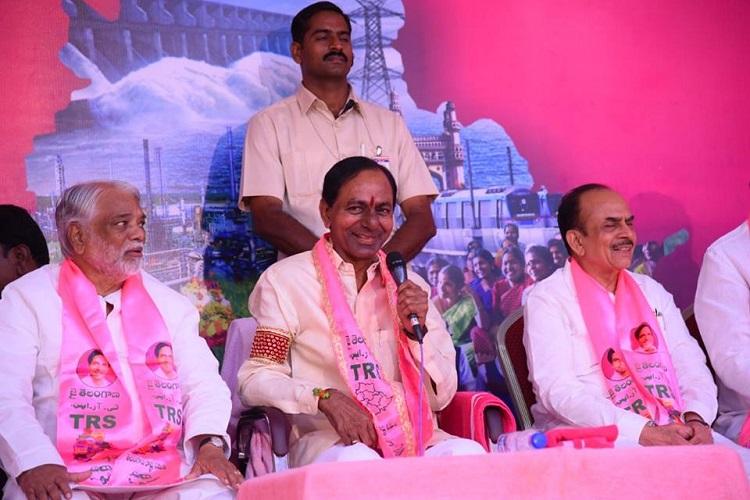
Telangana NRIs have joined the poll campaign on behalf of the TRS NRI wing extending their support to the TRS president and Chief Minister K Chandrashekhar Rao. Besides using social media, the NRIs will campaign in person in various constituencies across the State, said TRS NRI coordinator Mahesh Bigala.

Speaking to media persons on Sunday, Mahesh Bigala exuded confidence that TRS will sweep over 100 seats in the Assembly elections. He said NRI Affairs Minister KT Rama Rao had been a great source of support for the Telangana migrant workers in the Gulf countries. “The Minister helped many victims in ensuring their safe return home,” he said.

The TRS NRI leader said the NRI Cell in Congress has been reduced to a namesake entity and failed to rescue any Gulf victims. “But Rama Rao has been promptly responding to people in need of help even when they post their SOS messages on social media,” he added.


Note: RSS Feeds taken from Respective Websites.

TRS will strive for ‘federal front’ after polls: KCR

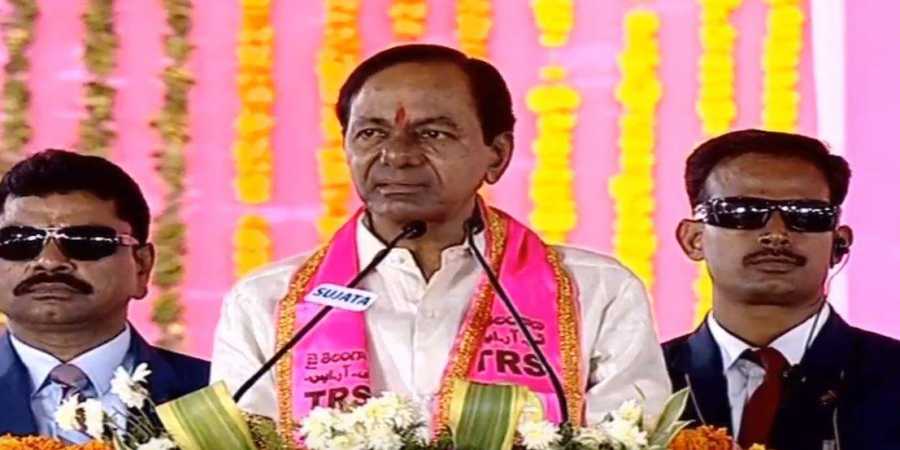
The TRS would play a role in national politics after the December seven state Assembly elections towards the formation of a “federal front” that enhances the powers of states, party president and caretaker chief minister K Chandrasekhar Rao said Monday.

Both the Congress and the BJP have miserably failed to rise to the expectations of people, he alleged, addressing an election campaign meeting at Khammam.

“…Narendra Modi was given power with lot of hopes, there is nothing great he has done. (He) has not done anything for people,” he said.

The two parties, while in power at the Centre, had centralised powers, encroaching on powers of states, he alleged.

“A definite ‘federal front’ that resists and stops them and enhances powers of states needs to come..I have made some effort for it… But, TRS will do politics, after these polls, that keeps Delhi under check,” he said.

Rao, who resumed his election campaign after a gap, said the state government was implementing as many as 411 welfare schemes.

He highlighted the schemes and promises of the Telangana Rashtra Samithi (TRS), including ‘Rythu Bandhu’ investment support scheme for farmers, hike in social security pension for poor, ‘Kanti Velugu’ eye screening for all, high salaries paid to Anganwadi personnel and others.

Referring to the criticism against the TRS government on the double bedroom houses for poor, he said it would be useful for two generations.

The Congress and the TDP are part of the “grand alliance” of opposition parties for the assembly elections.

He criticised the Congress and TDP for failing to ensure adequate power when they were in power.

Attacking Telugu Desam party (TDP) chief N Chandrababu Naidu, he alleged that the Andhra Pradesh Chief Minister has written to the Centre opposing certain irrigation projects in Telangana.


Note: RSS Feeds taken from Respective Websites.