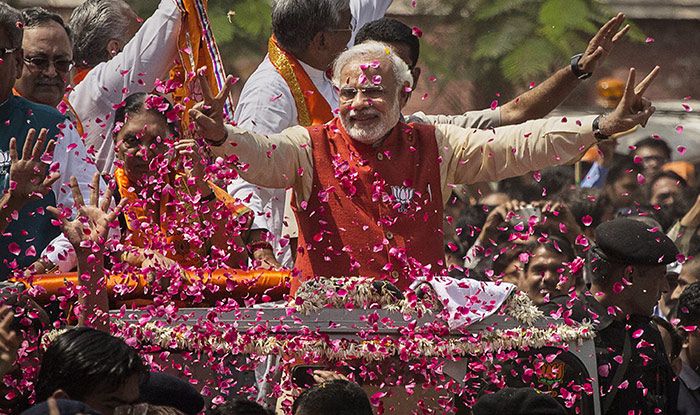
Telangana Elections LIVE : As polling nears end in 119 constituencies, Telangana recorded a Final Voter Turnout Of 73.2 %

As polling nears end in 119 constituencies, Telangana recorded a Final Voter Turnout Of 73.2 %.

–After Jwala Gutta, IPS Officer’s Name Missing;

–Manish Sisodia Slams EC

56.17% Turnout Till 3 PM; Sania Mirza Casts Vote In Hyderabad

PV Sindhu after casting her vote In Hyderabad

48.1 per cent voter turnout till 1 PM in Telangana.

8.97% Voter Turnout Till 9 AM

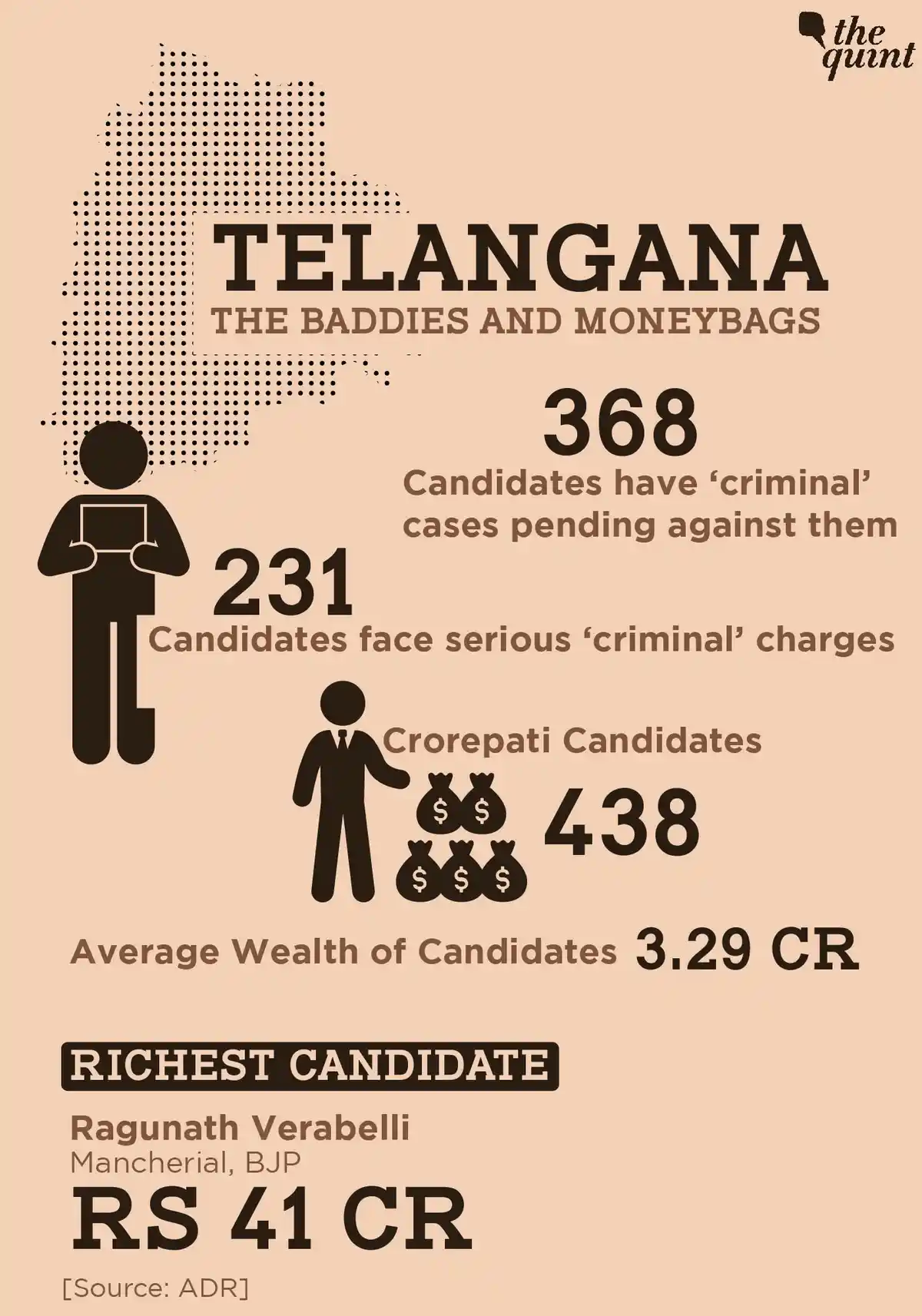
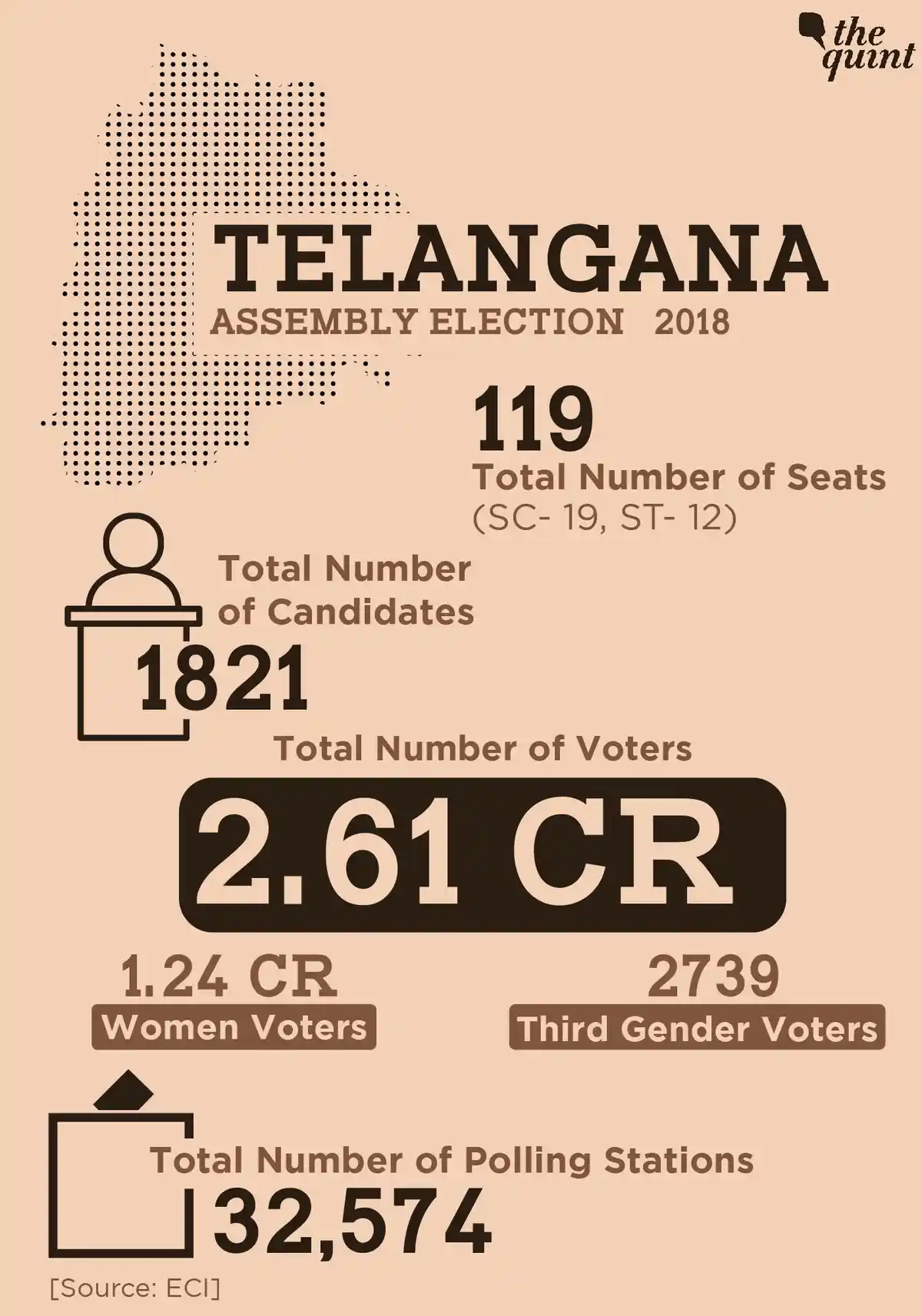
As many as 1,821 candidates including a transgender are in the fray in the election.

For the first time, Election Commission is using Voters Verifiable Paper Audit Trail (VVPAT) in Telangana.

224 video-surveillance teams and 133 video-viewing teams have been pressed into service.

Polling will start at 7 am and end at 5 pm, while in 13 constituencies which were classified as Left Wing Extremist-affected, polling ends one hour before (4 pm).

The TRS, seeking a second term in office, is going alone, as also the BJP.

The Congress has stitched together “Prajakutami” (People’s Front) along with the Telugu Desam Party (TDP), the Telangana Jana Samiti (TJS) and the CPI to take on the ruling TRS, led by caretaker Chief Minister K Chandrasekhar Rao (KCR).

The assembly polls in Telangana were originally scheduled to be held simultaneously with the Lok Sabha elections next year, but the House was dissolved on September 6 as per a recommendation by the state cabinet.

Security was beefed up at bordering areas which were identified as Left Wing Extremist-affected regions.

One lakh police personnel including 25,000 central paramilitary forces and 20,000 from other states are engaged in poll duties.

Campaigning by political parties came to an end at 5 pm Wednesday.

Over 2.80 crore electorate are eligible to exercise their franchise in the State, which has a total of 32,815 polling stations across.

More than 1.50 lakh polling officials including reserve staff are in the process of giving final touches Thursday to make the election to the 119-member House a smooth affair.

After a high-voltage campaign that saw war of words among contending parties, voting for the Assembly elections in Telangana will begin on Friday with the Congress-led alliance challenging the ruling TRS, and the BJP seeking to make it a triangular contest.


India’s youngest state, Telangana, goes to polls on Friday, 7 December, to constitute its second Legislative Assembly. The single-phase polling will see voting in all 119 constituencies.

The main contenders for this election remain to be the KCR-led TRS, which was in power for the last four years, and the Congress-led ‘Mahakutami’ (or ‘Grand Alliance’), which included the Telugu Desam Party (TDP) among many others.

  • Telangana is going to polls nearly seven months earlier as the TRS government dissolved the Assembly before its term ended
  • The Congress is considered the main Opposition in the state and is leading a grand alliance called ‘Mahakutami or Prajakutami’
  • TRS chief K Chandrashekar Rao will remain the caretaker chief minister till the new government is formed

What You Must Know About Telangana Polls 2018
What Do the Pre-poll Surveys Say?

The Aaj Tak-India Today survey predicts a massive victory for the Telangana Rashtra Samithi (TRS), with 43 percent voters predicted to cast their ballot for the KCR party. The Congress, on the other hand, is expected to garner 18 percent of vote share.

Interestingly, 11 percent of those surveyed wanted KCR to be the next prime minister, while 44 percent voted for PM Narendra Modi and 39 percent for Congress President Rahul Gandhi.

Another survey conducted by VDP Associates, claims that the TRS is all set to win at least 80 seats, while the Congress is expected to win around 20 seats. The survey predicts that the BJP will win seven seats, with the AIMIM getting eight.

The Main Contenders in Battlefield Telangana
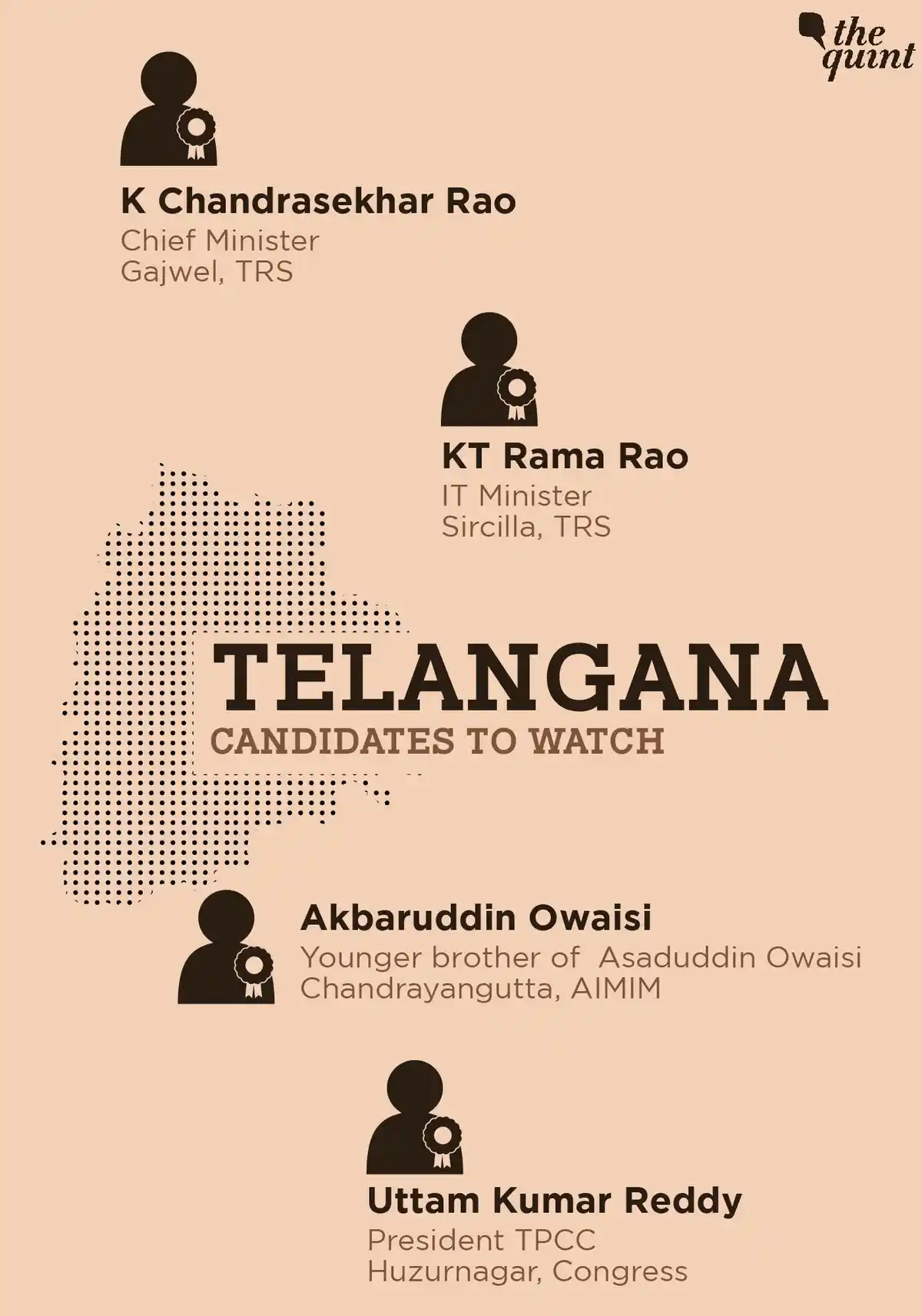
The main contenders for this election remain to be the KCR-led TRS, which was in power for the last four years, and the Congress-led ‘Mahakutami’ (or ‘Grand Alliance’), which included the Telugu Desam Party (TDP) among many others.

The BJP, although not a main contender, is expected to swing some percentage of vote share its way. In all, there are now as many as nine political parties vying for power in the state.

Early Polls in Telangana

A united Andhra Pradesh has voted for both state Assembly and the Lok Sabha at the same time — from 1999 till 2014. However, since August 2018, media reports suggested that KCR was getting ‘battle-ready’ to dissolve the Assembly and go to polls in winter 2018, along with Rajasthan, Madhya Pradesh, Chhattisgarh and Mizoram.

KCR dissolved the Telangana Assembly on 6 September, his supposed ‘lucky’ date.

Hours after dissolving the Assembly, he released a list of 105 candidates who will fight the elections from Husnabad, the very place he launched his 2014 campaign.


Disclaimer: RSS has been taken from their official website.
 

Nitin Gadkari confident of BJP forming govt in Chhattisgarh, MP & Rajasthan

Road Transport and Highways Minister Nitin Gadkari on Wednesday exude 100 percent confidence that the Bharatiya Janata Party (BJP) will form its government in the current elections in Chhattisgarh, Madhya Pradesh and Rajasthan. While talking about what the BJP government has done and it is doing for the development of Rajasthan, Nitin Gadkari said, “I have toured Chhattisgarh, Madhya Pradesh and Rajasthan and I am very confident that the BJP will form the Government again in all three states with majority.”

MP, Mizoram Polls 2018 LIVE updates: 75% polling in Mizoram, 74.6% in MP

In Mizoram, Congress will fight tooth and nail to save its last bastion in the North-East from falling. In the Christian dominated state, BJP’s pro-Hindutva image has done it any service and any party that is seen canoodling with the saffron party. Incumbent Chief Minister Lal Thanhawla’s tenure ends on December 15. Congress, the Mizo National Front (MNF), the Zoram People’s Movement (ZPM), and the Bharatiya Janata Party are the main political parties in the battle for Mizoram.

Madhya Pradesh, Mizoram Assembly Elections – LIVE updates

11:50 am: Voter turnout in Mizoram is at 29 percent till 11 am, as per ANI. In 2013 State Assembly Elections, the north-eastern state saw 89 percent voter turnout. Meanwhile in MP, 13.63% voter turnout was recorded till 11.15 am.

11:10 am: Special arrangements have been made to facilitate voting by members of the Bru community. Food and transport facilities are also being provided to those coming to cast votes. Violence between Mizo and Bru tribes broke out in 1997, following which many Bru families were forced to flee their home state and take shelter in the neighbouring Tripura.

10:44 am: After a person was arrested after BJP polling agents were found carrying campaign material within 200 meters of a polling booth in MP, another case of violation of section 126 of the Representation of People Act, 1951. The Election Commision is expected to look into the matter.

10: 30 am:  After initial reports of multiple Electronic Voting Machines (EVMs) and Voter Verifiable Paper Audit Trail (VVPAT) not working, over 100 EVMs have been replaced, chief electoral officer V Kantha Rao was quoted by reports as saying.


10:19 am: Earlier, Kamal Nath after casting his vote in Chhindwara said, “I have full faith in the people of Madhya Pradesh, they are simple and innocent people who have been robbed for a long time by BJP”.

In true democratic spirit, a 101-year-old woman was spotted outside the polling booth in Agar Malwa in MP after exercising her franchise:

10:02 am: In violation of election code of conduct, a person was apprehended after BJP’s polling agents were caught with campaign material within 200 meters of a polling booth in MP.

9:50 am: Mizoram has witnessed 15 percent voting till 9 am, as per ANI. The voting in the North-eastern state started at 7 am and will continue till 4 pm. Mizoram’s borders with neighbouring Tripura, Assam and Manipur as well as international borders with Myanmar and Bangladesh have been sealed since Sunday for elections.

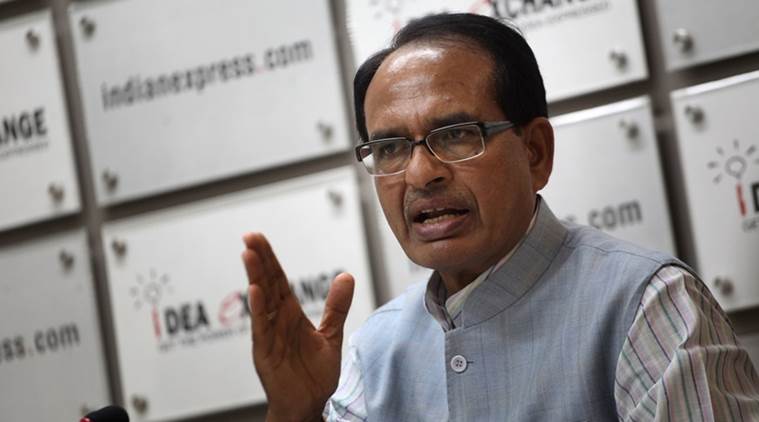
9:37 am: After claiming yesterday that there is pro-incumbency and not anti-incumbency in the state, CM Shivraj Chouhan after casting his vote in Budhni on Wednesday said he is confident that BJP will form the government with absolute majority.  “We’re 100% certain that BJP will form the government with an absolute majority. We have set a target of 200 seats and our lakhs of volunteers are working to make it a reality,” he told ANI.

9:22 am: There have been reports of EVMs not working in some of the booths in MP. Two faulty EVMs in Ujjain have been replaced, 11 VVPAT machines in Alirajpur, 5 VVPAT and 2 EVMs in Burhanpur also replaced. It was earlier reported that EVM at polling booth number 178 in Dabra, Gwalior district is not working.

9:03 am: In MP, a total of 5,04,95,251 voters will cast their votes to decide the fate of 2,907 candidates. Voting in three Maoist-affected seats Lanji, Paraswada and Baihar began at 7 am and will continue till 3 pm while the polling in the remaining 227 seats began at 8 am and will continue till 5 pm.

8:48 am: Congress leader Kamal Nath cast his vote in Chhindwara while MP minister and BJP leader Yashodhara Raje Scindia cast her vote at a polling station in Shivpuri. She is up against Congress’ Siddharth Lada.

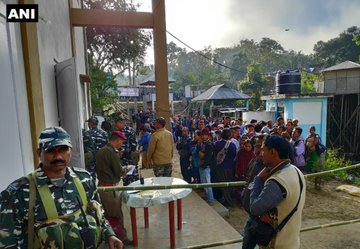
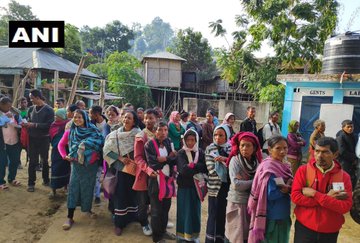
8:34 am: Mizoram has 7,70,395 registered electors who will vote in 1,164 polling booths across the state. Nearly 209 candidates are in the fray. Here are some visuals of voters as they exercise their franchise:

View image on TwitterView image on Twitter


8:22 am:  Both BJP and Congress leaders made temple runs as polling began in MP. MP CM Shivraj Singh Chouhan offered prayers on banks of Narmada river in Budhni with his wife Sadhna Singh. Meanwhile, Congress leader Kamal Nath made his obeisance at Hanuman temple in Chhindwara.

8:13 am: Polling in Maoist-affected constituencies began early in Madhya Pradesh while voting in the rest of the state started at 8 am. The most-watched seat today is CM Shivraj Singh Chouhan’s Budhni. He is pitted against Congress’ Arun Yadav there.

8:03 am: In Mizoram, all booths will be connected wirelessly leaving no “shadow areas”. The state has a hilly terrain which makes access to certain locations difficult. Mizoram Deputy Inspector General of Police earlier Joseph Lalchhuana earlier told PTI the move will help in timely reporting of the progress in polls.

7:45 am:  On the eve of MP polls, Shivraj Singh Chouhan who is the longest-serving chief minister of the state told PTI that pro-incumbency and not anti-incumbency is at play in the state. “What is at work here is pro-incumbency and not anti-incumbency,” said the 59-year-old BJP leader, whose party has been in power in the state since 2003,” he told PTI.

7:30 am: Voting in MP will begin at 8 am. About 500 ‘pink’ polling booths all across MP which will completely be managed by all-woman staff. From presiding officers till security guards, these booths will have all women staff.

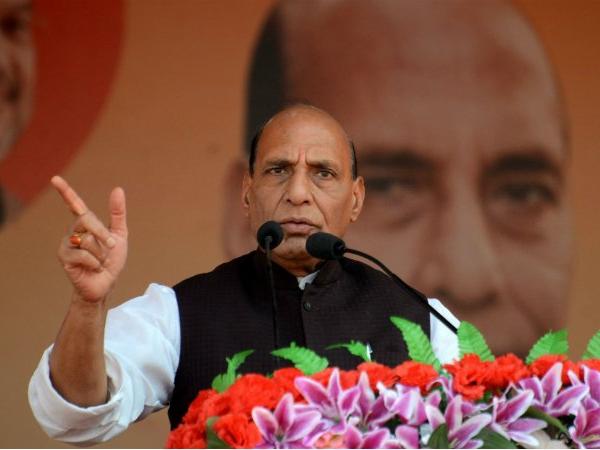
MP polls: Rajnath Singh takes dig at Congress manifesto; says party ‘holding on to cow’s tail’ for survival in state

Union home minister Rajnath Singh said on Sunday that the Congress in Madhya Pradesh has now latched onto the cow for its survival.

The Congress, in its manifesto for the 28 November Assembly elections, has promised to build cow shelters across the state.

“Congress leaders are now doing temple-hopping as they know that the party cannot achieve anything on its own. They are kneeling before God and holding onto cow’s feet,” Singh said, addressing campaign rallies in Sagar, Morena and Gwalior region. They are holding on to the cow’s tail and promising to build shelter homes for cows,” he said.

“For us (the ruling BJP) cow is not an election issue. Temple and cow are crucial parts of our culture,” he added.

Saying that chief minister Shivraj Singh Chouhan is the first choice of people, the senior BJP leader alleged that the “Congress does not like him as he is born in a simple family.”

The opposition party is yet to choose its chief ministerial candidate while the BJP has renominated Chouhan, Singh said.

When he campaigned in the state during 2003 elections, “there was darkness under the regime of then chief minister Digvijay Singh, now there is brightness (electricity) in each household,” he said.

Under the Congress rule from 1993-2003, agricultural grown rate of the state was three percent, which has now soared to 20 percent, while the per capita income has risen to Rs 80,000 from Rs 15,000, the Union minister said.


Disclaimer: RSS has been taken from their official website.
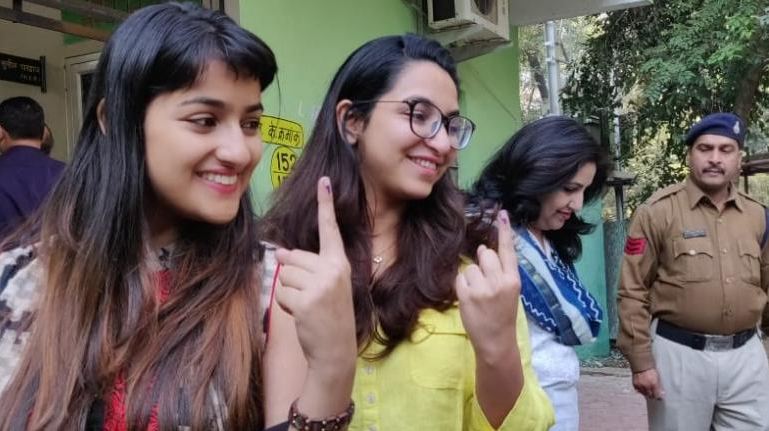
Madhya Pradesh Assembly election results will tell us more about 2019 than all other four states, here’s why

Madhya Pradesh has emerged as the most coveted prize to bag among the three north Indian states due to elect their new Assemblies this year. This is because Madhya Pradesh mirrors the big Indian story of agrarian distress, economic disruptions caused by demonetisation and the Goods and Services Tax, and social conflict. Should the Bharatiya Janata Party (BJP) still win the state for the fourth time in a row, the Congress will seem a ship doomed to sink in the whirlpool of the 2019 Lok Sabha elections. Conversely, a Congress victory will have the party set sail its flotilla for capturing power in Delhi.

Among the three north Indian states, Chhattisgarh’s national significance is limited as it sends only 11 MPs to the Lok Sabha. By contrast, Madhya Pradesh has 29 Lok Sabha seats, just three more than Rajasthan’s 26. Yet Rajasthan has been relegated in importance because a Congress triumph here will be par for the course. Ever since the BJP formed the government in Rajasthan in 1993, the power there has alternated between it and the Congress every five years. A Congress victory, therefore, cannot be taken as a reflection of the political mood in north India.

By contrast, the BJP won 165 out 230 Assembly seats in Madhya Pradesh in 2013, 143 in 2008, and 173 in 2003. More significantly, it polled 44.87 percent of votes in 2013, 37.64 percent in 2008, and 42.50 percent in 2003. In fact, in the 2014 Lok Sabha elections, the BJP’s vote share ballooned to a stunning 54.03 percent, a rarity in India.

“In the aftermath of the fall of the Congress nationally, there are not many states where the dominance of one single party has been shaping so clearly. In Madhya Pradesh, the Congress is not only kept out of power, but the BJP has also established its domination beyond electoral politics,” wrote Yatindra Singh Sisodia in Electoral Politics in Madhya Pradesh: Explaining the BJP consolidation, a paper he authored in 2014.

Based on the post-poll survey he conducted for the Centre for the Study of Developing Societies, Delhi, Sisodia, quite significantly, added, “It (BJP) has also been able to spread its support base across social sections… While the leadership (Prime Minister Narendra Modi and Chief Minister Shivraj Singh Chouhan) factor that contributed to the electoral success may have limitations in the long run, the fact that the BJP has wider social base and that it is seen as a party that may perform better than its rivals, will surely remain more dependable factors in this consolidation.”Shivraj Singh Chouhan and Narendra Modi. AFP file image

Not only has the Congress been kept out of power in Madhya Pradesh for 15 years, it lags far behind the BJP. For instance, it polled 36.38 percent of votes in the 2013 Assembly elections, nearly nine percent less than the BJP. Yet the hopes of the Congress have risen because of the social and economic tumult in the state, making it believe that the moment is propitious to overcome the massive lead the BJP has over it. Only a Congress win or photo finish in Madhya Pradesh will provide proof whether anti-incumbency, of even indeterminate magnitude, has set in against Modi and the BJP.

Yet the task of beating the BJP in Madhya Pradesh is formidable. For instance, agrarian distress in the state has been grabbing headlines, mostly notably when five farmers died in police firing last year. Traditionally, the BJP is considered an urban-centric party. Yet, in 2013, out of 194 constituencies in the state where urban population is less than 50 percent, the BJP won as many as 132, against the 55 that the Congress won. These comparative figures show the BJP has roots deep enough in rural Madhya Pradesh to limit the outfall of the discontent among farmers.

The challenge before the Congress to eat into the BJP’s rural base can also be perceived from the perspective of caste. The largest segment of agriculturists in the state belongs to the Other Backward Classes (OBCs), which account for around 42 percent of the electorate. Chouhan is a Dhakad, an OBC community engaged in agriculture and constituting about 3 to 4 percent of the state’s electorate.

The BJP’s OBC base is formidable – 67 percent of Yadavs voted for it in 2013 as against 25 percent of them for the Congress. The chasm between the two parties was less when it came to the support of non-Yadav OBCs – 45 percent of them voted for the BJP and 35 percent for the Congress. Given that the Dhakads are not numerically preponderant, it can be argued that Chouhan’s OBC identity will not stem the BJP’s slide because of agrarian distress.

However, Chouhan has refrained from harping on his OBC identity, choosing instead to project himself as the “son of a farmer.” He has repeatedly projected the Congress as the party of “raja (Digvijay Singh), maharaja (Jyotiradita Scindia) and udyogpati (industrialist).” In this context, it will be interesting to see whether agrarian distress will drive farmers to desert one of their own fighting to save his chief ministerial chair.

Should the BJP’s support among OBC farmers crack in a state that is its stronghold, it will be to the benefit of Opposition parties anchored among middle castes. In north India, the gains will not accrue to the Congress, whose upper caste leadership structure has always shied away from courting the OBCs on the basis of their caste identity.

As such, in Madhya Pradesh, both the upper castes and OBCs have been railing against the BJP for reversing the Supreme Court judgment that was seen to have diluted the Scheduled Castes and Scheduled Tribes (Prevention of Atrocities) Act.

In 2013, the BJP won 28 out of 35 seats reserved for SCs and 31 out of 47 seats reserved for STs. The anger among the upper castes and OBCs could, quite surprisingly, adversely impact the BJP in the SC reserved seats. This is because in 30 out of 35 such seats, the OBCs and the upper castes together account for as much as 60-65 percent of votes. Should they decide to not support the BJP, its 2013 tally of 28 seats would likely dip.

Comprising less than 16 percent of the electorate, the upper castes have been die-hard supporters of the BJP in Madhya Pradesh – 57 percent of Brahmins, 60 percent of Rajputs and 43 percent of other upper castes voted for the BJP in 2013. In comparison, only 22 percent of Brahmins, 25 percent of Rajputs and 25 percent of other upper castes did for the Congress.

Is the disaffection of the upper castes against the BJP strong enough to propel them in decisive numbers to the Congress? The answer to this question will determine whether the Congress will continue to play the soft Hindu card, such as indulging in its own brand of politics over the cow and projecting its leader Rahul Gandhi as the janeu-dhari Brahmin. Madhya Pradesh could very well have the Congress redefining its self – and becoming a pole to which the upper castes, particularly Brahmins, could decide to flock.

In hindsight, one reason why the Congress did not stitch an alliance with the Bahujan Samaj Party (BSP) was perhaps because it feared such a decision would alienate the upper castes and OBCs-farmers. In 2013, 36 percent of SCs voted for the BJP in 2013, 33 percent for the Congress and 22 percent for the BSP. What the Congress could have gained from aligning with the BSP, it hopes to more than make up with the votes of the upper castes and farmers.

Yet it might become a problem for the Congress if the BSP’s vote-share among Dalits increases exponentially and the upper castes and OBCs don’t desert the BJP in significant numbers. In 2013, out of 57 constituencies having SC population of 20 percent and above, the Congress won just eight seats and the BJP a whopping 46. Then again, out of 80 seats in which STs constituted 20 percent or more of the population, the BJP won 49 seats and the Congress 29.

Much has been written on Madhya Pradesh’s economic woes arising from demonetisation and the Goods and Services Tax. In 2013, the BJP polled 42 percent of votes of the upper income group, 46 percent of the middle income group, 45 percent of the lower income group, and 44 percent of the poor. By contrast, the Congress polled 27 of votes of the upper income group, 34 percent of the middle income group, 38 percent of the lower income group, and 44 percent of the poor.

In other words, the BJP was voted by as many poor as was the Congress, traditionally the principal recipient of their votes. Let alone the poor, in case the BJP loses substantial ground among the middle and lower income groups, the Congress would cite this as proof of the backlash against the Modi government’s economic policies. It could arm the Congress to mount an attack on the BJP before the 2019 Lok Sabha elections.

Creating credible narratives in electoral politics is undoubtedly important. But Madhya Pradesh’s significance goes far beyond that – it will tell us whether the BJP has the skills to resolve the animosities its own social policies have triggered among its large support base; and whether it can pacify those who have been cut by its economic policies. On the other hand, the fall of the BJP’s impregnable fortress of Madhya Pradesh will recast Congress’ personality into a mould that will have an upper caste polish to it, apart from encouraging its leaders into believing that anti-incumbency has started to work against the BJP and that they have hit upon the right strategy to take advantage of it.


Disclaimer: RSS has been taken from their official website.
Fact Check: Fake letters flood social media in poll-bound MP

ith just two days left for polling in Madhya Pradesh, a series of letters claiming “leaks” of internal communications among political parties are circulating on social media.

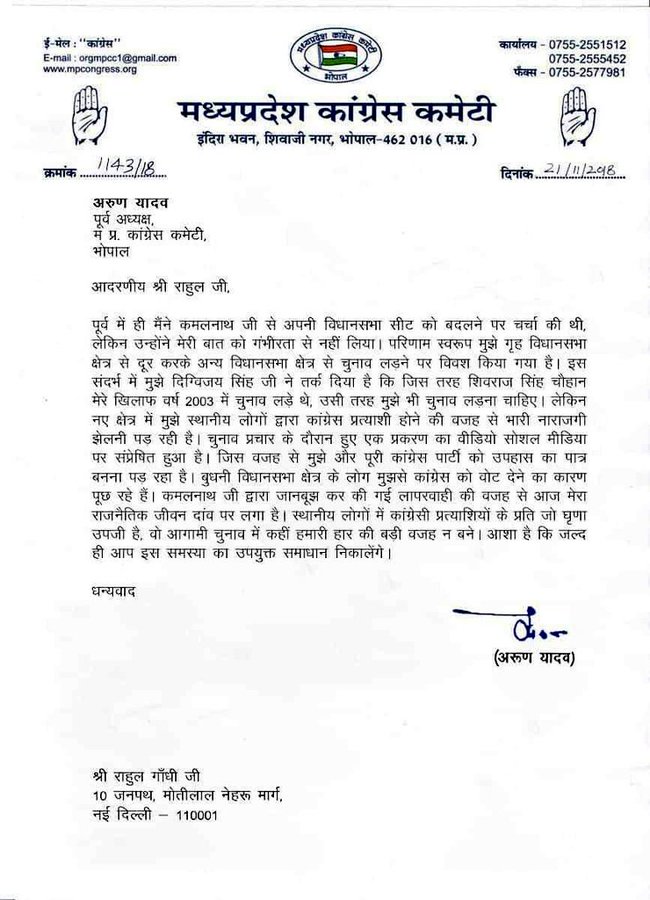
One such letter allegedly written by Congress candidate Arun Yadav, from Budhni assembly seat, in Sehore district is being widely shared on WhatsApp groups.

According to the letter, Yadav is unhappy after not being allowed to contest from his home seat. Yadav is locked in a pitched electoral battle against Madhya Pradesh’s three-time Chief Minister Shivraj Singh Chouhan. In the letter, he is criticising MP Congress chief Kamal Nath over ticket distribution. The letter also mentions, “Being a Congress candidate he is facing wrath of people.”

India Today Fact Check found the letter to be fake. There are evidences in the letter which indicates that the letter is fake.

There are several glaring mistakes in the letter. The name of the person to whom the letter is addressed is written on the top, generally. Whereas, in this case, the name of the person writing the letter is on the top while the receiver’s name is at the end.

Secondly, the official address of Congress president Rahul Gandhi according to the Lok Sabha website is 12, Tughlak Lane in New Delhi. In the letter two different addresses namely 10 Janpath and Motilal Nehru Marg are mentioned. Errors like these in official letters of political parties are possible, but not when written by a two time Lok Sabha MP and former state congress president to the party president.

MP Congress spokesperson Pankaj Chaturvedi told India Today, “The letter is fake. The signature in the viral letter does not match with those of Yadav.”

He has sent us a copy of the letter that Yadav wrote to the Election Commission earlier with his signature. We found the signature is not matching.

Chaturvedi shared with us what he claimed as the official record book of MP Congress unit. It shows the letter with dispatch number 1143/18 was not addressed to the Congress president on November 21. According to his record book, the letter was sent to a person named Santosh Kumar Pandey on August 17. As per Chaturvedi, “Pandey was appointed as the working president of Annupur district.”

A closer look at the signatures also reveals the discrepancies among the two.

Arun Yadav has also tweeted about the “fake letter” and his party has filed a police complaint.

View image on Twitter

View image on Twitter

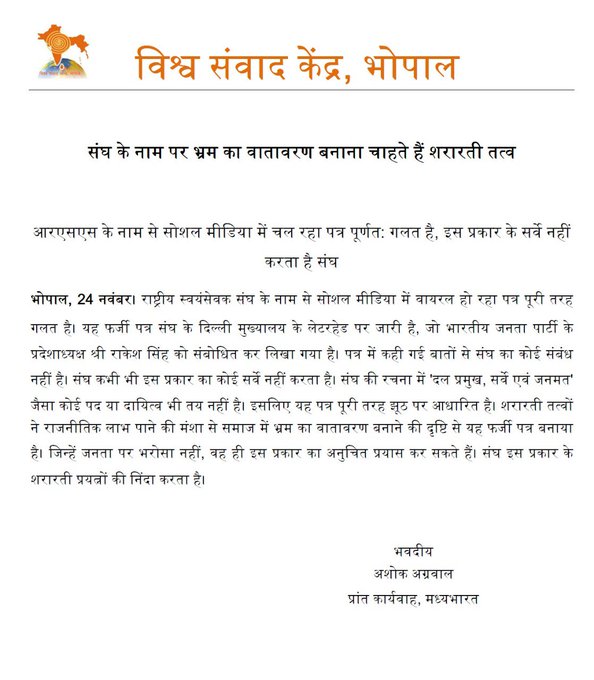
Another letter going viral in Madhya Pradesh, allegedly written by RSS is addressed to Madhya Pradesh BJP chief Rakesh Singh. This letter talks about a “secret survey” undertaken by RSS from November 15-21, 2018, which says BJP is heading for a defeat in the state. According to this survey mentioned in the letter, Congress is strong in 142 seats while BJP is likely to win only 68 seats. The letter also expresses doubts over any impact of Modi and Shah’s campaign on the voters. The letter is signed by one Pramod Namdev whose designation is mentioned as head of “Survey and Janmat” ( Survey evang janmat).

When we checked the website of RSS, we did not find any such designation called “head of survey and janmat”. Few old news reports of 2017 about RSS survey on Gujarat elections are available on the internet but they are mostly based on sources and no concrete evidence of RSS survey is given.

RSS media wing Vishwa Samvad Kendra has issued a statement calling this letter “fake”. It further stated that this has been “circulated mischievously to create confusion for political gains”.

View image on Twitter

RSS spokesperson Ajay Narang reiterated the same. While speaking to India Today he said, “RSS never conducts any political surveys. Moreover, we do not have any ‘survey’ wing as mentioned in the letter.”

Media in-charge of BJP Madhya Pradesh, Lokendra Parasar claimed that the party has filed a complaint in this regard with the election commission. But at the time of filing this report we have not received the complaint copy, even after our repeated requests.

It is possible that RSS has conducted some confidential internal survey about Madhya Pradesh election, but we could not verify independently the authenticity of this particular letter.


Disclaimer: RSS has been taken from their official website.
Congress cannot fight me, that is why abusing my mother: PM Modi

Hitting out at the Congress, Modi today said that the people of Madhya Pradesh will give a befitting reply to the party for abusing his mother in the coming assembly elections.


HIGHLIGHTS

  • Raj Babbar had compared devalued rate of rupee to PM’s nonagenarian mother
  • Congress has disrespected my mother, Modi said
  • He also accused Congress of indulging in caste politics

Prime Minister Narendra Modi on Saturday lambasted the Congress for making a personal attack on him. Referring to Congress leader Raj Babbar’s recent remark, Modi said the Congress is rattled by the good work of the Bharatiya Janata Party (BJP).

“For the past 18 years, I have been defeating the Congress at every single opportunity, and today it has fallen to the level that it has dragged my mother in elections. Congress cannot fight Modi, that is why it is now abusing my mother,” said Modi while addressing a rally in Madhya Pradesh’s Chhatarpur.

Congress leader Raj Babbar had recently compared the devalued rate of the Indian rupee to the PM’s nonagenarian mother, who is around 97 years old. “He [Modi] used to say that the rupee has fallen so much against the dollar that it was nearing the age of the then prime minister [Manmohan Singh]. Today, the rupee’s value has dropped so low, that it is inching closer to your [Modi’s] beloved mother’s age,” Babbar had said on Thursday at a rally in Indore.

Hitting out at the Congress, Modi today said that the people of Madhya Pradesh will give a befitting reply to the party for abusing his mother in the coming assembly elections.

He also said that corruption is the culture of the Congress. “Those who are out on bail in corruption cases are now unnerved. Coffers of banks were emptied for rich during madam’s [Sonia Gandhi] government, but we opened banks’ doors for needy youth,” he said.
Accusing the Congress of indulging in caste politics, Modi said, “People had voted Congress out of power in Madhya Pradesh 15 years ago because of its divisive politics.”

Earlier, Congress president on Friday had targeted Modi alleging that he created a cobweb just like the Bollywood villain Mogambo to “loot” the armed forces and that the Rafale scam is one of his many adventures which will be exposed soon.

In a tweet in Hindi, Rahul said PM Modi has created a “cobweb”, just like Bollywood villain Mogambo, to “loot” India’s armed forces. He alleged the Rafale scam was “one of his many adventures” that will be exposed soon.

The 230 member-Madhya Pradesh assembly will go to polls on November 28. It will be only clear on December 11 as to who the people of the state have blessed with their votes after the EVM’s are opened for counting on this day.


Disclaimer: RSS has been taken from their official website.
How Upper Caste Anger on Dalit Atrocities Act May Impact Madhya Pradesh Elections

To take the case of Malwa region only, in Mandsaur, Ratlam and Ujjain lakhs of upper castes marched across towns to register their anger against the BJP, led by small, disorganised outfits like Karni Sena and Samanya Pichhda Alpsankhyak Kalyan Samaj (SAPAKS).


In September, one month after the NDA overturned the dilution in SC/ST Atrocities Act by the Supreme Court, protests led by upper castes and OBCs broke out all across Madhya Pradesh.

To take the case of Malwa region only, in Mandsaur, Ratlam and Ujjain lakhs of upper castes marched across towns to register their anger against the BJP, led by small, disorganised outfits like Karni Sena and Samanya Pichhda Alpsankhyak Kalyan Samaj (SAPAKS).
While the visible anger against the BJP, which is trying to win a fourth term in MP, has subsided, this substantial section of society, which in recent elections voted overwhelmingly in favour of the BJP, is looking to exact its ‘revenge’.

“Jab Thawarchandji [Gehlot] hamare paas aaye vote maangne, humne unse kaha ki jab aapne hamare bacchon ke baare mein nahi socha to hum aapke bacche ke baare mein kyun sochein?” says Bhairav Singh Solanki, a regional Karni Sena leader.

Union Social Justice minister Thawarchand Gehlot is facing huge backlash from the small but influential section of Rajput voters in Alote, where his son Jitendra Gehlot is fighting for a second term.

Thawarchand has been campaigning here for his son for past several days. On Monday, he welcomed UP Chief Minister Yogi Adityanath to a rally in Taal, in an attempt to assuage the popular dissent. In his speech Adityanath, who himself is a Rajput and has on several occasions talked glowingly about “Rajput pride”, talked about bringing in “Ram Rajya” and invoked “Ram Janmabhoomi”.

However the widespread anger against the government which is being seen by the upper castes and OBCs as having sided with the SC/ST community is far from over.

“Jab Supreme Court ne ek baar is Act ko sahi kar diya to fir aapko kya zarurat thi usmein ched chad karne ki? Iska seedha matlab to yahi hai ki aapko ek jaati vishesh ke hi vote chahiye. To fir unhi se vote mangiye na,” Rajpal Singh Dodia says in Alote.

Gehlot’s son has been prevented from entering several Rajput dominated villages here like Negrun, Pipliya Sisodia, Babuniya, Lasudiya. In these villages Rajputs have put up signboards asking BJP candidates to stay away. Such no-entry villages can be spotted not just in Ratlam’s Alote but across the Malwa region.

Although it may be premature to predict that the upper castes and OBC leaders are getting automatically polarised towards the Congress. “Hame yaad hai jab sansad mein SC/ST Act pe BJP sanshodhan laa rahi thi tab Digvijaya khamosh the aur Scindia Jee table baja ke uska swagat kar rahe the,” says Vijender Singh Solanki, a Raput, in Ratlam town. A lot of local journalists and businessmen too privately express similar emotions.

In some seats like Jaora and Ghatiya, upper castes have decided to show their anger against both the BJP and the Congress by supporting strong Independent candidates as well.

There are 82 reserved seats in MP’s 230 seat strong Assembly. In the rest of the seats, the upper castes and OBCs command great influence. It was perhaps with this in mind that CM Shivraj Singh Chouhan prevented release of the film Padmavati, later Padmaavat, and wrote on his official Twitter account the misuse of the SC/ST Atrocities Act will not be allowed.

Around 10 km away from Bhuda, in Mandsaur, a Rajput dominated village called Kittukheri came into limelight earlier this year, when, like several other Rajput dominated villages it put up posters saying they will vote NOTA in the upcoming elections angered by the BJP’s support to the stringent provisions of the SC/ST Atrocities Act.

“Amit Shah says in Chhattisgarh that till the BJP is in power reservation will not go. If this is the case we have clearly no future under the BJP regime,” says Dharampal Singh Rajawat.

“We all voted for Narendra Modi in 2014 because he said he will bring back black money, he will deposit money in our accounts, he will build Ram mandir. What happened to all those promises? If they can ban currency notes why can they not build Ram mandir?” asks Upender Singh.

“And what happened to the Kashmir problem? At least 40-45 people from our village are working in the Army most of who are posted in Kashmir. Does Modi think that Rajputs are born only to be posted on the border and die? We were also part of the Kisan andolan in Mandsaur last year we saw what their police did to our farmers,” says Karu Singh Hada.

There are around 7,000 Rajput votes spread across Kittukheri, Munderi, Borkheri, Band Pipliya, Jarha and Aakli—nearby Rajputv villages. Locals here say that they’ll do whatever the leaders of Karin Sena ask them to do. “We are not allowing BJP leaders or workers inside our villages. Only Congress people are being allowed and only on the condition that they give us in writing all that they’re planning to give us. So on the voting day we will decide between the Congress and NOTA,” Rajawat adds.

The BJP candidates did not win by a huge margin in 2013, Rajawat further adds. “Even if they lose just 50 voters per village, compared to last time, the BJP will be routed from here. Last time there were 2 families supporting the Congress and eight supporting the BJP. The situation this time could be exact reverse.”

In some sense though, the BJP is suffering a unique, mostly silent anger not just from the upper castes and OBCs but from the SC/ST community as well.

“Look how they treated Chandrashekhar [leader of Bhim Army]. The BJP talks in our favour but have they ever appointed a senior party functionary from our caste? Neither has the Congress actually, but over the past few years one thing we have realised is that “Jai Shri Ram” and “Jai Bheem” don’t go together,” says Vinod Parihar, a local Bhim army leader in Alote.

There is a widespread polarisation of Dalit voters here because cases of atrocities against Dalits are more frequently reported. Dalit grooms who take out their wedding processions are regularly attacked and in some cases not allowed to sit and eat with upper castes. Recently, a Dalit groom went to his wedding wearing a helmet. His photo became popular on social media.

Parihar says that since Dalit parties are not strong in this region, the Dalits have decided to support the the Congress to defeat the BJP.

Upper caste anger against the SC/ST Atrocities Act is also bringing some other smaller players like SAPAKS (Saamanya Picchada Alpsankhyank Kalyan Samaj Sanstha) into the folds of regional politics.

A local journalist who has been reporting on regional politics here says the whole district was chock-a-block with people. “Even national parties here haven’t been able to gather as many people here as this small outfit did. They got huge traction. Which is why being a party focused on upper castes, it is a threat both to the Congress and the BJP.”

Sunil Bansal was a local BJP leader who has now joined SAPAKS that became a political outfit in October this year. He goes from door to door asking for votes but without much fanfare. “My party is batting for the rights of 78% people who suffer from the SC/ST Act and reservation politics. My constituency is the government servants and you don’t find people around me because I’ve told them, for their own good, to sit quietly. We will emerge as the kingmakers here, you’ll see,” Bansal says.

Meanwhile, the RSS is also in full swing here, quietly carrying out a door-to-door campaign while calling it a voter awareness drive.

“There are a couple of things worth noting. After three successive terms of the BJP, people worry about the consequences which is why even those who are fed up of the BJP don’t want to say it overtly, fearing consequences if it comes to power again. Secondly, the RSS we have seen kicking in just 4-5 days before elections. But this time they started their work almost a fortnight ago,” says the local journalist.


Note: RSS Feeds taken from Respective Websites.

MP Polls : Digvijaya Singh Sidelined In Madhya Pradesh To Hide Failure: PM Modi

Election in Madhya Pradesh: Digvijaya Singh, who was Madhya Pradesh chief minister from 1993-98, has said that “his party loses votes if he campaigns.”


In an apparent reference to Congress leader Digvijaya Singh, Prime Minister Narendra Modi said that one of the senior Congress leaders is not being allowed to campaign for the upcoming assembly elections in the state as the party fears that people will recall the failure of their tenure if Mr Singh campaigns.

Digvijaya Singh, who was Madhya Pradesh chief minister from 1993-98, has said that “his party loses votes if he campaigns.”

Addressing a rally here on Sunday, the Prime Minister said, “One of the senior Congress leaders is not being allowed to campaign during these elections. The reason is that the Congress fears that if he campaigns, the party will lose as people will recall what the fate of Madhya Pradesh was during the time they were in power.”

The Prime Minister also accused the Congress of playing divisive politics and said, “Congress neither has any policy, intention, nor a leader… its leader is confused. Let the naamdar (apparently Congress chief Rahul Gandhi) write down on a piece of paper how many zeroes are there in Rs. 23,000 crore. He will get confused.”

He further asserted that these elections are not about who would win or who won’t win but about rejecting the “negative forces who have always focused on the ‘divide and rule’ approach.”

Talking about the development work in Indore city, the Prime Minister announced that as part of the Smart City project, Rs. 23,000 crore will be spent on development of seven cities in poll-bound Madhya Pradesh including Indore over five years. He added, “In last two years, the foreign tourists’ influx has increased.”

Madhya Pradesh will go to polls on November 28 to elect 230 members of the legislative assembly. The results will be declared on December 11.


Note: RSS Feeds taken from Respective Websites.

Dissent in BJP ranks in Madhya Pradesh over denial of tickets for assembly elections

Deeraj Pateriya (49), who is the Bharatiya Janata Yuva Morcha’s state president and is contesting as an independent from Jabalpur North, said, “There is an attempt to finish me politically. And I want to show my popularity by contesting”.


The ruling Bharatiya Janata Party (BJP) in Madhya Pradesh is battling dissent in its ranks on a scale that appears much bigger than its rival, the Congress. Among its prominent rebels is former minister and four time BJP member of Parliament, Ramkrishna Kusmaria, (75), who is contesting as an independent from two seats- Pathria and Damoh — in the drought-prone Bundelkhand region.

“I gave 40 years of my life to the party and in return they did not had courtesy to tell me that a ticket will be denied to me,” he said. claiming to be hurt.

Deeraj Pateriya (49), who is the Bharatiya Janata Yuva Morcha’s state president and is contesting as an independent from Jabalpur North, said, “There is an attempt to finish me politically. And I want to show my popularity by contesting”.

Kusmaria and Pateriya have joined other senior leaders, such as former state minister Sartaj Singh, who is contesting on a Congress ticket from Hoshangabad, to have publically expressed their anger at the party’s ticket distribution.

“Over 67 important party leaders who are contesting from other political parties or as independents have been expelled so far,” said a senior BJP leader at the party headquarters in Bhopal. The leaders expelled include sitting MLA from Bhind Narendra Singh Kushwah and former mayor of Gwalior Sameeksha Gupta. There are 230 assembly seats in Madhya Pradesh, which goes to the polls on November 28.

The BJP leader quoted above said the party has a list of at least 100 leaders working against the party but no action is being taken due to electoral compulsions. “Any action now will send wrong message to our cadre and will provide the Congress an issue to hit at us,” the leader said.

The leader accepted that it was for the first time in the state that so many BJP workers had been expelled. The number was about 20 in the run-up to 2013 assembly elections, he said. “This is the biggest rebellion in the BJP I have ever witnessed,” said Kusum Mehadele, a minister in the Shivraj Singh Chouhan cabinet who was also denied ticket.


The BJP has dropped four ministers and at least 45 sitting MLAs .But officially, the party rejected reports of large-scale rebellion. State BJP spokesperson Rajneesh Agrawal said, “I don’t think there is any alarming situation for the party. Every political party faces such a situation at the election time and it would not have any impact on the party’s prospects.”

In the Congress, the scale of the rebellion appears to be smaller. “We have expelled less then 20 leaders and workers,” a state Congress leader said on condition of anonymity.He said there were not many rebel candidates unlike Rajasthan where the party had faced violent protest by workers for denial of tickets.

The only big leader to face action was former Rajya Sabha member Satyavrat Chaturvedi, whose son Nitin Chaturvedi is contesting on a Samajwadi party ticket. He was expelled.

“The BJP is battling rebellion because the party has not only betrayed the people but also a section of its workers and leaders”, said state Congress spokesperson Bhupendra Gupta.

Political observer Bhagwandev Israni confirmed the scale of the rebellion was larger in the BJP. “This is a reflection of the political scenario. The BJP is facing a bigger problem than the Congress, unlike the previous three elections, as BJP leaders and workers realise which direction the wind is blowing.”


Note: RSS Feeds taken from Respective Websites.