Satta market bets big on BJP in MP and Chhattisgarh, Congress in Rajasthan

Highlights

  • “We are confident that the BJP would make a comeback while scope for the Congress is slim in MP. BJP would also win Chhattisgarh whereas Congress will make a comeback in Rajasthan,” said a bookie
  • Satta market in every election runs in crores. Bets are placed not just over phone, but also on websites and online mobile applications

Whether BJP would form government for the fourth time or Congress will make a comeback after 15 years in Madhya Pradesh?

While a political party may win or lose but the ensuing elections would bring in some extra moolah for bookies in the festive season.

As the parties struggle to finalise candidates, the satta market is already on a high this election season.

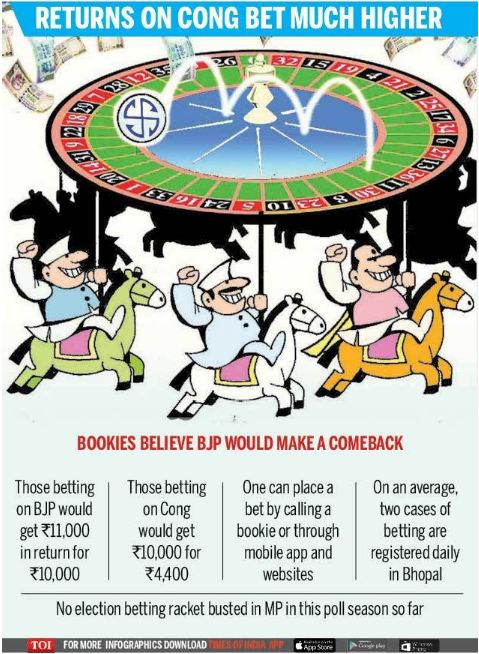
If the trend in satta markets is anything to go by, BJP would make a comeback in MP. Bookies are bullish on ruling BJP in the election. The rates in satta market point at the possibility.

As per the bookies, if a person places a bet of Rs 10,000 on BJP, he would get Rs 11,000 in return if the party comes to power while in case of Congress, the stake holder tends to lose Rs 10,000 for placing a bet of Rs 4,400.It means profit is offered more on Congress by punters believing that the party would not be able to make a comeback in this assembly election. Profit margin is low for BJP since bookies believe more people would like to place a bet on BJP.

“We are confident that the BJP would make a comeback while scope for the Congress is slim in MP. BJP would also win Chhattisgarh whereas Congress will make a comeback in Rajasthan. The satta market is running good this poll season. Rates may vary once the tickets are finalised by the parties, but we expect the trend to remain the same,” said a bookie.

Satta market in every election runs in crores. Bets are placed not just over phone, but also on websites and online mobile applications, leaving almost no room for police to nab the bookies and the ones placing the bet.

Probably, this is the reason why no gang has been busted in state so far for running election betting racket. And it is not that people in major cities, including Bhopal are not into betting. At least three cases of betting are registered daily in Bhopal. The craze of betting is more for cricket and it is shifted to politics only during the polls.

Officials said busting an online betting racket is a challenge as such gangs keep moving from one place to another. Online betting can be operated even from a moving car, café or from any public place in the city, state or from any other part of the country.

DIG Dharmendra Choudhary said the police are running special campaigns against criminals involved in gambling and betting ahead of elections. The criminals are being made to sign bonds to prevent them from committing such crimes in the future. He said that crime branch, Bhopal monitors and keeps an eye on online betting. Raids are being conducted on receiving specific tips to nab criminals. Police station level actions were also taken against such illegal betting and gambling dens being operated in the city.
ASP (Crime) Rashmi Mishra said crime branch activated its network of informers in the city prior to elections to keep an eye on illegal activities. She said that it is difficult to crack online betting and gambling rackets, but police take actions against criminals after specific inputs.
Speaking about websites and mobile apps for gambling, IG (Bhopal) Jaideep Prasad said police would act against such rackets on getting specific inputs and complaints. The state cyber cell keeps a constant vigil on such websites and mobile apps and take necessary action, he said.
SP (cyber cell) Bhopal Rajesh Bhadouria said the cyber cell takes action against any criminal activity which falls under the provisions of IT Act. The cyber cell is keeping a constant vigil on cyber-crimes in view of upcoming elections, he said, adding, action is taken on basis of any intelligence or information received on any specific activity.
Disclaimer: RSS has been taken from their official website.

BJP wants UP CM Yogi to help garner Hindu votes in MP, Rajasthan

“The BJP high command will decide on Yogiji’s itinerary but yes, we do hope that he will campaign in Madhya Pradesh for there is no denying that he has influence here,” says BJP leader Rajneesh Agarwal.


Bharatiya Janata Party (BJP) units in Madhya Pradesh and Rajasthan want Uttar Pradesh chief minister Yogi Adityanath to campaign for them in the upcoming assembly polls in a bid to consolidate the Hindu vote, according to people familiar with the developments.

Adityanath, who took over as UP CM last March, is also the chief of the influential Gorakhnath mutt. He has been involved in election campaigns in states such as Gujarat and Himachal Pradesh in 2017 and Karnataka in 2018. “The party high command will decide on Yogiji’s itinerary. We hope that he will campaign here because he has influence here,” said Madhya Pradesh BJP leader Rajneesh Agarwal.

Rajasthan BJP spokesperson Mukesh Pareek said there was a demand for Adityanath to campaign in the state because of his personality.

“He is a good speaker and also a religious leader. His personality attracts people,” he said. Senior party leader Onkar Singh LakhaSingh wat said the Nath sampradaya (tradition), of which Adityanath is the head, wields significant influence in Rajasthan. “Since the ninth century, the Marwar area and Alwar have been centres of the Nath faith so Yogi Adityanath is bound to have a resonance in these areas.” Party functionaries indicated Adityanath might visit the state in the first week of November.

Adityanath is already campaigning in Chhattisgarh, where the BJP is in power, and delivered a speech on Tuesday after chief minister Raman Singh filed his nomination papers. Using references from the Ramayana , Adityanath urged the electorate to vote to a fourth straight term in office. Singh touched Adityanath’s feet and sought his blessings. “His programme is still being finalised but yes, it’s certain that he is going to be among party’s star campaigners in pollbound states. He has a great following and will be touring extensively in these states,” says Mrityunjay Kumar, Adityanath’s adviser. Chhattisgarh goes to the polls in two phases on November 12 and 20, Madhya Pradesh on November 28 and Rajasthan on December 7.

The Congress, which is the opposition in all three states, said Adityanath’s campaign style relies on communal polarisation.

“The BJP is trying to communalise the atmosphere by using Adityanath, especially in bordering areas of Madhya Pradesh, but he won’t succeed for the people also know that he couldn’t save children from dying in his own backyard and the less said the better about law and order in UP,” says Bhupendra Gupta, a Congress leader in Madhya Pradesh, referring to the controversial deaths of scores of babies in a Gorakhpur hospital last year.


Disclaimer: RSS has been taken from their official website.

Sitting BJP Lawmakers In Rajasthan Fear Party May Drop Them

No list is out yet in Rajasthan, where assembly elections will be held after the polling in Chhattisgarh, but party leaders say there is apprehension among its MLAs over failing to secure a renomination.


After the BJP denied tickets to several sitting MLAs in the first list of candidates for the Chhattisgarh assembly polls, party legislators in Rajasthan are keeping their fingers crossed.

No list is out yet in Rajasthan, where assembly elections will be held after the polling in Chhattisgarh, but party leaders say there is apprehension among its MLAs over failing to secure a renomination.

This comes amid speculation that about 80 BJP MLAs in Rajasthan will be denied the ticket this time as the party fights anti-incumbency and faces a stiffer challenge from the Congress in the December 7 elections, as indicated by some opinion polls.

The current 200-member Assembly has 163 BJP MLAs.

Party leaders said some sitting MLAs are trying to seek tickets for their family members after their poor performance in the bypolls for the parliamentary seats of Ajmer and Alwar and the Mandalgarh assembly seat.

Several party MLAs have indicated to the state leadership that want to change their constituency this time.

But the party may not allow this.

“Let the list of candidates be announced,” BJP’s Rajasthan election in-charge Prakash Javadekar recently told reporters. “We might replace candidates but the candidates will not be allowed to change seats.”

In the run-up to the elections, party leaders including Mr Javadekar, BJP state in-charge Avinash Rai Khanna and state BJP president Madan Lal Saini have also made clear that winnability would be the key criterion for picking candidates.

Party leaders said they are working on how to deal with possible protests by MLAs who are denied tickets and their supporters.


Disclaimer: RSS has been taken from their official website.

Can smartphones for women in Chhattisgarh help in economic development?

Download App For Detailed NEWS : chhattisgarh512

In a remote village in Chhattisgarh, over 200 women lined up outside a government office, each holding a small, orange ticket. One by one, they shuffled into and out of the office, replacing their ticket with a smartphone. Excited new phone owners gathered in groups outside the hall talking about how they would use the phone.

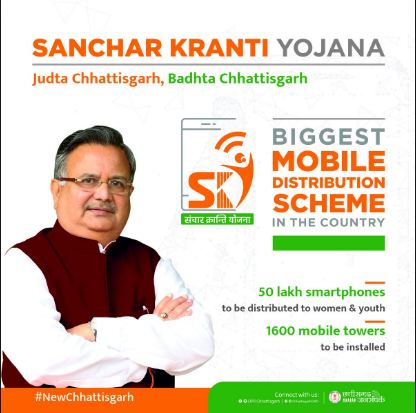
This scene was not unique to one village. All across Chhattisgarh through September 2018, the state government was giving a smartphone to one woman in each rural household. The programme, entitled Sanchaar Kranti Yojana (SKY), or the Telecommunications Revolution Scheme, covered 2.3 million rural women by the end of September. As if that weren’t ambitious enough, SKY also gave smartphones to 300,000 college students and 350,000 urban women–and will increase network coverage by building just under 1,500 towers, thus encouraging even more phone use and ownership beyond the beneficiary pool.

The main purpose behind programme SKY is to address low phone ownership in Chhattisgarh and to empower women in the process. As evident from the heat maps below, Chhattisgarh has India’s fourth lowest mobile phone ownership rate–45.6%–which is five percentage points lower than the overall average.

At the same time, Chhattisgarh’s gender gap in phone ownership is the lowest in India at 14.3 percentage points: 52% of men own a phone compared to 38% of women. At 32.7 percentage points, India’s overall average gap is more than twice that amount. Yet a relatively smaller gender gap in ownership does not necessarily mean the gap won’t grow over time–many states with higher male phone ownership also have larger gender gaps.

In this way, programme SKY is a timely nudge that encourages a narrowing rather than enlargement of the mobile gender gap. (For more insights on the causes and effects of the gap, see a new report by our team, led by Rohini Pande and Charity Troyer Moore of Evidence for Policy Design at Harvard Kennedy School, Erica Field of Duke University and Simone Schaner of University of Southern California.)

The benefits of mobile phones

The potential impacts of SKY go beyond female mobile engagement. Ample research already shows that mobile phones encourage economic development. Phones help producers and consumers access the best price for market goods and learn about job opportunities. In Kenya, mobile money has reduced households’ vulnerability to economic shocks. “Behavioral messaging” through SMS and voice calls have improved behavior in domains like finance, health, and education.

A few studies highlight the value of women’s mobile phone access, both for themselves and others. One study found that M-PESA, Kenya’s mobile money platform, has lifted 2% of Kenyan households out of poverty. Increases in consumption were concentrated among female-headed households, suggesting that women had more to gain from mobile money. A study from Niger found that when women took cash transfers through mobile money application rather than as cash, household dietary diversity improved, a result attributed to women’s increased bargaining power within the household.

This result echoes a broader finding in current research: Empowering women with assets is valuable to economic development. Studies show that when women have access to resources, they use them for children. For example, greater access to pension benefits among female-headed households in South Africa led to improved nutrition for girls. There are similar patterns among households in Brazil, where studies show that higher female income leads to greater chance of child survival, higher nutrition investments in girls, and larger relative investments in human capital and leisure.

Similarly, we might expect women to use their SKY phones to improve their children’s lives in some way. While empowering women with technology is a noble pursuit in its own right, this further highlights the value of SKY targeting female beneficiaries rather than male.

A problem: The male monopoly

The success of SKY’s targeting of female beneficiaries comes with a caveat: Transfers are only as effective insofar as the beneficiary perceives them as useful and relevant. Recent experience with the Pradhan Mantri Jan Dhan Yojana (PMJDY), or Prime Minister’s People’s Wealth Scheme, illustrates this.

The intent of PMJDY was to open a bank account for at least one member in every household. Yet PMJDY alone was not enough to achieve full financial inclusion, as many accounts remained dormant after being opened. In order for the economy to see the downstream impacts of the scheme, beneficiaries needed to understand what a bank account could do for them and how to use one. In other words, the relevant metric for measuring financial inclusion lies not in the number of people with an account but the number of people who use accounts.

In a similar way, if SKY beneficiaries do not find phones useful or obtain the skill to use them, then the initiative will fail to close the mobile phone gender gap and women will not reap these benefits. The issue is further complicated by the fact that unlike bank accounts, phones can be easily transferred, and men often control asset ownership within households in South Asian cultures.

Thus, even if a woman sees her new phone as useful, if she does not know how to use it, then her husband may use his monopoly on technological know-how to justify taking it. This underscores the potential added value of digital literacy training to the SKY programme and, more broadly, highlights the importance of providing training alongside programmes that give assets to the poor.


Disclaimer: RSS has been taken from their official website.

BJP slams Rahul Gandhi, says he knows nothing about Rajasthan

The BJP has accused Rahul Gandhi of spreading lies about Prime Minister Narendra Modi and the Rajasthan government to mislead the people of Rajasthan.

HIGHLIGHTS

  • BJP accused Rahul Gandhi of spreading lies about PM Modi & the Rajasthan govt
  • BJP said that Gandhi hardly knew anything about Rajasthan
  • BJP said the Vasundhara Raje govt has waived off farmer loans upto Rs 50,000

The Bhartiya Janata Party (BJP) has accused Congress President Rahul Gandhi of spreading lies about Prime Minister Narendra Modi and the Rajasthan government to mislead the people of Rajasthan.

The BJP was reacting to Rahul Gandhi’s allegations against Modi and Raje in Jhalawar and Kota on Wednesday.

The BJP said that Gandhi hardly knew anything about Rajasthan, the problems of the people and what the government has been doing for them.

The BJP said that the Vasundhara Raje government in the state has waived off farmer loans up to Rs 50,000 about which Gandhi was as ignorant as he was about the dramatic improvement in education standards following the merger of non-performing primary schools with senior secondary ones.

The BJP also said that Gandhi’s allegations about shifting CBI Director because he was about to start investigating Rafael deal were misplaced.

The BJP also accused Congress of blocking recruitments of teachers and other employees by creating hurdles earlier through courts and now by complaining to the Election Commission.


Disclaimer: RSS has been taken from their official website.

MP Assembly Elections 2018: Key factors likely to impact the election

CM Shivraj Singh Chouhan’s government has been facing ire of upper-caste protesters, agitating farmers and is surfing against a tide of anti-incumbency.


Madhya Pradesh is scheduled to vote on November 28. The polls are expected to witness a tough contest between the incumbent Bharatiya Janata Party (BJP) and the Indian National Congress.

The BJP government led by Chief Minister Shivraj Singh Chouhan is facing an anti-incumbency sentiment to some extent after being in power for 15 years. Chouhan has held the top office for 13 out of the 15 years.

MP will head to polling in a single-phase election, and the tenure of the current Assembly will end on January 7, 2019.

The counting of votes will happen on December 11 along with Chhattisgarh, Mizoram, Rajasthan and Telangana.

Here’s are some of the key issues likely to impact the elections:

Anti-incumbency

While Chouhan remains popular and has maintained his ‘vikas purush’ image even after being the chief minister for 13 years, reports suggests that significant fatigue against the government has crept in.

In a state where the politics has been largely binary between the BJP and the Congress, a tide of voters seeking change of guard would be difficult for Chouhan to overturn.

Data from past assembly polls suggests that a large swing of votes is possible in the state. Such instances have occurred in the past, including in 2003 when the BJP stormed to power.

Upper-caste voters

In September, multiple districts across the state observed a complete shutdown in support of protests called by various upper caste outfits against amendments to the SC/ST Prevention of Atrocities (POA) Act passed by Parliament in July.

The protests were called by upper-caste outfits including the new SAPAKS party, Rajput Karni Sena, among others.

Reports suggests that the upper-caste voters, who have traditionally supported the BJP in the state, may be drifting the other way.

Fearing this, a senior BJP leader sent an “SOS” to the party’s central command, seeking “impact creating” corrective measures “urgently”, according to a report by The Asian Age.

The leader said the party had to take measures to prevent backlash from upper-caste voters.

“The anger among the ‘savarnas’ (upper castes) is too deep-rooted to be contained by any small measures. It has to be big impact-making steps by the Centre to prevent them from landing in the fold of Congress out of vengeance,” a senior Madhya Pradesh BJP leader had told the newspaper.

Unemployment

The issue of rising unemployment continues to plague the Chouhan government, like most states in India.

According to data from the Labour Ministry, Madhya Pradesh had an unemployment rate of 40 percent in urban areas and 44 percent in rural areas in 2015-16. The overall unemployment rate was around 43 percent.

Chouhan’s government has come under fire for lack of job creation. The opposition has also targeted the BJP government over this issue and has been promising speedy creation of jobs, if elected.

Mandsaur and the farmer agitation

On June 6, 2017, police in Mandsaur fired at protesters who were demanding better prices for their harvest. Six protesters were killed in the police firing, leading to violent protests that spread to neighbouring districts. A day later, a local factory was torched by protesters.

The protests forced the Chouhan government to launch the Bhavantar Bhugtan Yojana (BBY) in October 2017, under which registered farmers would be paid the difference between the minimum support price (MSP) and a modal price. The amount would be calculated by taking into consideration the average price of a crop in the state and two neighbouring states.

Congress President Rahul Gandhi was denied permission by the administration to meet the farmers. This, coupled with the death of six farmers, created a positive image for the Congress and a negative image for Chouhan’s government, political observers suggest.

To mark the first anniversary of the farmer protests, Gandhi staged a rally in Mandsaur on June 6 this year. In what was seen as a virtual election campaign launch for the party, Gandhi attacked the BJP governments at the Centre and the state.

Chouhan’s popularity

Congress has also been trying to play the ‘soft Hindutva’ card by undertaking a Ram Van Gaman Path yatra and the party constantly portraying Congress President Rahul Gandhi has a ‘Shiv bhakt’ during road shows and public meetings. Congress, however, denies playing such a card.

Despite such attempts by the Congress, many believe that the election will not be fought on religious or social issues. The BJP believes people would vote on the basis of development work undertaken by the Chouhan government and its successes in the state over the last 15 years.

Other suggests the election will revolve around a central factor — if people will vote for or against Chouhan.

Despite being the chief minister for 13 years, Chouhan remains a highly popular candidate.


Disclaimer: RSS has been taken from their official website.

Madhya Pradesh elections a test of BJP popularity vs Congress resurgence.

The ruling BJP’s broad-based support in Madhya Pradesh shows signs of waning, but it is not clear whether the Congress can capitalize


Madhya Pradesh lies at the heart of India and will soon be at the heart of the nation’s politics. Next month’s assembly elections in the state will give the first indication on whether the ruling Bharatiya Janata Party’s (BJP) popularity endures or if a Congress resurgence is imminent.

BJP has dominated the state’s polity over the past several years. This dominance was on display in the last MP elections in 2013 when it secured 45% of all votes—the highest in the state for nearly 30 years—and 72% of seats in the state. BJP’s vote share was 9 percentage points higher than Congress’s (36%) but it was far more successful in converting votes into seats. For every seat won, the BJP needed 92,069 votes, less than half of the Congress figure of 212,332.

BJP also had higher victory margins on average. Of the 165 constituencies it won in the 230-member assembly, the BJP had a victory margin greater than 10% in 92 constituencies. In contrast, the Congress won only 17 of the 58 constituencies with a victory margin greater than 10%. BJP’s victories were equally decisive in reserved and unreserved constituencies.

In Madhya Pradesh, scheduled tribes (STs) account for 21% of the population (compared with 9% of India’s population) and have 47 seats reserved for them.

In 2013, the BJP secured 31 of the 47 seats and, even in overwhelmingly tribal constituencies (more than 80% tribal population), the party registered significant victories.

One reason for this success could be proactive grassroots work in tribal areas by socio-religious affiliates of the Sangh Parivar. In a 2008 research paper, political scientists Tariq Thachil and Ronald Herring attributed BJP’s success in tribal strongholds across India to the Sangh Parivar’s efforts in providing critical social services in tribal pockets. These activities have not just increased BJP’s popularity but also promoted Hindu identity in these areas.

The growth of Hindu identity in a predominantly Hindu state (91% of the state’s population) could explain why both the BJP and Congress have made public displays of their Hindu credentials a central part of their campaigns.

However, recent events could threaten BJP’s prospects in tribal-dominated constituencies and elsewhere. The controversy over the Scheduled Caste and Scheduled Tribe (Prevention of Atrocities Act) and the differing stances of BJP leaders on the issue have opened a chasm between tribal voters and upper caste voters, as a previous Plain Facts column pointed out. While tribal voters seem to be dissatisfied with the government’s handling of atrocities against the marginalized communities, the BJP’s core upper caste vote bank seems to feel that the government is pandering to tribal and Dalit interest by refusing to dilute the Atrocities Act. Data from post-poll surveys conducted by Lokniti-CSDS suggests that a large majority of upper caste voters support the BJP in Madhya Pradesh, as in other parts of the country. Restiveness among them signals trouble for the party.

The other threat to the BJP in Madhya Pradesh is agrarian distress in a predominantly agrarian state. While farmers have traditionally supported BJP, pressures on income have led to agrarian riots in recent years.

The political impact of this discontent could be felt more in poorer districts where BJP has enjoyed relatively less support. Using Mint’s district wealth tracker, we find that the BJP’s vote share in the 10 poorest districts of the state was considerably lower at 39% compared with 50% in the 10 richest (more urban) districts.

The combination of farmer protests, SC/ST tensions, and general anti-incumbency sentiment towards a party that has been in power for the past 15 years, in theory, offers hope to the Congress. However, the Congress in Madhya Pradesh has been marred by factionalism. In a 2014 research paper, Shreyas Sardesai of Lokniti-CSDS attributed the party’s disastrous showing in 2013 to factionalism. A united front with a focus on improving their poor votes-to-seat ratio could revive Congress fortunes in the state and the country.

For the BJP, another resounding victory could cement its status as the dominant party in the Hindi belt and boost the morale of party loyalists ahead of 2019. For chief minister Shivraj Singh Chouhan, a fourth term in power could also mean a bigger role in national politics in the years to come.


Disclaimer: RSS has been taken from their official website.

MP Polls : BJP launches ‘Samriddh Madhya Pradesh’ campaign

In a bid to reach out to masses in poll-bound Madhya Pradesh, the BJP on Sunday launched ‘Samriddh (Prosperous) Madhya Pradesh’ campaign from here by flagging off 50 hi-tech vehicles designed as chariots.

The mass outreach programme is aimed at preparing ‘Drishti Patra’ or a vision document for the next month’s polls on the basis of suggestions received from the common people, a party leader said.

Chief Minister Shivraj Singh Chouhan and Union minister Narendra Singh Tomar flagged off the chariots, fitted with LED screens, sound systems and other equipment, from the state BJP headquarters in the state capital.

The chariots will comb all the 230 assembly constituencies in the next 15 days during which they would travel to at least 20 places in every segment.

The BJP has also released a phone number on which the suggestions can be forwarded either through WhatsApp, SMSes or by making a phone call.

Speaking at the launch function, Chouhan said his government had modelled various welfare schemes on the basis of feedback received from the common people.

“Because of this, we have decided to prepare a roadmap of a prosperous Madhya Pradesh on the basis of suggestions of the 7.5-crore people of the state,” he said.

The chief minister attacked the Congress for its “misrule” of the past.

“During the rule of the Congress (before 2013), people were forced to take temporary roads in their farmland for travelling instead of the main roads which were almost non-existent then. People had to spend nights on roads during summer season due to power cuts,” he said.

The CM also accused the Congress of pushing Madhya Pradesh into poverty through its policies.

“Every sector, including the education and irrigation, was in a bad shape at that time because of the Congress which had pushed this state into BIMARU category.

“We (the BJP government) lifted Madhya Pradesh from that category and turned it into a ‘Sucharu’ (smoothly run) and viksit (developed) state,” he said.

(BIMARU is an acronym for states of Bihar, Madhya Pradesh, Rajasthan and Uttar Pradesh grouped into the category in the past for their poor economic condition.)

Mr. Chouhan said Madhya Pradesh will become a prosperous state in the next five years, if the BJP gets the popular mandate for another term.

Madhya Pradesh will go to polls on November 28. Counting of votes will take place on December 11.


Disclaimer: RSS has been taken from their official website.


Rajasthan polls: Manvendra Singh’s entry gives Congress the edge over BJP among Rajputs

The MLA has considerable influence in Marwar, which sends 30 legislators to the Assembly.


Banking on anti-incumbency sentiment against the Vasundhara Raje-led Bharatiya Janata Party government in Rajasthan to help it put up a winning performance in the December 7 state election, the Congress received a shot in the arm with former BJP leader Manvendra Singhjoining its ranks on October 17. Congress leaders and political pundits say the Rajput leader’s entry gives the Congress a clear edge over the BJP in the Marwar region, which sends 30 legislators to the state’s 200-strong Assembly.

Manvendra Singh, the MLA from Sheo, is the son of former Union minister and senior BJP leader Jaswant Singh. He quit the BJP in September, saying that his decision to join the party had been a mistake. With his departure, the BJP no longer has a Rajput leader with a high evel of popularity in the state. Rajputs account for around 7% of the state’s population.

In previous elections, influential Rajput leaders such as Jaswant Singh and the late Bhairon Singh Shekhawat had boosted the BJP’s electoral prospects in Marwar, which comprises the districts of Jodhpur, Barmer, Nagaur, Sirohi, Pali, and Jalore. On average, 15 to 17 Rajput legislators have been voted in to the 200-member state assembly during each election, most of them coming from the BJP. Of the 27 Rajputs elected to the House in 2013, for instance, 24 were from the BJP.

However, that support began to crumble after the BJP denied Jaswant Singh a Lok Sabha ticket in the 2014 general elections and decided instead to field Colonel Sonaram Choudhary, a former Congress leader and a Jat. Jaswant Singh chose to contest as an independent candidate. He lost the election by a margin of 80,000 votes. The Rajputs were miffed with the BJP’s treatment of Jaswant Singh. After Jaswant Singh slipped into a coma in August 2014, Manvendra Singh started mobilising votersagainst the BJP.

Why Rajputs are angry with Raje, BJP

Evidence of Manvendra Singh’s popularity was apparent on September 22, when his Swabhiman Rally in Barmer drew lakhs of supporters. In fact, resentment among Rajputs with the ruling BJP is so intense that members of the community threw stones at Chief Minister Vasundhara Raje’s bus during her Gaurav Yatra in August, forcing her to complete the Marwar leg of her campaign tour in a helicopter.

Other factors have also contributed to Rajput anger against Raje and the BJP. In July 2017, they violently protested against the killing of Rajput gangster Anandpal Singh by the state police. Singh was facing murder charges. His family claimed he had wanted to surrender and that the encounter was fake. Eventually, the Central government gave in to the community’s demand and ordered a Central Bureau of Investigation inquiry. The fact that no Rajput BJP legislator came out in support of Anandpal Singh’s family angered the community.


Disclaimer: RSS has been taken from their official website.

Madhya Pradesh polls: BJP launches ‘prosperous MP’ campaign

In a bid to reach out to masses in poll-bound Madhya Pradesh, the BJP Sunday launched ‘Samriddh (Prosperous) Madhya Pradesh’ campaign from here by flagging off 50 hi-tech vehicles designed as chariots.

The mass outreach programme is aimed at preparing ‘Drishti Patra’ or a vision document for the next month’s polls on the basis of suggestions received from the common people, a party leader said.

Chief Minister Shivraj Singh Chouhan and Union minister Narendra Singh Tomar flagged off the chariots, fitted with LED screens, sound systems and other equipment, from the state BJP headquarters in the state capital.

The chariots will comb all the 230 assembly constituencies in the next 15 days during which they would travel to at least 20 places in every segment.

The BJP has also released a phone number on which the suggestions can be forwarded either through WhatsApp, SMSes or by making a phone call.

Speaking at the launch function, Chouhan said his government had modelled various welfare schemes on the basis of feedback received from the common people.

“Because of this, we have decided to prepare a roadmap of a prosperous Madhya Pradesh on the basis of suggestions of the 7.5-crore people of the state,” he said.

The chief minister attacked the Congress for its “misrule” of the past.

“During the rule of the Congress (before 2013), people were forced to take temporary roads in their farmland for travelling instead of the main roads which were almost non-existent then. People had to spend nights on roads during summer season due to power cuts,” he said.

The CM also accused the Congress of pushing Madhya Pradesh into poverty through its policies.

“Every sector, including the education and irrigation, was in a bad shape at that time because of the Congress which had pushed this state into BIMARU category.

“We (the BJP government) lifted Madhya Pradesh from that category and turned it into a ‘Sucharu’ (smoothly run) and viksit (developed) state,” he said.

BIMARU is an acronym for states of Bihar, Madhya Pradesh, Rajasthan and Uttar Pradesh grouped into the category in the past for their poor economic condition.

Chouhan said Madhya Pradesh will become a prosperous state in the next five years, if the BJP gets the popular mandate for another term.

Madhya Pradesh will go to polls on November 28. Counting of votes will take place on December 11.

Meanwhile, the state Congress unit has sought the Election Commission’s intervention to stop the “Samriddha Madhya Pradesh Abhiyan”, which the party said is a violation of model code of conduct.

“This is time for the BJP to give an account of its work. Instead of doing that, they are luring the people with false promises and are misleading them by seeking suggestions and ideas, which is prohibited under the poll code. We have filed a complaint with the EC,” said state Congress spokesman Narendra Saluja.

Leader of Opposition in the state Legislative Assembly Ajay Singh also dismissed the campaign as a gimmick.

“The chief minister is trying to sell false dreams to the people fearing defeat in polls, which is imminent. This campaign is aimed at deceiving the common people,” Singh alleged.

Meanwhile, in an embarrassment to the BJP, a portrait of former prime minister and BJP patriarch (late) Atal Bihari Vajpayee was not put up at the launch function held at its headquarters.

When asked about this, BJP senior leader Prabhat Jha tried to play down the incident and said, “Vajpayee ji is in the heart of every person of the state. So, this incident should not be misinterpreted”.

Disclaimer: RSS has been taken from their official website.