Chhattisgarh polls: Areas not even on Google maps will vote for first time

Many areas of Chhattisgarh will vote for the first time in 20 years


Crossing rivers barefoot, wading through jungles just sanitised by the accompanying security personnel and even airdropped by choppers into the Naxal-affected interiors, many on poll duty in Chhattisgarh feel like the real-life version of the protagonist from Bollywood dark comedy “Newton”, while some say they feel more like a revolutionary such as Bhagat Singh.

They are public sector undertaking (PSU) employees, teachers, anganwadi and panchayat workers, among numerous others braving the treacherous terrain of the infamous Bastar region, which appear even more dangerous after a recent spurt in Naxal attacks ahead of the polls.

Many areas of Chhattisgarh will vote for the first time in 20 years, while some security and local administration officials proudly declare that a few of those are yet to make it to the Google Maps.

Talking to them, the immediate recollection is of Rajkumar Rao-starrer “Newton”, a film that took a satirical look at the Naxal problem through the eyes of a poll officer.

From walking up to 10 km to crossing rivers and spending nights in Naxal-hit areas, the poll officers will have to go past numerous hurdles and face life-threatening challenges to do their duty, but none of them is complaining.

A few of them admit that they are a bit afraid, but they also assert that they still want to do this.

A 25-year-old Anganwadi worker, the mother of two children, from Sukma district, says she is doing this for her father and brother, both of whom were part of the Salwa Judum and killed by Naxals.

Salwa Judum (meaning “Peace March” or “Purification Hunt” in Gondi language) was a militia mobilised and deployed as part of anti-insurgency operations in Chhattisgarh, aimed at countering Naxal violence in the region. The militia, comprising local tribal youth, received support and training from the Chhattisgarh government. It was banned by a Supreme Court order in 2011.

“I always wanted to do something revolutionary like my father, so I am doing this for him and my brother. We need peace and hopefully, a successful election will lead to that,” the woman, whose husband is in the police and who has left her kids with her mother-in-law, said.

“This is no less than a revolution for me, she added with tears in her eyes.

For another 22-year-old panchayat worker from Sukma, who has been asked to go to the hypersensitive polling booth at Chintalnar, it is a moment of pride as he will be the first person from his village to sit in a chopper.

“I am the only person from my block panchayat who is taking part in this exercise as my other colleagues are married. Being a bachelor, I was chosen. I am scared, but it is okay as I will be the first person from my village to sit in a chopper,” he said with a broad smile on his face.

The poll parties going to the hypersensitive booths on the 80-km stretch from Dornapal to Jagargunda were mostly airlifted and had reached their respective destinations a day or two before the polling day, Sukma Collector Jai Prakash Maurya said.

A teacher from Bijapur district, in his late 30s, who is going to the Usur block on poll duty, said he belonged to a family of freedom fighters and was always inspired by Bhagat Singh.

“I always told my students in the village that you should do something for the country. Now, it is my turn to do something. If you ask me how do I feel, I don’t know, but I might be doing something like what Bhagat Singh did,” he said.

All the 437 polling booths in Sukma and Bijapur districts have been declared as “sensitive”.

Bijapur Collector KB Kunjam said about 80 polling parties were airlifted and 76 relocated to a safer position, but there were still 40-odd booths that were extremely risky.

“Some of the poll officers conveyed to us that some of the polling booths, including those in schools, were painted with messages of boycotting the polls. So, we are making temporary arrangements,” he told PTI.

Both Maurya and Kunjam said some of the poll parties were dispatched two days before the polling.

Besides the local police, Central Reserve Police Force (CRPF) personnel and at some places, Border Security Force (BSF) and Indo-Tibetan Border Police (ITBP) jawans would accompany them, they said, adding that necessary security arrangements were put in place.

“This election process is like a war for us against Naxals, but without guns and with voting machines,” Maurya said.

On the request of the district collectors, the names of the poll officers have not been mentioned.


Disclaimer: RSS has been taken from their official website.
BJP paradrops big guns ahead of Chhattisgarh face-off

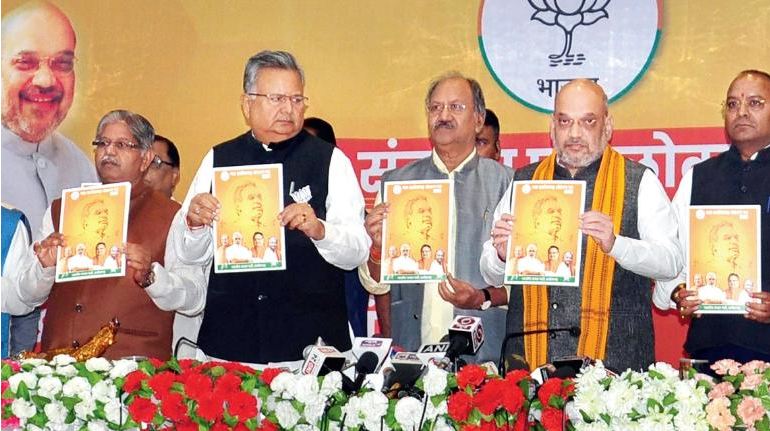
Shah released the party’s manifesto in Raipur, lauding the three-term government of chief minister Raman Singh for the developmental work it had done for the state once referred to as ‘BIMARU’.

On the final day of campaign for the first phase of polling in Chhattisgarh, the ruling Bharatiya Janata Party (BJP) para-dropped big guns to ensure that the opposition Congress party felt the heat. BJP chief Amit Shah and Hindutva mascot Yogi Adityanath, led the attack from the front.

Shah released the party’s manifesto in Raipur, lauding the three-term government of chief minister Raman Singh for the developmental work it had done for the state once referred to as ‘BIMARU’ (original acronym coined in the 1980s for the four states of Bihar, Madhya Pradesh, Rajasthan and Uttar Pradesh that were economically backward).

“The Congress ruled the country for 55 years, but it is the BJP which is working hard to ensure that the fruits of development reach the last person in the society. The manifesto for the fourth term in office has been prepared by consulting all sections of the society. I assure you that all promises made will be honoured,” Shah said.

Raman Singh, who is seeking re-election for a fourth term, told reporters: “The Congress used farmers like vote banks. They did nothing for farmers in the past 60 years. This year, we will buy 80 lakh quintals of wheat from farmers.” Singh was congratulated by his party president for making the state of Chhattisgarh “almost Naxalism-free”.

“The BJP government under chief minister Raman Singh has contained naxalism and made the state almost free of it. A party that feels naxalism is a medium for revolution cannot do any good for Chhattisgarh,” Shah accused the Congress.

Shah’s statement was in reference to Uttar Pradesh Congress chief Raj Babbar’s comments in Raipur last Saturday, when he said, “Naxals had launched a ‘revolution’ which cannot be stopped through guns but resolved through talks.” Uttar Pradesh chief minister Yogi Adityanath was also unsparing in his attack against the Congress.

Addressing a rally in Chhattisgarh’s Lormi, Adityanath said: “The Congress encouraged naxalism for its gains, but when it became dangerous for the security of people, it was the BJP which had to deal with the issue sternly. The Congress has been encouraging Naxalism actively and covertly.”

Adityanath accused the grand old party of jeopardising the nation’s security. “The Congress, for its own gains, played with the security of the country, be Chhattisgarh or Jharkhand, where the issue was of giving asylum to naxalites, or using states like Kashmir for political benefits. But for the BJP, national security is of prime importance, hence we never accepted toying with it,” Yogi said.

The BJP’s Hindutva posterboy, who has been championing the cause of the Ram temple at the disputed site in Uttar Pradesh’s Ayodhya, raised the issue in battleground Chhattisgarh, too.

Adityanath said: “While it is a known fact that Lord Ram was born in Ayodhya, the matter is pending before the Supreme Court. Senior Congress leader Kapil Sibal had petitioned before the court that a decision should not have been taken over the issue before 2019.”

He further alleged, “The Congress should be asked if they are related to Lord Ram or with foreign invader Babur. Congress has no idea about the country’s respect and prestige. The Congress has always played with national security and is now coming to you for votes.”

The first phase of polling to 18 out of the 90 Assembly segments in Chhattisgarh takes place on November 12.


Disclaimer: RSS has been taken from their official website.
Rahul Gandhi just ‘an entertainment’ for people in Chhattisgarh, knows nothing about state: Raman Singh

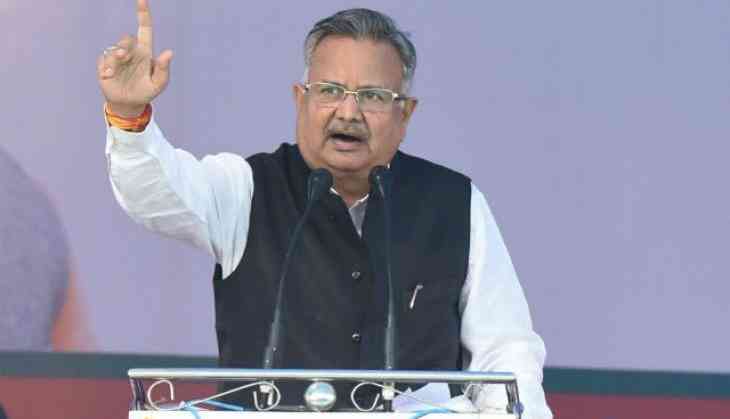
Launching a scathing attack on Rahul Gandhi, poll-bound Chhattishgarh’s Chief Minister Raman Singh on Saturday alleged the Congress chief was “sort of an entertainment” for people in the state and his campaign could be detrimental to his own party.

Ahead of the crucial first phase of voting in the state on Monday, Singh said Gandhi does not know anything about Chhattisgarh and his rallies would not help the Congress draw any significant votes.

Singh’s counter-attack came a day after the Congress president, during his election campaign on Friday, accused Singh of indulging in graft and of doing any work only after taking “permission from his 10-15 industrialist friends”.

“Rahul does not know anything about Chhattisgarh. People of Chhattisgarh do not take him seriously. He is sort of an entertainment for them,” Singh told PTI in an interview.

Singh, who has been chief minister of the tribal-dominated state for a record 15 years out of its 18-year history, said Gandhi’s presence in the state would not dent poll prospects of the BJP but might prove detrimental to his own Congress party.

While there was no immediate comment from the Congress on the latest jibe at its party chief, the allegations levelled by various political parties have often become personal amid a rising election fever in the country’s political landscape.

While the Congress has been accusing the BJP-led governments at the Centre and in various states of indulging in crony capitalism, Gandhi has launched an aggressive campaign centred around these charges for the five poll-bound states, including Chhattisgarh, which is being seen as semi-finals before the 2019 Lok Sabha elections.

The saffron party has denied these charges and have levelled counter-allegations of corruption and crony-capitalism being things of past when the Congress was in power.

Gandhi has been actively campaigning in Chhattisgarh where voting will be done in two phases — on November 12 for 18 seats (including 12 in naxal-affected areas) and on November 20 for the remaining 72 seats.

Voting in Singh’s own constituency Rajnandgaon, where the Congress has given the ticket to late Atal Bihari Vajpayee’s niece and former BJP leader Karuna Shukla, will also take place on Monday.

During his campaign rallies on Friday, Gandhi had hit out at Prime Minister Narendra Modi and Chief Minister Singh over various issues, including lack of development in Chhattisgarh.

Singh, who is eying a fourth term as chief minister, said Chhattisgarh has developed on all fronts contrary to what the Congress party claims.

“Chhattisgarh used to be a backward stage. In 15 years of the BJP rule, it has become one of the developed states. We are growing at a great pace and will soon be along top five developed states of the country,” he said.

To a question on whether the BJP will lose votes due to an alliance between former Chhattisgarh Chief Minister Ajit Jogi-led Janta Congress Chhattisgarh and Dalit leader Mayawati’s Bahujan Samaj Party, Singh said the BJP’s vote share will remain intact despite the formation of this “selfish coalition”.

“It is a selfish coalition and both the parties will not have any effect on the BJP votes,” he said.

On the menace of Naxalism, Singh said Maoists in the state were living on life support.

“We have neutralised Naxalites and their agenda with our development work. Maoists in the state are living on life support. It will soon be over,” the chief minister said.

The 66-year-old BJP veteran, who was a practising ayurvedic doctor before taking the plunge into politics in 1980s, became Chhattisgarh’s chief minister in December 2003, after the saffron party snatched power from the Congress just about three years after the state was carved out of Madhya Pradesh.

In the 2013 election, the BJP got 49 seats while the Congress secured 39. The BSP got one, while one seat was won by an Independent candidate.


Disclaimer: RSS has been taken from their official website.
Amit Shah Releases BJP’s Chhattisgarh Manifesto

Up to Rs 2 Lakh Interest-Free Loans for Women

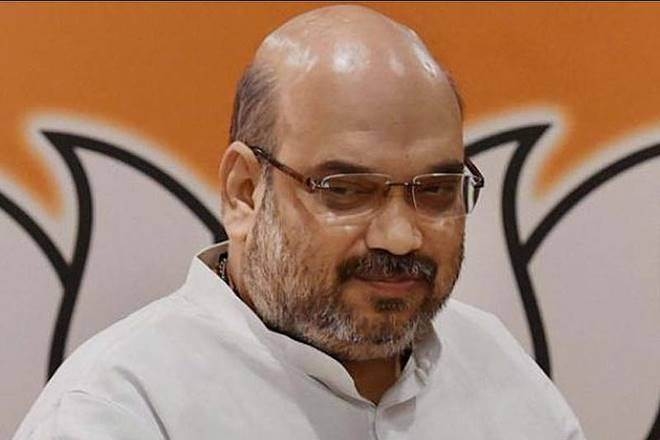
A day after the Congress came up with its Chhattisgarh election manifesto, Bharatiya Janta Party (BJP) president Amit Shah released his party’s list of promises in Raipur on Saturday.

While releasing poll manifesto, CM Raman Singh announced interest-free loans of up to Rs 2 lakh for women to establish their business. Named ‘Sankalp Patra’, the manifesto promises to set up a film city in Chhattisgarh. Besides, distributing free books and uniforms to students up to class 12.

“Under the BJP rule, Chhattisgarh has become a welfare state. Various schemes, including MGNREGA, have been made corruption-free,” said Amit Shah. “Chhattisgarh was the first state to have a legislation on skill development,” he added.

Shah, during the event, also exuded confidence that BJP under Singh’s leadership will retain power in this central state.

All political parties have pushed their top leaders in the campaign to garner support with Prime Minister Narendra Modi and Rahul Gandhi addressing public meetings at different areas of the state. The ruling BJP has deployed top leaders to retain the power in the state, while Congress is trying hard to wrest power from the ruling party.

Congress chief Rahul Gandhi on Friday released the party’s manifesto for Chhattisgarh which promises farm loan waiver, minimum support price for crops as per the Swaminathan Commission recommendations and ban on liquor sales. Amit Shah and UP CM Yogi Adityanath are scheduled to address rallies in the state to maximise the support ahead of the first phase polls.

With only two days left for the first phase of assembly elections in Chhattisgarh, Congress president Rahul Gandhi and BJP chief Amit Shah will campaign in the state on Saturday.

Election campaign for the first phase of Chhattisgarh polls will end on Saturday night, 48 hours before the voting on November 12. Chhattisgarh polls will be held in two phases, November 12 and November 20.

Disclaimer: RSS has been taken from their official website.
Chhattisgarh Polls : Scrutiny of nominations held for final phase of elections; Monday is last day of withdrawal

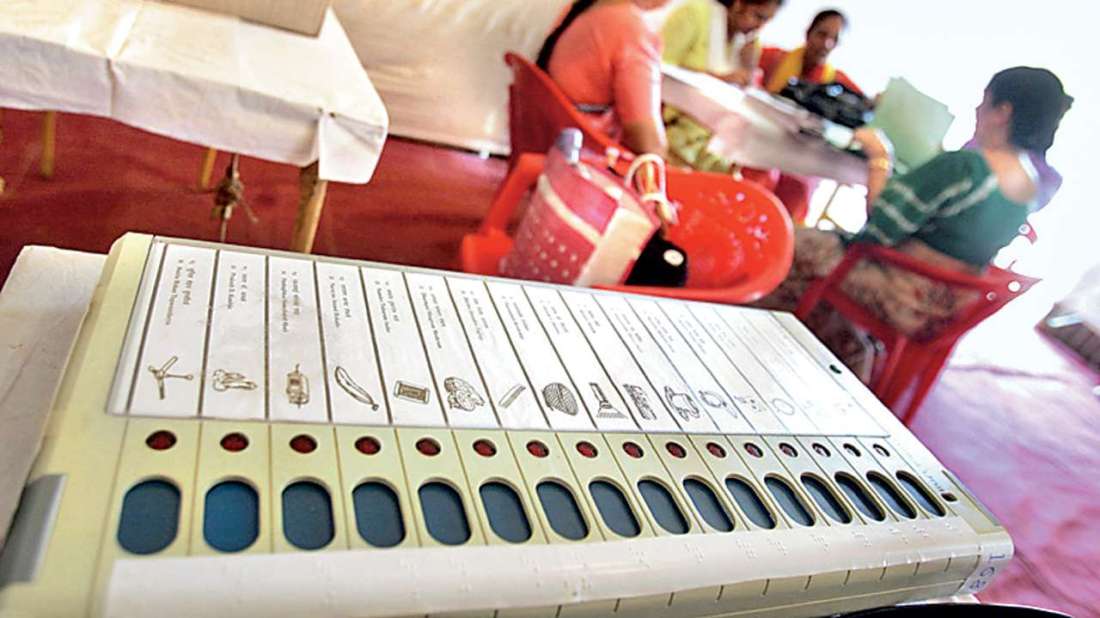
In Chhattisgarh, scrutiny of nominations for the second phase of assembly elections took place today.

AIR correspondent reports, in Chhattisgarh, more than two thousand six hundred nominations were filed by the candidates in 72 assembly segments, which are going for poll in second phase.

Yesterday was the last day for filing of nomination papers. On the last day, over one thousand three hundred nominations were filed.

In last assembly elections in the year 2013, one thousand eighty two aspirants had filed their nomination papers from these 72 constituencies.

More than one crore 53 lakh voters, including 76 lakh females, are eligible to exercise their franchise in second phase.

The last date for withdrawal of nomination papers is November five. Vikalp Shukla, AIR News, Raipur

Chhattisgarh has 90 constituencies. Assembly elections are scheduled to be held in two phases on November 12th and 20th.


Disclaimer: RSS has been taken from their official website.

Congress releases third list of candidates for Chhattisgarh polls; party banking on old and new faces to regain power

The Congress is banking on a combination of new faces and old-timers in ticket distribution to end its 15-year wait to rule Chhattisgarh, which goes to polls next month.

The Opposition party, late on Saturday evening, released a list of candidates — its third — for 37 Assembly seats going to polls in the second and last phase of voting on 20 November. It has renominated 15 sitting MLAs and fielded 11 candidates who had lost in 2013, besides giving tickets to 11 fresh faces.

No sitting MLA was denied a ticket in the third list. However, only three women figure in it.

A Congress leader said the party is ensuring that representation is given to all sections of society. “It is a completely balanced list wherein the party has given representation to leaders belonging to all sections of society,” claimed the head of the Chhattisgarh Congress communication wing, Shailesh Nitin Trivedi.

“Candidates were selected on the basis of the party’s survey and performances of leaders,” he said, adding that it is a “well-planned strategy” to win the upcoming election.

The two lists released earlier contained 18 names. With this, the Opposition party has, so far, announced 55 candidates in BJP-ruled Chhattisgarh, which has a 90-member House.

State Congress chief Bhupesh Baghel (Patan seat), Congress Legislative Party leader TS Singhdeo (Ambikapur), senior Congress leader Satyanarayan Sharma (Raipur Rural) and prominent tribal leader Amarjeet Bhagat (Sitapur) were among the sitting MLAs who were given tickets.

In the last Assembly polls, 26 Congress sitting MLAs, including prominent leaders like Rampukar Singh, Ravindra Choubey, Amitesh Shukla and Mohammad Akbar, had tasted defeat. This time, Singh (Pathalgaon-ST), Shukla (Rajim), Akbar (Kawardha) and Choubey (Saja) have been renominated from their respective seats.

Chhattisgarh Congress working president Shiv Kumar Dahariya, who had lost the previous election from Bilaigarh (SC), has been fielded from Arang (SC) this time. Similarly, Guru Rudra Kumar, who had lost the 2013 election from Arang, has been given a ticket from Ahiwara (SC).

A popular young Congress leader, Vikas Upadhyay, who had lost to BJP minister Rajesh Munat from Raipur West last time by a margin of 6,160 votes, has been renominated from the seat. He will take on Munat again.

Among other leaders who have been given tickets despite losing the 2013 polls are Premsai Tekam (Pratappur) and Pratima Chandrakar (Durg Rural).

Vinay Kumar Bhagat and Uttamdan Minj, who had lost the 2008 Assembly election from Jashpur and Kunkuri, respectively, have been fielded from the same seats this time. Vinay Jaiswal, an eye surgeon, Devendra Yadav, Ramkumar Yadav are among the fresh faces fielded by the party this time.

Bhilai Municipal Corporation Mayor Devendra Yadav, a youth leader, has been fielded from the Bhilai Nagar seat, where he will take on state minister and sitting BJP MLA Premprakash Pandey. Jaiswal will contest from Manendragarh.

Ramkumar Yadav, a prominent farmer leader, had contested from Chandrapur constituency as a Bahujan Samaj Party candidate in 2013 and had finished runner-up. He recently joined the Congress, which has given him ticket from Chandrapur.

Voting in Chhattisgarh will be held in two phases — on 12 November and 20 November — and counting will take place on 11 December.

The first phase covers 18 seats spread across eight naxal-affected districts — Bastar, Bijapur, Dantewada, Sukma, Kondagaon, Kanker, Narayanpur and Rajnandgaon. The remaining 72 seats will see polling on 20 November.

The ruling BJP has so far announced 78 candidates.

In 2013, the BJP had won 49, the Congress 39, the BSP 1 and an Independent 1.

The BJP has been ruling the tribal-dominated state, which came into existence in November 2000, since 2003 under the leadership of Raman Singh.


Disclaimer: RSS has been taken from their official website.
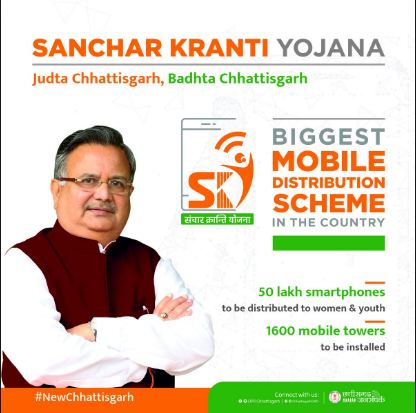
Can smartphones for women in Chhattisgarh help in economic development?

Download App For Detailed NEWS : chhattisgarh512

In a remote village in Chhattisgarh, over 200 women lined up outside a government office, each holding a small, orange ticket. One by one, they shuffled into and out of the office, replacing their ticket with a smartphone. Excited new phone owners gathered in groups outside the hall talking about how they would use the phone.

This scene was not unique to one village. All across Chhattisgarh through September 2018, the state government was giving a smartphone to one woman in each rural household. The programme, entitled Sanchaar Kranti Yojana (SKY), or the Telecommunications Revolution Scheme, covered 2.3 million rural women by the end of September. As if that weren’t ambitious enough, SKY also gave smartphones to 300,000 college students and 350,000 urban women–and will increase network coverage by building just under 1,500 towers, thus encouraging even more phone use and ownership beyond the beneficiary pool.

The main purpose behind programme SKY is to address low phone ownership in Chhattisgarh and to empower women in the process. As evident from the heat maps below, Chhattisgarh has India’s fourth lowest mobile phone ownership rate–45.6%–which is five percentage points lower than the overall average.

At the same time, Chhattisgarh’s gender gap in phone ownership is the lowest in India at 14.3 percentage points: 52% of men own a phone compared to 38% of women. At 32.7 percentage points, India’s overall average gap is more than twice that amount. Yet a relatively smaller gender gap in ownership does not necessarily mean the gap won’t grow over time–many states with higher male phone ownership also have larger gender gaps.

In this way, programme SKY is a timely nudge that encourages a narrowing rather than enlargement of the mobile gender gap. (For more insights on the causes and effects of the gap, see a new report by our team, led by Rohini Pande and Charity Troyer Moore of Evidence for Policy Design at Harvard Kennedy School, Erica Field of Duke University and Simone Schaner of University of Southern California.)

The benefits of mobile phones

The potential impacts of SKY go beyond female mobile engagement. Ample research already shows that mobile phones encourage economic development. Phones help producers and consumers access the best price for market goods and learn about job opportunities. In Kenya, mobile money has reduced households’ vulnerability to economic shocks. “Behavioral messaging” through SMS and voice calls have improved behavior in domains like finance, health, and education.

A few studies highlight the value of women’s mobile phone access, both for themselves and others. One study found that M-PESA, Kenya’s mobile money platform, has lifted 2% of Kenyan households out of poverty. Increases in consumption were concentrated among female-headed households, suggesting that women had more to gain from mobile money. A study from Niger found that when women took cash transfers through mobile money application rather than as cash, household dietary diversity improved, a result attributed to women’s increased bargaining power within the household.

This result echoes a broader finding in current research: Empowering women with assets is valuable to economic development. Studies show that when women have access to resources, they use them for children. For example, greater access to pension benefits among female-headed households in South Africa led to improved nutrition for girls. There are similar patterns among households in Brazil, where studies show that higher female income leads to greater chance of child survival, higher nutrition investments in girls, and larger relative investments in human capital and leisure.

Similarly, we might expect women to use their SKY phones to improve their children’s lives in some way. While empowering women with technology is a noble pursuit in its own right, this further highlights the value of SKY targeting female beneficiaries rather than male.

A problem: The male monopoly

The success of SKY’s targeting of female beneficiaries comes with a caveat: Transfers are only as effective insofar as the beneficiary perceives them as useful and relevant. Recent experience with the Pradhan Mantri Jan Dhan Yojana (PMJDY), or Prime Minister’s People’s Wealth Scheme, illustrates this.

The intent of PMJDY was to open a bank account for at least one member in every household. Yet PMJDY alone was not enough to achieve full financial inclusion, as many accounts remained dormant after being opened. In order for the economy to see the downstream impacts of the scheme, beneficiaries needed to understand what a bank account could do for them and how to use one. In other words, the relevant metric for measuring financial inclusion lies not in the number of people with an account but the number of people who use accounts.

In a similar way, if SKY beneficiaries do not find phones useful or obtain the skill to use them, then the initiative will fail to close the mobile phone gender gap and women will not reap these benefits. The issue is further complicated by the fact that unlike bank accounts, phones can be easily transferred, and men often control asset ownership within households in South Asian cultures.

Thus, even if a woman sees her new phone as useful, if she does not know how to use it, then her husband may use his monopoly on technological know-how to justify taking it. This underscores the potential added value of digital literacy training to the SKY programme and, more broadly, highlights the importance of providing training alongside programmes that give assets to the poor.


Disclaimer: RSS has been taken from their official website.

Chhattisgarh Elections : Congress Fields Vajpayee’s Niece To Take On Raman Singh

The first phase of assembly election in Chhattisgarh will be held on November 12 and the last date for filing of nominations is October 23.


The Congress has fielded former prime minister Atal Bihari Vajpayee’s niece Karuna Shukla in the Rajnandgaon assembly constituency in Chhattisgarh against Chief Minister Raman Singh.

In the second list released by the Congress for the first phase of the Chhattisgarh assembly election, the party declared its candidates for the remaining six constituencies. It earlier declared candidates for 12 seats.

The first phase of assembly election in Chhattisgarh will be held on November 12 and the last date for filing of nominations is October 23.

Karuna Shukla had quit the BJP a few years ago and joined the Congress.

While Girwar Janghel will contest from the Khairagarh seat, Bhuneshwar Singh Baghel will contest from Dongargarh-SC seat and Daleshwar Sahu from the Dongargaon assembly constituency.


Disclaimer: RSS has been taken from their official website.

Amit Shah: Congress colluded with Maoists to retain power in Chhattisgarh

Targeting the Congress ahead of the state Assembly polls over various issues, Shah challenged the opposition party to an open debate on its development track record.

Bharatiya Janata Party (BJP) president Amit Shah on Friday accused the Congress of forging “ties with Naxals” to remain in power in Chhattisgarh before 2003.

The BJP government in the state had succeeded in containing the Maoist menace, Shah said, addressing a tribal convention at Narharpur in the insurgency-hit Kanker district.

Targeting the Congress ahead of the state Assembly polls over various issues, he challenged the opposition party to an open debate on its development track record.

The convention marked the conclusion of the Atal Vikas Yatra campaign launched by Chief Minister Raman Singh to highlight the achievements of his 15-year rule.

“Chhattisgarh once reverberated with the sound of bullets…. I have no hesitation in saying that the earlier Congress government (before the BJP came to power in the state in 2003) had forged ties with Naxals to stay in power. We broke that nexus and cracked down on Naxals.

“Entire Chhattisgarh is gradually getting rid of Naxalism and heading on the path of development,” Shah said.

When Chhattisgarh came into existence, it was dubbed as one of the “Bimaru (backward/sick) states and despite being in power for the initial three years, the Congress did nothing to boost its economic growth, he alleged.

The Congress did nothing to maintain law and order, curb Naxalism, eradicate hunger and uplift the forest-dwellers, despite being in power for 55 years at the Centre, the BJP chief said.

“Atalji (then prime minister Atal Bihari Vajpayee) founded the state and Raman Singh developed it,” he said.

Shah mentioned the 24-hour power supply, road connectivity in the interior villages, purchase of forest produce at a minimum support price and other development works as some of Singh’s achievements in the last 15 years.

He slammed the Congress over a scandal triggered by the circulation of a “sex CD”, purportedly featuring state Public Works Department Minister Rajesh Munat. Munat has filed a case against state Congress chief Bhupesh Baghel for allegedly trying to malign his image by circulating the CD.

“The BJP will be contesting the polls under the leadership of Prime Minister Narendra Modi and Chief Minister Singh, but I want to ask Congress president Rahul Baba (Rahul Gandhi), who will lead the Congress? Will it be those who shamefully manufacture fake CDs for character assassination?” Shah asked.

“Are you (Gandhi) going ahead with a leader, who allegedly indulged in character assassination through fake CDs for seeking the mandate in Chhattisgarh?”

“Our mothers and sisters here are waiting to settle the score over the CD issue and rout the Congress,” he said.

The BJP never indulged in the politics of “chaturai” (cunningness), Shah said.

He challenged the Congress to a debate on the work done during Modi’s four-year rule and Raman Singh’s 15-year tenure as against the opposition party’s “55-year rule”.

“People have two options in the coming polls. The first is the Congress which only talked about ‘garibi hatao’ (remove poverty) but removed the poor instead, while the other is the BJP, which, without raising slogans, ensured power supply to every house, provided houses for all, built toilets and gave bonus to the Tendu leaf collectors,” Shah said.

Earlier, after arriving at the Raipur airport, Shah flew in a helicopter to Sihawa, the origin of the Mahanadi river in Dhamtari district, where he offered prayers at the Mahamai Temple at Farsia village.

Shah’s visit to Sihawa and Narharpur is being seen by political observers as an attempt to woo the tribal population of Chhattisgarh.

The Assembly polls are scheduled to be held in the state later this year.


Disclaimer: RSS has been taken from their official website.

BJP president Amit Shah on Chhattisgarh visit on October 5

BJP president Amit Shah will be on a day-long visit of poll-bound Chhattisgarh Friday during which he will take part in several programmes including a tribal convention in naxal-affected Kanker district.

BJP president Amit Shah will be on a day-long visit of poll-bound Chhattisgarh Friday during which he will take part in several programmes including a tribal convention in naxal-affected Kanker district. Shah will arrive at Swami Vivekananda Airport in Raipur at 10.30 am, a party spokesperson said.

The BJP chief will soon leave for Sihawa Ashram in Dhamtari district where he will meet seers to seek their blessings, he said. Shah will then participate in a programme for distribution of bonus to collectors of tendu-patta (tendu leaves) at Narharpur in Kanker district at 12 noon, the leader said, adding the BJP chief will also address a tribal convention there.

Later, Shah will travel to Charoda in Durg district at 3 pm and address a women’s convention, he said. He will meet members of the Gujarati community in Bhilai at 4.40 PM. Assembly polls are slated to be held in Chhattisgarh later this year.


Disclaimer: RSS has been taken from their official website.