MP, Mizoram Polls 2018 LIVE updates: 75% polling in Mizoram, 74.6% in MP

In Mizoram, Congress will fight tooth and nail to save its last bastion in the North-East from falling. In the Christian dominated state, BJP’s pro-Hindutva image has done it any service and any party that is seen canoodling with the saffron party. Incumbent Chief Minister Lal Thanhawla’s tenure ends on December 15. Congress, the Mizo National Front (MNF), the Zoram People’s Movement (ZPM), and the Bharatiya Janata Party are the main political parties in the battle for Mizoram.

Madhya Pradesh, Mizoram Assembly Elections – LIVE updates

11:50 am: Voter turnout in Mizoram is at 29 percent till 11 am, as per ANI. In 2013 State Assembly Elections, the north-eastern state saw 89 percent voter turnout. Meanwhile in MP, 13.63% voter turnout was recorded till 11.15 am.

11:10 am: Special arrangements have been made to facilitate voting by members of the Bru community. Food and transport facilities are also being provided to those coming to cast votes. Violence between Mizo and Bru tribes broke out in 1997, following which many Bru families were forced to flee their home state and take shelter in the neighbouring Tripura.

10:44 am: After a person was arrested after BJP polling agents were found carrying campaign material within 200 meters of a polling booth in MP, another case of violation of section 126 of the Representation of People Act, 1951. The Election Commision is expected to look into the matter.

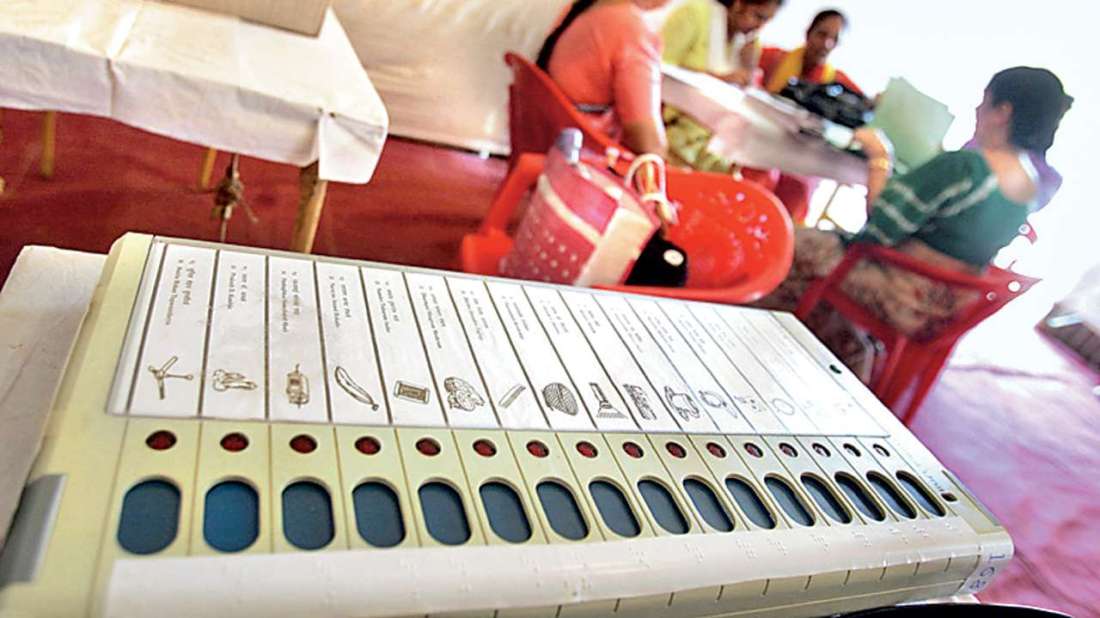
10: 30 am:  After initial reports of multiple Electronic Voting Machines (EVMs) and Voter Verifiable Paper Audit Trail (VVPAT) not working, over 100 EVMs have been replaced, chief electoral officer V Kantha Rao was quoted by reports as saying.


10:19 am: Earlier, Kamal Nath after casting his vote in Chhindwara said, “I have full faith in the people of Madhya Pradesh, they are simple and innocent people who have been robbed for a long time by BJP”.

In true democratic spirit, a 101-year-old woman was spotted outside the polling booth in Agar Malwa in MP after exercising her franchise:

10:02 am: In violation of election code of conduct, a person was apprehended after BJP’s polling agents were caught with campaign material within 200 meters of a polling booth in MP.

9:50 am: Mizoram has witnessed 15 percent voting till 9 am, as per ANI. The voting in the North-eastern state started at 7 am and will continue till 4 pm. Mizoram’s borders with neighbouring Tripura, Assam and Manipur as well as international borders with Myanmar and Bangladesh have been sealed since Sunday for elections.

9:37 am: After claiming yesterday that there is pro-incumbency and not anti-incumbency in the state, CM Shivraj Chouhan after casting his vote in Budhni on Wednesday said he is confident that BJP will form the government with absolute majority.  “We’re 100% certain that BJP will form the government with an absolute majority. We have set a target of 200 seats and our lakhs of volunteers are working to make it a reality,” he told ANI.

9:22 am: There have been reports of EVMs not working in some of the booths in MP. Two faulty EVMs in Ujjain have been replaced, 11 VVPAT machines in Alirajpur, 5 VVPAT and 2 EVMs in Burhanpur also replaced. It was earlier reported that EVM at polling booth number 178 in Dabra, Gwalior district is not working.

9:03 am: In MP, a total of 5,04,95,251 voters will cast their votes to decide the fate of 2,907 candidates. Voting in three Maoist-affected seats Lanji, Paraswada and Baihar began at 7 am and will continue till 3 pm while the polling in the remaining 227 seats began at 8 am and will continue till 5 pm.

8:48 am: Congress leader Kamal Nath cast his vote in Chhindwara while MP minister and BJP leader Yashodhara Raje Scindia cast her vote at a polling station in Shivpuri. She is up against Congress’ Siddharth Lada.

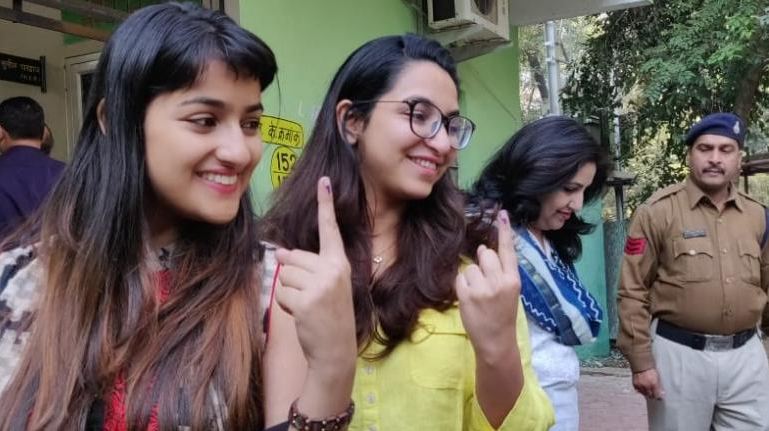
8:34 am: Mizoram has 7,70,395 registered electors who will vote in 1,164 polling booths across the state. Nearly 209 candidates are in the fray. Here are some visuals of voters as they exercise their franchise:
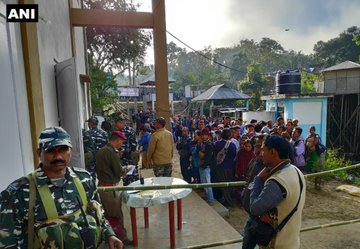
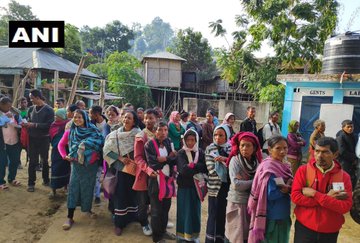
View image on TwitterView image on Twitter


8:22 am:  Both BJP and Congress leaders made temple runs as polling began in MP. MP CM Shivraj Singh Chouhan offered prayers on banks of Narmada river in Budhni with his wife Sadhna Singh. Meanwhile, Congress leader Kamal Nath made his obeisance at Hanuman temple in Chhindwara.

8:13 am: Polling in Maoist-affected constituencies began early in Madhya Pradesh while voting in the rest of the state started at 8 am. The most-watched seat today is CM Shivraj Singh Chouhan’s Budhni. He is pitted against Congress’ Arun Yadav there.

8:03 am: In Mizoram, all booths will be connected wirelessly leaving no “shadow areas”. The state has a hilly terrain which makes access to certain locations difficult. Mizoram Deputy Inspector General of Police earlier Joseph Lalchhuana earlier told PTI the move will help in timely reporting of the progress in polls.

7:45 am:  On the eve of MP polls, Shivraj Singh Chouhan who is the longest-serving chief minister of the state told PTI that pro-incumbency and not anti-incumbency is at play in the state. “What is at work here is pro-incumbency and not anti-incumbency,” said the 59-year-old BJP leader, whose party has been in power in the state since 2003,” he told PTI.

7:30 am: Voting in MP will begin at 8 am. About 500 ‘pink’ polling booths all across MP which will completely be managed by all-woman staff. From presiding officers till security guards, these booths will have all women staff.
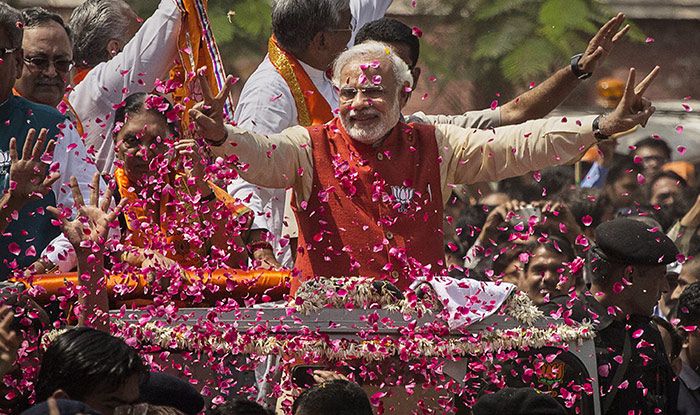
Congress cannot fight me, that is why abusing my mother: PM Modi

Hitting out at the Congress, Modi today said that the people of Madhya Pradesh will give a befitting reply to the party for abusing his mother in the coming assembly elections.


HIGHLIGHTS

  • Raj Babbar had compared devalued rate of rupee to PM’s nonagenarian mother
  • Congress has disrespected my mother, Modi said
  • He also accused Congress of indulging in caste politics

Prime Minister Narendra Modi on Saturday lambasted the Congress for making a personal attack on him. Referring to Congress leader Raj Babbar’s recent remark, Modi said the Congress is rattled by the good work of the Bharatiya Janata Party (BJP).

“For the past 18 years, I have been defeating the Congress at every single opportunity, and today it has fallen to the level that it has dragged my mother in elections. Congress cannot fight Modi, that is why it is now abusing my mother,” said Modi while addressing a rally in Madhya Pradesh’s Chhatarpur.

Congress leader Raj Babbar had recently compared the devalued rate of the Indian rupee to the PM’s nonagenarian mother, who is around 97 years old. “He [Modi] used to say that the rupee has fallen so much against the dollar that it was nearing the age of the then prime minister [Manmohan Singh]. Today, the rupee’s value has dropped so low, that it is inching closer to your [Modi’s] beloved mother’s age,” Babbar had said on Thursday at a rally in Indore.

Hitting out at the Congress, Modi today said that the people of Madhya Pradesh will give a befitting reply to the party for abusing his mother in the coming assembly elections.

He also said that corruption is the culture of the Congress. “Those who are out on bail in corruption cases are now unnerved. Coffers of banks were emptied for rich during madam’s [Sonia Gandhi] government, but we opened banks’ doors for needy youth,” he said.
Accusing the Congress of indulging in caste politics, Modi said, “People had voted Congress out of power in Madhya Pradesh 15 years ago because of its divisive politics.”

Earlier, Congress president on Friday had targeted Modi alleging that he created a cobweb just like the Bollywood villain Mogambo to “loot” the armed forces and that the Rafale scam is one of his many adventures which will be exposed soon.

In a tweet in Hindi, Rahul said PM Modi has created a “cobweb”, just like Bollywood villain Mogambo, to “loot” India’s armed forces. He alleged the Rafale scam was “one of his many adventures” that will be exposed soon.

The 230 member-Madhya Pradesh assembly will go to polls on November 28. It will be only clear on December 11 as to who the people of the state have blessed with their votes after the EVM’s are opened for counting on this day.


Disclaimer: RSS has been taken from their official website.

How Upper Caste Anger on Dalit Atrocities Act May Impact Madhya Pradesh Elections

To take the case of Malwa region only, in Mandsaur, Ratlam and Ujjain lakhs of upper castes marched across towns to register their anger against the BJP, led by small, disorganised outfits like Karni Sena and Samanya Pichhda Alpsankhyak Kalyan Samaj (SAPAKS).


In September, one month after the NDA overturned the dilution in SC/ST Atrocities Act by the Supreme Court, protests led by upper castes and OBCs broke out all across Madhya Pradesh.

To take the case of Malwa region only, in Mandsaur, Ratlam and Ujjain lakhs of upper castes marched across towns to register their anger against the BJP, led by small, disorganised outfits like Karni Sena and Samanya Pichhda Alpsankhyak Kalyan Samaj (SAPAKS).
While the visible anger against the BJP, which is trying to win a fourth term in MP, has subsided, this substantial section of society, which in recent elections voted overwhelmingly in favour of the BJP, is looking to exact its ‘revenge’.

“Jab Thawarchandji [Gehlot] hamare paas aaye vote maangne, humne unse kaha ki jab aapne hamare bacchon ke baare mein nahi socha to hum aapke bacche ke baare mein kyun sochein?” says Bhairav Singh Solanki, a regional Karni Sena leader.

Union Social Justice minister Thawarchand Gehlot is facing huge backlash from the small but influential section of Rajput voters in Alote, where his son Jitendra Gehlot is fighting for a second term.

Thawarchand has been campaigning here for his son for past several days. On Monday, he welcomed UP Chief Minister Yogi Adityanath to a rally in Taal, in an attempt to assuage the popular dissent. In his speech Adityanath, who himself is a Rajput and has on several occasions talked glowingly about “Rajput pride”, talked about bringing in “Ram Rajya” and invoked “Ram Janmabhoomi”.

However the widespread anger against the government which is being seen by the upper castes and OBCs as having sided with the SC/ST community is far from over.

“Jab Supreme Court ne ek baar is Act ko sahi kar diya to fir aapko kya zarurat thi usmein ched chad karne ki? Iska seedha matlab to yahi hai ki aapko ek jaati vishesh ke hi vote chahiye. To fir unhi se vote mangiye na,” Rajpal Singh Dodia says in Alote.

Gehlot’s son has been prevented from entering several Rajput dominated villages here like Negrun, Pipliya Sisodia, Babuniya, Lasudiya. In these villages Rajputs have put up signboards asking BJP candidates to stay away. Such no-entry villages can be spotted not just in Ratlam’s Alote but across the Malwa region.

Although it may be premature to predict that the upper castes and OBC leaders are getting automatically polarised towards the Congress. “Hame yaad hai jab sansad mein SC/ST Act pe BJP sanshodhan laa rahi thi tab Digvijaya khamosh the aur Scindia Jee table baja ke uska swagat kar rahe the,” says Vijender Singh Solanki, a Raput, in Ratlam town. A lot of local journalists and businessmen too privately express similar emotions.

In some seats like Jaora and Ghatiya, upper castes have decided to show their anger against both the BJP and the Congress by supporting strong Independent candidates as well.

There are 82 reserved seats in MP’s 230 seat strong Assembly. In the rest of the seats, the upper castes and OBCs command great influence. It was perhaps with this in mind that CM Shivraj Singh Chouhan prevented release of the film Padmavati, later Padmaavat, and wrote on his official Twitter account the misuse of the SC/ST Atrocities Act will not be allowed.

Around 10 km away from Bhuda, in Mandsaur, a Rajput dominated village called Kittukheri came into limelight earlier this year, when, like several other Rajput dominated villages it put up posters saying they will vote NOTA in the upcoming elections angered by the BJP’s support to the stringent provisions of the SC/ST Atrocities Act.

“Amit Shah says in Chhattisgarh that till the BJP is in power reservation will not go. If this is the case we have clearly no future under the BJP regime,” says Dharampal Singh Rajawat.

“We all voted for Narendra Modi in 2014 because he said he will bring back black money, he will deposit money in our accounts, he will build Ram mandir. What happened to all those promises? If they can ban currency notes why can they not build Ram mandir?” asks Upender Singh.

“And what happened to the Kashmir problem? At least 40-45 people from our village are working in the Army most of who are posted in Kashmir. Does Modi think that Rajputs are born only to be posted on the border and die? We were also part of the Kisan andolan in Mandsaur last year we saw what their police did to our farmers,” says Karu Singh Hada.

There are around 7,000 Rajput votes spread across Kittukheri, Munderi, Borkheri, Band Pipliya, Jarha and Aakli—nearby Rajputv villages. Locals here say that they’ll do whatever the leaders of Karin Sena ask them to do. “We are not allowing BJP leaders or workers inside our villages. Only Congress people are being allowed and only on the condition that they give us in writing all that they’re planning to give us. So on the voting day we will decide between the Congress and NOTA,” Rajawat adds.

The BJP candidates did not win by a huge margin in 2013, Rajawat further adds. “Even if they lose just 50 voters per village, compared to last time, the BJP will be routed from here. Last time there were 2 families supporting the Congress and eight supporting the BJP. The situation this time could be exact reverse.”

In some sense though, the BJP is suffering a unique, mostly silent anger not just from the upper castes and OBCs but from the SC/ST community as well.

“Look how they treated Chandrashekhar [leader of Bhim Army]. The BJP talks in our favour but have they ever appointed a senior party functionary from our caste? Neither has the Congress actually, but over the past few years one thing we have realised is that “Jai Shri Ram” and “Jai Bheem” don’t go together,” says Vinod Parihar, a local Bhim army leader in Alote.

There is a widespread polarisation of Dalit voters here because cases of atrocities against Dalits are more frequently reported. Dalit grooms who take out their wedding processions are regularly attacked and in some cases not allowed to sit and eat with upper castes. Recently, a Dalit groom went to his wedding wearing a helmet. His photo became popular on social media.

Parihar says that since Dalit parties are not strong in this region, the Dalits have decided to support the the Congress to defeat the BJP.

Upper caste anger against the SC/ST Atrocities Act is also bringing some other smaller players like SAPAKS (Saamanya Picchada Alpsankhyank Kalyan Samaj Sanstha) into the folds of regional politics.

A local journalist who has been reporting on regional politics here says the whole district was chock-a-block with people. “Even national parties here haven’t been able to gather as many people here as this small outfit did. They got huge traction. Which is why being a party focused on upper castes, it is a threat both to the Congress and the BJP.”

Sunil Bansal was a local BJP leader who has now joined SAPAKS that became a political outfit in October this year. He goes from door to door asking for votes but without much fanfare. “My party is batting for the rights of 78% people who suffer from the SC/ST Act and reservation politics. My constituency is the government servants and you don’t find people around me because I’ve told them, for their own good, to sit quietly. We will emerge as the kingmakers here, you’ll see,” Bansal says.

Meanwhile, the RSS is also in full swing here, quietly carrying out a door-to-door campaign while calling it a voter awareness drive.

“There are a couple of things worth noting. After three successive terms of the BJP, people worry about the consequences which is why even those who are fed up of the BJP don’t want to say it overtly, fearing consequences if it comes to power again. Secondly, the RSS we have seen kicking in just 4-5 days before elections. But this time they started their work almost a fortnight ago,” says the local journalist.


Note: RSS Feeds taken from Respective Websites.

Dissent in BJP ranks in Madhya Pradesh over denial of tickets for assembly elections

Deeraj Pateriya (49), who is the Bharatiya Janata Yuva Morcha’s state president and is contesting as an independent from Jabalpur North, said, “There is an attempt to finish me politically. And I want to show my popularity by contesting”.


The ruling Bharatiya Janata Party (BJP) in Madhya Pradesh is battling dissent in its ranks on a scale that appears much bigger than its rival, the Congress. Among its prominent rebels is former minister and four time BJP member of Parliament, Ramkrishna Kusmaria, (75), who is contesting as an independent from two seats- Pathria and Damoh — in the drought-prone Bundelkhand region.

“I gave 40 years of my life to the party and in return they did not had courtesy to tell me that a ticket will be denied to me,” he said. claiming to be hurt.

Deeraj Pateriya (49), who is the Bharatiya Janata Yuva Morcha’s state president and is contesting as an independent from Jabalpur North, said, “There is an attempt to finish me politically. And I want to show my popularity by contesting”.

Kusmaria and Pateriya have joined other senior leaders, such as former state minister Sartaj Singh, who is contesting on a Congress ticket from Hoshangabad, to have publically expressed their anger at the party’s ticket distribution.

“Over 67 important party leaders who are contesting from other political parties or as independents have been expelled so far,” said a senior BJP leader at the party headquarters in Bhopal. The leaders expelled include sitting MLA from Bhind Narendra Singh Kushwah and former mayor of Gwalior Sameeksha Gupta. There are 230 assembly seats in Madhya Pradesh, which goes to the polls on November 28.

The BJP leader quoted above said the party has a list of at least 100 leaders working against the party but no action is being taken due to electoral compulsions. “Any action now will send wrong message to our cadre and will provide the Congress an issue to hit at us,” the leader said.

The leader accepted that it was for the first time in the state that so many BJP workers had been expelled. The number was about 20 in the run-up to 2013 assembly elections, he said. “This is the biggest rebellion in the BJP I have ever witnessed,” said Kusum Mehadele, a minister in the Shivraj Singh Chouhan cabinet who was also denied ticket.


The BJP has dropped four ministers and at least 45 sitting MLAs .But officially, the party rejected reports of large-scale rebellion. State BJP spokesperson Rajneesh Agrawal said, “I don’t think there is any alarming situation for the party. Every political party faces such a situation at the election time and it would not have any impact on the party’s prospects.”

In the Congress, the scale of the rebellion appears to be smaller. “We have expelled less then 20 leaders and workers,” a state Congress leader said on condition of anonymity.He said there were not many rebel candidates unlike Rajasthan where the party had faced violent protest by workers for denial of tickets.

The only big leader to face action was former Rajya Sabha member Satyavrat Chaturvedi, whose son Nitin Chaturvedi is contesting on a Samajwadi party ticket. He was expelled.

“The BJP is battling rebellion because the party has not only betrayed the people but also a section of its workers and leaders”, said state Congress spokesperson Bhupendra Gupta.

Political observer Bhagwandev Israni confirmed the scale of the rebellion was larger in the BJP. “This is a reflection of the political scenario. The BJP is facing a bigger problem than the Congress, unlike the previous three elections, as BJP leaders and workers realise which direction the wind is blowing.”


Note: RSS Feeds taken from Respective Websites.

It’s ‘one family, one ticket’ as BJP fields kin of senior leaders in MP

Faced with anti-incumbency and pressure from its leaders, BJP has done a tight-rope walk between changing sitting MLAs in its candidates’ list and accommodating the kin of those who have the potential to defeat the official nominee in case their wishes are not fulfilled.

Two such names figured in the third list of candidates for Madhya Pradesh Assembly elections released on Thursday, a day before the last date of nominations. The ego tussles between its top leaders in the state has led to the delay in declaration of names. BJP national general secretary Kailash Vijayvargiya’s son Akash will be the BJP candidate from Indore-3 seat. His name was finalised after some bad blood within the party.

Vijayvargiya had issued a statement a day before the announcement that Akash will win from whichever seat he contests the election, thus throwing a virtual challenge to the party leadership. The candidature of Akash was held up as Lok Sabha speaker and Indore MP Sumitra Mahajan wanted her son Mandaar also to be fielded from one of the Indore seats but this was not acceptable to the party. Since she was away on an official visit to Argentina, senior party leaders met Mahajan when she returned on  November 5 to discuss the issue. She has, however, denied that she ever wanted a ticket for her son.

Former chief minister Babulal Gaur’s daughter-in-law Krishna will contest from Govindpura seat. Gaur had quit the Shivraj Singh Chouhan cabinet some years ago after he crossed the 75-year age cut-off.

Congress leader Prem Chandra Guddu, who has switched over to the BJP, is also said to be in talks for a ticket for his son Ajit.

In most cases where BJP has denied tickets to sitting MLAs, it has accommodated a kin of the outgoing legislator. Lakshminarayan Yadav’s son Sudhir Yadav has been fielded from Surkhi seat.
Similarly, sons of ministers Gauri Shankar Sejwal and Harsh Singh are in the fray in their place.

Union minister Narendra Singh Tomar reportedly wants his son Devendra to be fielded from one of the seats in Gwalior which he represents in the Lok Sabha.

Chief Minister Shivraj Singh Chouhan has been asked by the central leadership to pander to the wishes of some of the leaders he is not on good terms as not doing so may cost the BJP these seats. Chouhan’s brother-in-law Sanjay Singh Mesani joined the Congress and has been given the ticket from Wara Seoni seat.
Mahajan has also taken a backseat as Vijayvargiya has managed to get the ticket to his followers in Indore. Similarly, some of the candidates in Tomar’s area are not from his camp though he has been entrusted with the task of ensuring BJP candidates in the region win their seats. Meanwhile, BJP leader Sartaj Singh joined Congress on Thursday as he was not fielded by his party. Congress has given him the ticket from Hoshangabad.

Disclaimer: RSS has been taken from their official website.

MP polls: Rahul Gandhi starts campaign in BJP’s bastion

Congress president Rahul Gandhi arrived in the Malwa-Nimad region of the poll-bound Madhya Pradesh on Monday for a two-day election campaign.

The Gandhi scion, along with senior party leaders — Madhya Pradesh Congress president Kamal Nath and Member of Parliament from Guna Jyotiraditya Scindia, visited the Mahakaleshwar temple and paid obeisance to Lord Shiva.

Congress has been hoping to make inroads into the ruling Bharatiya Janata Party’s (BJP) bastion for over a decade.

The Congress party had managed just nine out of the 66 seats, belonging to the region. The Malwa-Nimad region accounts for the state’s 66 out of the total 230 assembly seats.

Madhya Pradesh goes to polls on November 28, 2018. The results will be declared on December 11, 2018.


Disclaimer: RSS has been taken from their official website.

Amit Shah To Start BJP’s Mass Contact Campaign In Madhya Pradesh Today

Amit Shah will launch the ‘Maha Jansampark Abhiyan’ from historic Rajwada area and walk for nearly 15 minutes up to Krishnapura Chhatri area to appeal people in the dense commercial area to vote for the BJP, a party spokesman said.


With an eye on assembly polls due later this year BJP president Amit Shah will arrive in Indore today to formally launch the party’s mass contact campaign in the curcial Malwa-Nimad region of Madhya Pradesh to woo voters especially traders, tribals and farmers.

Amit Shah will launch the ‘Maha Jansampark Abhiyan’ from historic Rajwada area and walk for nearly 15 minutes up to Krishnapura Chhatri area to appeal people in the dense commercial area to vote for the BJP, a party spokesman said.

From Indore, Mr Shah will go to tribal Jhabua district to address ‘Adivasi Sammelan’ and later visit Jaora in Ratlam district for addressing farmers, he said.

Mr Shah will also interact with party functionaries at Indore and Ujjain divisions to charge them ahead of crucial assembly polls, the spokesman said.


Disclaimer: RSS has been taken from their official website.

MP election 2018: Congress gave false electoral rolls to mislead court, says EC

The Election Commission and Congress leaders traded accusations in the Supreme Court over the veracity of documents produced by the party to claim that electoral rolls in Madhya Pradesh were full of errors, prompting the top court to ask both sides to file affidavits to back their stands.

The EC, through Supreme Court Bar Association (SCBA) president Vikas Singh, accused the Congress of producing in court portions of electoral lists in MP which were not true.

“They are trying to prejudice the court with wrong documents and get relief,” Singh charged. Singh also refused to hand over the entire electoral rolls in MP to the party leaders, saying that it cannot “hand over data which can be mined”.

Instead, he insisted, that the EC was doing all it can, including using software analysis, to check facts and figures.

He contested some names which the Congress leaders had charged were duplicates to claim that they had produced wrong facts with intent to get relief from the court.

Senior advocate Kapil Sibal vehemently contested this version. He said that the data had been collected from public sources and that they were only trying to establish its authenticity. He denied the allegation that the party was trying to mislead the court.

The EC had in Rajasthan conceded the Congress demand to give them word files of the electoral rolls for verification. Senior Congress leader Kamal Nath has since accused the EC of going back on its stand and denying the party the list for Madhya Pradesh.

The EC has, so far, resisted handing over the requisite data ahead of the impending polls.

The standoff forced the bench led by Justice AK Sikri to ask both sides to file affidavits in support of their case. He was sitting alongside Justice Ashok Bhushan. Affidavits are sworn statements made to the court.

Sibal also demanded to know why the EC hadn’t taken any action so far against websites which were unauthorisedly reproducing the electoral rolls.

Kamal Nath had on August 10 filed a petition seeking a direction to the EC to ensure proper verification of electoral rolls to weed out duplicate voters in the interest of free and fair polls to the state Assembly.

His petition had also demanded compulsory cross-verification of EVM vote counts with the Voter Veri fiable Paper Audit Trail (VVPAT) in the forthcoming polls.

MP polls may be tough battle for Shivraj Singh Chouhan, but scars of Congress misrule still fresh in people’s minds

I first heard of “Bangali Doctors” in a film on primary healthcare in South Rajasthan. It was a documentary was based on the work of a well-known Udaipur-based NGO, Seva Mandir, and produced by Abhijit Vinayak Banerjee, a renowned economist of the Massachusetts Institute of Technology. Little did I expect to encounter this term again several years later in a tribal village of Madhya Pradesh.

These “Bangali Doctors” are like German silver — neither Bengali nor doctors. They are quacks. I recall from Banerjee’s film that the original “Bangali Doctors” were half-trained paramedics. They came to came to Rajasthan from Eastern Bihar, then part of larger Bengal. Successive generations adopted the title and also brought along people from their villages over the years.

These quacks form a vital link in the healthcare chain. They are the next port of call after the village “ojha” (voodoo practitioner). Only after them comes the state primary health centre.

We were at the tiny tribal hamlet of Pandutalab in Dewas district, 70 kilometers from Indore. The Mahila Jagat Lihaaz Samiti ran a Communitarian Natural Resource Conservation in the village. It was a field centre of an NGO formed by social activist Rahul Banerjee and his wife Subhadra Khaperde.

Rahul, better known as Rahul Indori, is a civil engineer from IIT-Khargapur. He also holds a PhD in environmental planning and management. Subhadra comes from a Dalit marginal farmers’ family in Chhattisgarh’s Kanker district. She is also a grassroots social worker and activist. The couple has worked among the tribals of Madhya Pradesh on a range of subjects and thus know the lay of the land as well as the back of their hands.

Lunch was free-range desi chicken curry and a unique tribal-style okra cooked in butter milk. While devouring the food, I asked Rahul about the central government’s Ayushman Bharat scheme. I wanted to know whether he thought it would be a game-changer. He was sceptical. He thought it was likely to miss the proverbial wood for the trees.

The foundation of a successful public health programme is its primary health outreach. Most illnesses start as primary health problems. They need immediate attention, otherwise they escalate into emergencies or chronic health problems. The government-fun primary health infrastructure in rural areas is inadequate and dysfunctional. Therein lies the menace of quacks and “Bangali Doctors”.

After three terms of Shivaraj Singh Chauhan as Chief Minister of Madhya Pradesh, this was appalling. Will this lack of development work against him? The community members working in the farm are not so sure. First, a few of them understand the difference between good and poor healthcare. Caught in a time warp and lacking exposure, they accept it as their lot. What matters to them is money, and “mamaji” has showered them in cash in the recent months. Among them, the Pradhan Mantri Awas Yojna was a big hit. It is another matter that the village headman took Rs 20,000 in cash for every application cleared. Still, a roof over their head makes a world of difference.

But is this enough to secure their votes? Much depends on the selection of candidates and ground mobilisation. The Congress does have presence in the region. But like most places, it is faction ridden. While the BJP seems ahead right now, a “wave” could change this fact.

Back in Indore, given a choice between poha and sabudana khichdi, I am partial towards the latter. The best was to please an Indori, I discovered, is by saying that their sabudana is better than what they make in Pune. That puts their guard down for all tricky questions.

There are a few BJP karyakartas among my old business contacts, whom I meet on most trips to get a pulse of place. Six months ago, any question about the BJP’s chances would invite a derisive laugh. “Are you serious?” they would ask in a Vadra-esque style. Now, they are more restrained.

At first, they deflect the question towards the Lok Sabha polls, saying, “No one can stop Modi-ji.” But when pinned down to the Assembly elections in Madhya Pradesh, they say, “Malwa mein toh koi problem nahin hain (there’s no problem in Malwa).” The earlier bravado is missing. “East mein fight rahega; Malwa nikal ayega (there will be a fight in the east, but Malwa will breeeze through).”

The stress on the east and central regions are real. If they are correct, BJP president Amit Shah’s rallies in the east are on hold. The party is waiting for the “mahaul” to change. Madhya Pradesh Congress chief Kamal Nath is giving his all to these elections and will make a difference in Chindhwara and its adjoining regions.

To counter the Congress strategy, the Rashtriya Swayamsevak Sangh has stepped up its booth-level work. They have now assigned two workers at every booth to cater to 50 voters as against one booth worker earlier. While technology and digital outreach will be a force multiplier for the RSS, the Congress is not sparing any money or efforts either.

The BJP’s confidence seems to stem from two counts. First, the huge sums Chouhan has doled out under the Bhavantar Bhugtan Yojana on minimum support price (MSP). Farmers have had a good soya bean yield and reaped a double bonanza with the MSP scheme. Other minor sops, such as capping electricity bills for farmers at Rs 200, have been good draws, as well.

But not everyone is happy with “mamaji’s” generosity. The trading community that had to bear the brunt of the Goods and Services Tax believe it is their money that is funding these doles — a case of robbing “Pappu” to pay “Pidi” that they don’t like.

It is here that Congress leader Digvijaya Singh comes to the rescue of BJP loyalists. They are confident that as long as Singh is around, Congress unity is going to remain a mirage.

The highway from Indore to Ratlam is not in the best condition at the moment. Although not better than the US beltways — as Chouhan had claimed — it is still one of the best roads in the country. Having sized me up by now, the driver was quick to recall the condition of the roads during Singh’s tenure. Only for that, people should not vote for the Congress, he remonstrated. He must have suffered in those times, and the memory was still raw, I thought.

An eternal point of difference between the folks of Indore and Ratlam is the quality of the sev. Residents of Ratlam claim that their products are superior beause of the quality of the local water. I am not a sev connoisseur to be able to pass judgement, but on this trip, I found that there was divergence in their political views, as well.

On the day of my trip, a central minister was visiting the nearby towns of Alote and Taal for rallies. At both places, the towns traders called for shutters to be downed as a mark of protest, unhappy with amendment to the Scheduled Caste and Scheduled Tribe (Prevention of Atrocities) Act. The anger is swelling. If allowed to gather momentum, it will make a heavy dent in the BJP’s upper-caste vote bank.

Contrary to popular perception, Mayawati’s Bahujan Samaj Party contesting the Madhya Pradesh Assembly polls solo may benefit the Congress. It will split any gains the BJP was hoping to make with SC/ST votes. So it is a potential double whammy for the BJP that has left its most die-hard supporters flummoxed.

A couple of my old associates from Mandsaur were down. I asked them whether there was any residual strains of the riots last year. They smiled and said everyone knew the real story. Last year, there was a bumper crop of opium. According to my associates, the opium mafia had engineered the riots, which provided them cover to smuggle out the excess (undeclared) yield. The state erred in its assessment, and the situation went out of hand. “Ab sab shant hain(everything is peaceful now). With a bountiful of soya crop and MSP, there is real “bhavantar” now, they said, punning on the word to imply a change of mood.

On the way back to Indore, I stopped for a tea break at the small town of Badnawar. The shop owner we called upon was very clear about his choice — the memories of Congress misrule were still raw in his mind. He said with a lot of emotion, “Mukhiya se naraaz hain, iska matlab toh yeh nahin ki chor ke haath ghar ka chabi saup dega (We’re angry with the chief minister, but that doesn’t mean we’ll hand over the keys to our house to a thief).”

Finally, it is this sentiment that can see Modi and Chouhan through once again, but it is far from a done deal for the BJP.