Telangana Elections LIVE : As polling nears end in 119 constituencies, Telangana recorded a Final Voter Turnout Of 73.2 %

As polling nears end in 119 constituencies, Telangana recorded a Final Voter Turnout Of 73.2 %.

–After Jwala Gutta, IPS Officer’s Name Missing;

–Manish Sisodia Slams EC

56.17% Turnout Till 3 PM; Sania Mirza Casts Vote In Hyderabad

PV Sindhu after casting her vote In Hyderabad

48.1 per cent voter turnout till 1 PM in Telangana.

8.97% Voter Turnout Till 9 AM

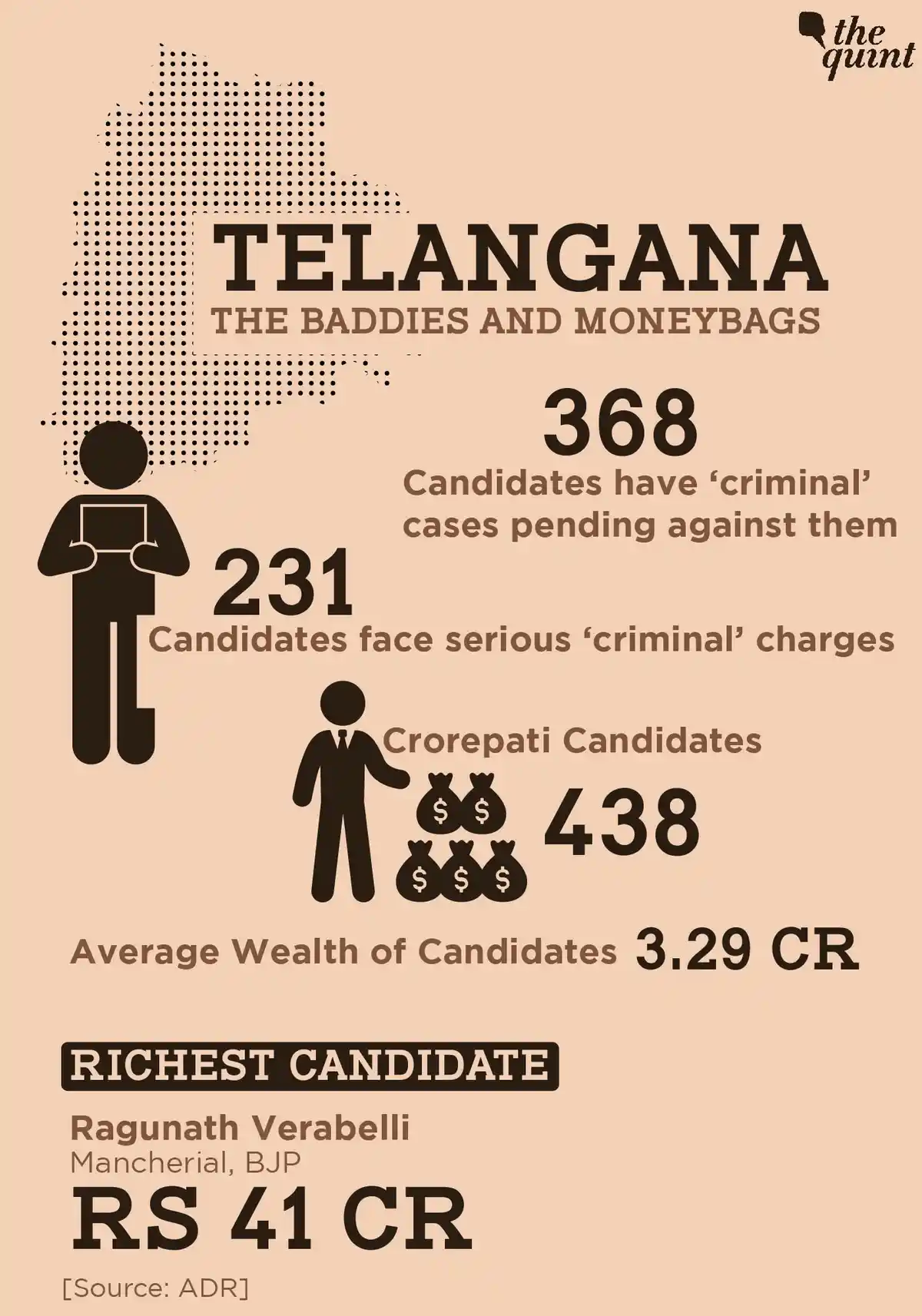
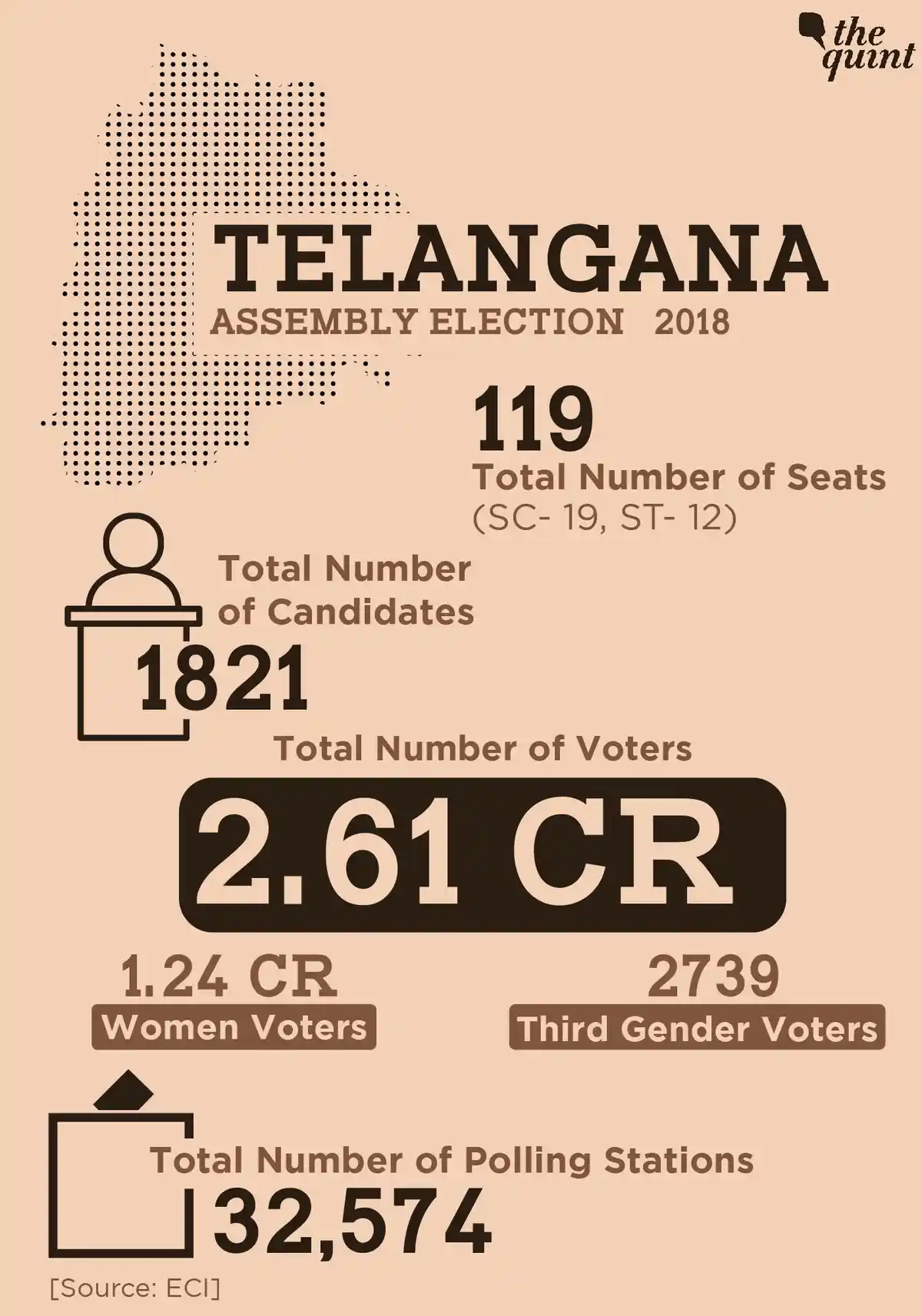
As many as 1,821 candidates including a transgender are in the fray in the election.

For the first time, Election Commission is using Voters Verifiable Paper Audit Trail (VVPAT) in Telangana.

224 video-surveillance teams and 133 video-viewing teams have been pressed into service.

Polling will start at 7 am and end at 5 pm, while in 13 constituencies which were classified as Left Wing Extremist-affected, polling ends one hour before (4 pm).

The TRS, seeking a second term in office, is going alone, as also the BJP.

The Congress has stitched together “Prajakutami” (People’s Front) along with the Telugu Desam Party (TDP), the Telangana Jana Samiti (TJS) and the CPI to take on the ruling TRS, led by caretaker Chief Minister K Chandrasekhar Rao (KCR).

The assembly polls in Telangana were originally scheduled to be held simultaneously with the Lok Sabha elections next year, but the House was dissolved on September 6 as per a recommendation by the state cabinet.

Security was beefed up at bordering areas which were identified as Left Wing Extremist-affected regions.

One lakh police personnel including 25,000 central paramilitary forces and 20,000 from other states are engaged in poll duties.

Campaigning by political parties came to an end at 5 pm Wednesday.

Over 2.80 crore electorate are eligible to exercise their franchise in the State, which has a total of 32,815 polling stations across.

More than 1.50 lakh polling officials including reserve staff are in the process of giving final touches Thursday to make the election to the 119-member House a smooth affair.

After a high-voltage campaign that saw war of words among contending parties, voting for the Assembly elections in Telangana will begin on Friday with the Congress-led alliance challenging the ruling TRS, and the BJP seeking to make it a triangular contest.


India’s youngest state, Telangana, goes to polls on Friday, 7 December, to constitute its second Legislative Assembly. The single-phase polling will see voting in all 119 constituencies.

The main contenders for this election remain to be the KCR-led TRS, which was in power for the last four years, and the Congress-led ‘Mahakutami’ (or ‘Grand Alliance’), which included the Telugu Desam Party (TDP) among many others.

  • Telangana is going to polls nearly seven months earlier as the TRS government dissolved the Assembly before its term ended
  • The Congress is considered the main Opposition in the state and is leading a grand alliance called ‘Mahakutami or Prajakutami’
  • TRS chief K Chandrashekar Rao will remain the caretaker chief minister till the new government is formed

What You Must Know About Telangana Polls 2018
What Do the Pre-poll Surveys Say?

The Aaj Tak-India Today survey predicts a massive victory for the Telangana Rashtra Samithi (TRS), with 43 percent voters predicted to cast their ballot for the KCR party. The Congress, on the other hand, is expected to garner 18 percent of vote share.

Interestingly, 11 percent of those surveyed wanted KCR to be the next prime minister, while 44 percent voted for PM Narendra Modi and 39 percent for Congress President Rahul Gandhi.

Another survey conducted by VDP Associates, claims that the TRS is all set to win at least 80 seats, while the Congress is expected to win around 20 seats. The survey predicts that the BJP will win seven seats, with the AIMIM getting eight.

The Main Contenders in Battlefield Telangana
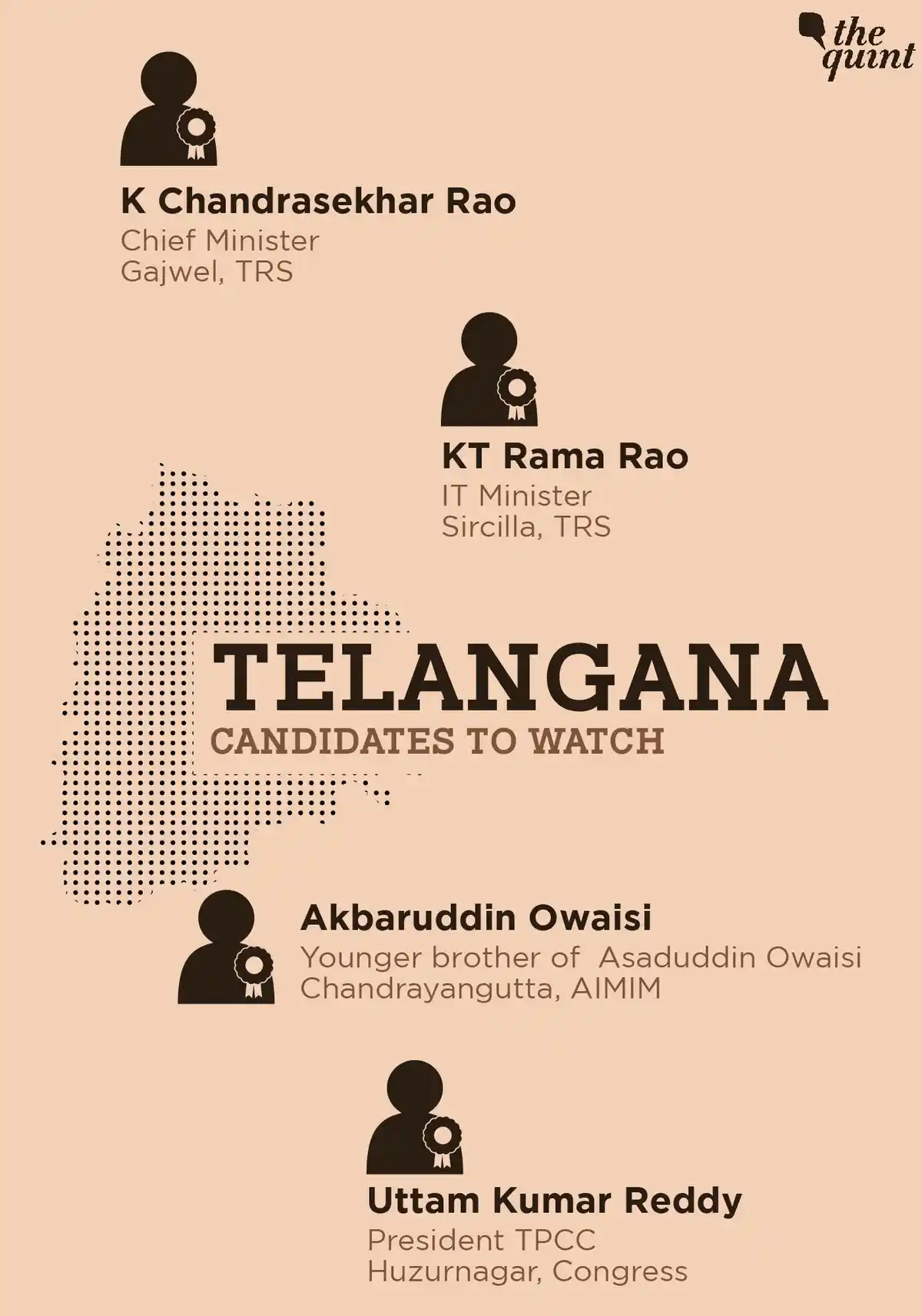
The main contenders for this election remain to be the KCR-led TRS, which was in power for the last four years, and the Congress-led ‘Mahakutami’ (or ‘Grand Alliance’), which included the Telugu Desam Party (TDP) among many others.

The BJP, although not a main contender, is expected to swing some percentage of vote share its way. In all, there are now as many as nine political parties vying for power in the state.

Early Polls in Telangana

A united Andhra Pradesh has voted for both state Assembly and the Lok Sabha at the same time — from 1999 till 2014. However, since August 2018, media reports suggested that KCR was getting ‘battle-ready’ to dissolve the Assembly and go to polls in winter 2018, along with Rajasthan, Madhya Pradesh, Chhattisgarh and Mizoram.

KCR dissolved the Telangana Assembly on 6 September, his supposed ‘lucky’ date.

Hours after dissolving the Assembly, he released a list of 105 candidates who will fight the elections from Husnabad, the very place he launched his 2014 campaign.


Disclaimer: RSS has been taken from their official website.
 

Telangana polls: TRS aims to use an eight-point election strategy to counter challenge posed by Mahakutami

As the Congress-led Opposition combine is battle-ready to take on the Telangana Rashtra Samithi (TRS) juggernaut, Telangana chief minister K Chandrashekar Rao (KCR) is embarking upon a comprehensive electoral strategy to frustrate the efforts of his rivals.

Such a strategy include the following:

1. Painting Mahakutami as proxy for Andhra Pradesh leadership

Painting the Congress-led Mahakutami as proxy for Andhra Pradesh leadership, TRS supremo KCR plans to revive the Telangana sentiment on the poll eve. The prime attack of TRS against the Mahakutami is on TDP. It is a calculated move on part of TRS as the Chandrababu Naidu-led TDP is a marginal player in the Congress-led alliance.

Unless the grand alliance wins the polls with a slender margin, the TDP will not have a decisive role in the Telangana government. Yet, TRS targets Congress for its alliance with TDP, describing it as an Andhra Pradesh party. Given the continuing differences between the two Telugu states post-bifurcation, and Andhra Pradesh chief minister and TDP president Naidu taking a position unpalatable to Telangana on a host of issues confronting the two states, TRS expects to rouse the Telangana sentiment again. TRS expects that Congress is therefore vulnerable to attack as Telangana electorate believes state TDP to be working under the dictates of the Andhra Pradesh chief minister.

2. Capitalising on dissidence within Congress

The Congress is facing dissidence in as many as ten constituencies among the first list of 65 candidates which the party has announced so far. In fact, Congress rivals expected the dissidence to be in more seats. However, TRS expects that the dissidence may mount as Congress and its allies release the full list of 119 candidates.

Though TRS also faced severe dissidence in as many as 30 seats, the ruling party could somehow manage it to a larger extent. The resource-rich ruling parties can always score over their Opposition rivals in such matters. Congress, which was busy finalising seat-sharing and selection of candidates, could not exploit the discontent in TRS over the selection of candidates, especially on the issue of re-nomination of almost all its sitting MLAs, many of whom face anti-incumbency. But now, the TRS leadership is strategising promoting rebels from the Opposition camp, especially from the Congress, by capitalising on the dissidence over seat-sharing and selection of candidates.

3. Micro-managing constituencies where Opposition has an advantage

The Congress camp feels that the first list has a large number of strong candidates if their individual capacity in winning the elections is concerned. The party spokesperson Dasoju Sravan Kumar said that majority of Congress candidates are two to three time MLAs, former MPs, former ministers and those who lost narrowly in 2014 when the Telangana sentiment was at its peak and the party was facing anti-incumbency after a ten-year-long spell in power.

Even the TRS leaders privately acknowledge this and claim that their leader KCR, who is a master strategist, will certainly have an effective strategy to neutralise this. TRS expects to undertake micro-management in identified constituencies where either Opposition candidates are strong or where TRS is facing internal dissonance.

4. Will Congress votes transfer to its allies?

TRS believes the Congress vote may not transfer to its allies — TDP, TJS and CPI. KCR called upon his party machinery to focus on such vulnerabilities of the Opposition conglomerate. Due to heavy competition for Congress candidature in many constituencies, the party finds it difficult to contain discontent in the seats allotted to allies. The problem is much more acute in the seats that are likely to be given to Communist Party of India (CPI) and the Telangana Jana Samiti (TJS) led by Professor Kodandaram.

Congress leaders feel that CPI and TJS nominees are not winnable candidates and the party has to make sacrifices for the sake of alliance even as the allies are still sulking over inadequate representation for them in the grand alliance. As the nomination process comes to an end, the confusion and commotion in the Congress-led grand alliance may come down.

Yet, TRS expects disgruntlement in the rank and file of different parties. Congress and TDP are historic rivals. Kodandaram, who led the Telangana Joint Action Committee (TJAC) that led the movement for a separate state, was very critical of Congress and TDP during the movement. Thus, TRS hopes that the vote transfer within the Congress-led alliance will not be complete, asserts Taduri Srinivas, TRS spokesperson.

5. Banking on government’s welfare schemes

Converting the beneficiaries of his government’s welfare schemes into vote banks forms the core of KCR’s electoral plank. KCR government’s welfare schemes like pensions for the old, widows, and the differently-abled, Kalyana Laxmi and Shaadi Mubarak, the financial assistance scheme at the time of a girl’s wedding, the Rythu bandhu, capital assistance of Rs 8,000 per acre etc are quite popular. Though there may be inadequacies and lapses in the implementation of welfare schemes, TRS still expects large a vote bank in the form of beneficiaries of these schemes.

6. KCR’s popularity

The field-level reports indicate that many of TRS members in the dissolved Assembly seeking re-election are hugely unpopular among the voters, even as KCR enjoys public support. Therefore, realising this folly, KCR intends to convert the election into a sort of a referendum on himself as his party and its MLAs face anti-incumbency to an extent. KCR’s son and the Minister for Information Technology KT Rama Rao, describing KCR as lion, said that there are as many as 20 chief ministerial aspirants in Congress and the leader will be chosen by Delhi and sent to Hyderabad in a sealed cover. This is a clear attempt to convert the election into a personality fight, with KCR having an edge.

7. Mobilising minorities and caste groups

Social engineering by targeting Muslim vote through understanding with MIM and mobilising specific caste groups is yet another strategy of KCR. In fact, the Assembly was prematurely dissolved to delink the state elections from Lok Sabha polls as KCR feared anti-Modi sentiment would drive the minority vote towards Congress. Similarly, through targeted welfare schemes, KCR tried to rally OBC voters, who were strong supporters of TDP in the united state.

8. KCR’s sharp speeches

KCR intends to disarm Opposition with bitter criticism. He is known for his sharp speeches. Involving the use of powerful Telangana slang is the cynosure of TRS campaign. The chief minister has already addressed few public meetings and is expected to undertake a whirlwind tour of the state. Thus, he wants to set an election agenda, making the Opposition follow him.


Note: RSS Feeds taken from Respective Websites.

Telangana polls: TRS aims to use an eight-point election strategy to counter challenge posed by Mahakutami

As the Congress-led Opposition combine is battle-ready to take on the Telangana Rashtra Samithi (TRS) juggernaut, Telangana chief minister K Chandrashekar Rao (KCR) is embarking upon a comprehensive electoral strategy to frustrate the efforts of his rivals.

Such a strategy include the following:

1. Painting Mahakutami as proxy for Andhra Pradesh leadership

Painting the Congress-led Mahakutami as proxy for Andhra Pradesh leadership, TRS supremo KCR plans to revive the Telangana sentiment on the poll eve. The prime attack of TRS against the Mahakutami is on TDP. It is a calculated move on part of TRS as the Chandrababu Naidu-led TDP is a marginal player in the Congress-led alliance.

Unless the grand alliance wins the polls with a slender margin, the TDP will not have a decisive role in the Telangana government. Yet, TRS targets Congress for its alliance with TDP, describing it as an Andhra Pradesh party. Given the continuing differences between the two Telugu states post-bifurcation, and Andhra Pradesh chief minister and TDP president Naidu taking a position unpalatable to Telangana on a host of issues confronting the two states, TRS expects to rouse the Telangana sentiment again. TRS expects that Congress is therefore vulnerable to attack as Telangana electorate believes state TDP to be working under the dictates of the Andhra Pradesh chief minister.

2. Capitalising on dissidence within Congress

The Congress is facing dissidence in as many as ten constituencies among the first list of 65 candidates which the party has announced so far. In fact, Congress rivals expected the dissidence to be in more seats. However, TRS expects that the dissidence may mount as Congress and its allies release the full list of 119 candidates.

Though TRS also faced severe dissidence in as many as 30 seats, the ruling party could somehow manage it to a larger extent. The resource-rich ruling parties can always score over their Opposition rivals in such matters. Congress, which was busy finalising seat-sharing and selection of candidates, could not exploit the discontent in TRS over the selection of candidates, especially on the issue of re-nomination of almost all its sitting MLAs, many of whom face anti-incumbency. But now, the TRS leadership is strategising promoting rebels from the Opposition camp, especially from the Congress, by capitalising on the dissidence over seat-sharing and selection of candidates.

3. Micro-managing constituencies where Opposition has an advantage

The Congress camp feels that the first list has a large number of strong candidates if their individual capacity in winning the elections is concerned. The party spokesperson Dasoju Sravan Kumar said that majority of Congress candidates are two to three time MLAs, former MPs, former ministers and those who lost narrowly in 2014 when the Telangana sentiment was at its peak and the party was facing anti-incumbency after a ten-year-long spell in power.

Even the TRS leaders privately acknowledge this and claim that their leader KCR, who is a master strategist, will certainly have an effective strategy to neutralise this. TRS expects to undertake micro-management in identified constituencies where either Opposition candidates are strong or where TRS is facing internal dissonance.

4. Will Congress votes transfer to its allies?

TRS believes the Congress vote may not transfer to its allies — TDP, TJS and CPI. KCR called upon his party machinery to focus on such vulnerabilities of the Opposition conglomerate. Due to heavy competition for Congress candidature in many constituencies, the party finds it difficult to contain discontent in the seats allotted to allies. The problem is much more acute in the seats that are likely to be given to Communist Party of India (CPI) and the Telangana Jana Samiti (TJS) led by Professor Kodandaram.

Congress leaders feel that CPI and TJS nominees are not winnable candidates and the party has to make sacrifices for the sake of alliance even as the allies are still sulking over inadequate representation for them in the grand alliance. As the nomination process comes to an end, the confusion and commotion in the Congress-led grand alliance may come down.

Yet, TRS expects disgruntlement in the rank and file of different parties. Congress and TDP are historic rivals. Kodandaram, who led the Telangana Joint Action Committee (TJAC) that led the movement for a separate state, was very critical of Congress and TDP during the movement. Thus, TRS hopes that the vote transfer within the Congress-led alliance will not be complete, asserts Taduri Srinivas, TRS spokesperson.

5. Banking on government’s welfare schemes

Converting the beneficiaries of his government’s welfare schemes into vote banks forms the core of KCR’s electoral plank. KCR government’s welfare schemes like pensions for the old, widows, and the differently-abled, Kalyana Laxmi and Shaadi Mubarak, the financial assistance scheme at the time of a girl’s wedding, the Rythu bandhu, capital assistance of Rs 8,000 per acre etc are quite popular. Though there may be inadequacies and lapses in the implementation of welfare schemes, TRS still expects large a vote bank in the form of beneficiaries of these schemes.

6. KCR’s popularity

The field-level reports indicate that many of TRS members in the dissolved Assembly seeking re-election are hugely unpopular among the voters, even as KCR enjoys public support. Therefore, realising this folly, KCR intends to convert the election into a sort of a referendum on himself as his party and its MLAs face anti-incumbency to an extent. KCR’s son and the Minister for Information Technology KT Rama Rao, describing KCR as lion, said that there are as many as 20 chief ministerial aspirants in Congress and the leader will be chosen by Delhi and sent to Hyderabad in a sealed cover. This is a clear attempt to convert the election into a personality fight, with KCR having an edge.

7. Mobilising minorities and caste groups

Social engineering by targeting Muslim vote through understanding with MIM and mobilising specific caste groups is yet another strategy of KCR. In fact, the Assembly was prematurely dissolved to delink the state elections from Lok Sabha polls as KCR feared anti-Modi sentiment would drive the minority vote towards Congress. Similarly, through targeted welfare schemes, KCR tried to rally OBC voters, who were strong supporters of TDP in the united state.

8. KCR’s sharp speeches

KCR intends to disarm Opposition with bitter criticism. He is known for his sharp speeches. Involving the use of powerful Telangana slang is the cynosure of TRS campaign. The chief minister has already addressed few public meetings and is expected to undertake a whirlwind tour of the state. Thus, he wants to set an election agenda, making the Opposition follow him.


Note: RSS Feeds taken from Respective Websites.

TRS questions Congress volte-face

The TRS struck at the very foundation of the Congress-led ‘Mahakutami’ on Monday, questioning the premise on which the ‘unholy’ alliance was formed.

In a series of tweets, IT and Industries Minister K T Rama Rao asserted that the TRS entered into an alliance with the Congress and Telugu Desam Party in 2004 and 2009, respectively, only after the two parties agreed in writing to the main demand of statehood for Telangana.

“What’s the basis for the hypocritical alliance of TDP & INC now in Telangana? Other than sheer opportunism & power mongering,” Rama Rao tweeted, ridiculing the coming together of Congress, TDP, CPI and the TJS under the Mahakutami umbrella.

The Minister also recalled Andhra Pradesh Chief Minister and TDP president N Chandrababu Naidu’s 2014 tweet where he said: “Our aim is to make nation free of corrupt Congress. Will do whatever is best to ensure it.”

“Famous last words. Another pearl of wisdom from CBN Garu,” the Minister wrote on his Twitter handle. The Minister went on to slam the alliance, stating: “If Scamgress leaders Rahul & Sonia didn’t do squat for Telangana development till 2014, what changed since then? So the “Italian Mafia Raj” (as described below) has new friends now. Guess who it is? Now you know why I call it #MahaGhatiyaBandhan.”

Earlier in the day, Irrigation Minister T Harish Rao also sought to deflate the perceived hype over Mahakutami with a missive loaded with a dozen questions.

Harish’s posers

In a four-page open letter to TPCC president N Uttam Kumar Reddy, Harish Rao, coming down heavily on the ‘unholy’ alliance, asked the latter to clarify whether the Congress-TDP-CPI-TJS alliance was conditional. “Did the TDP president and Andhra Pradesh Chief Minister N Chandrababu Naidu give an assurance that he would give up his anti-Telangana stand and has he agreed to withdraw cases/objections raised against irrigation projects taken up by the Telangana government, before you agreed to enter into an alliance with him,” the Minister asked.

The Minister, who released the letter to the media at a press conference here, said the people of Telangana were upset with the alliance as they fear Naidu will continue with his arm-twisting tactics to influence decisions of the Telangana government in favour of Andhra Pradesh, especially with regard to river water sharing. He raised pending issues between the Andhra Pradesh and Telangana governments pertaining to irrigation projects, returning seven mandals in erstwhile Khammam district to Telangana, and division of the High Court and other assets. On all these issues, Naidu has been adamant and was not extending any cooperation to get them resolved, he said, wondering what then was the objective behind the alliance.
Charge against Cong

“Congress leaders have compromised the future of the State to fulfil their political ambitions by entering into an alliance with Naidu. The TDP president vehemently opposed statehood for Telangana and continues to hinder development in Telangana State by raising objections and filing cases against our irrigation projects and other programmes,” the Minister said.

Harish Rao accused Naidu of acting against the interests of Telangana and doubted if the latter would change his stand, considering his political interests in Andhra Pradesh. He pointed out that due to similar political interests of Andhra leaders, people of Telangana suffered in undivided Andhra Pradesh for six decades, prompting the TRS to fight for separate Telangana State. “As a responsible political party, Congress should clarify on these issues and convince Naidu to address these issues under their Common Minimum Programme before fighting the elections,” he demanded.

Advice to Kodandaram

Harish Rao stated that Naidu was allying with the Telangana Congress and other parties to influence the Telangana administration in favour of Andhra Pradesh. He advised Telangana Jana Samithi president M Kodandaram not to ally with TDP and put the fate of four crore people in Telangana State in the hands of Naidu.

Government Chief Whip in Council Paturi Sudhakar Reddy, Whip Bodakunti Venkateshwarlu and former MLAs Madan Reddy and Chinta Prabhakar were present.


Disclaimer: RSS has been taken from their official website.