


As Indians go to the polls in the coming weeks, they will be voting on whether to enable Prime Minister Narendra Modi to continue his ambitious economic reform program of the largest democracy on Earth. Unlike China’s authoritarian Xi Jinping, whose economy has been expanding at a slower rate than India’s—indeed China is in the throes of a secular growth decline—during Modi’s first term, he helped engineer India to become in 2018 one of the world’s top three fastest growing economies. Today, the International Monetary Fund (IMF) forecasts India to exhibit even higher growth in the coming years.
While that achievement should be reason enough for Indians to support Modi’s stay in office, the divisiveness that has been characteristic of the subcontinent’s political fabric has been weighing down Modi’s prospects to win a second the race. As luck would have it, however, recent trade policy attacks on India by U.S. President Donald Trump could well provide Mr. Modi with just the ammunition he needs to mollify his opponents.
Modern economic history around the world is replete with examples where robust reformers confront intensified political challenges as their programs begin to take hold. Modi is no exception to that rule. The structural policies he put in place during his first term are now engendering pain—most notably enlarged unemployment—before they’re able to substantially deliver their transformational gains. The result is Modi’s poll numbers are slipping. Populations rarely vote on ‘present value’ terms—the economists’ notion that down-payments made today are needed to enable even larger payoffs in the future.
| BE HEALTHY
  |
BEST PRODUCTS FOR BEST LIFE
BE HOT
  |
BE SMART
  |
Worse still for Modi is that in contrast to the political dynamics in 2014, when his Bharatiya Janata Party (BJP) was able to win an outright majority, today the numerous opposition parties that fractured back then, now appear to be coalescing.
The temptation for politicians in such circumstances is to veer towards a more populist stance even if it runs against the grain of their platform. Modi is certainly imbued with a populistic streak. But, overall, his policies have achieved a comparatively balanced market-oriented approach. That strategy has been one of the secrets of his success.
Financial markets and investors—both in India and abroad—would not look kindly on Modi if he were to now shift far to the left for political expediency. And they should. Why? Because there is little question that India has experienced a high annual growth rate in real GDP during the time Modi has been in office. Growth rose from 6.4% in 2013 to 8.2% in 2015; dipped to 7.1% in 2016 and further to 6.7% in 2017, but rebounded to 7.3% in 2018. For 2019, the IMF projects India will grow 7.5%, and in 2020 grow at 7.7%.
To be sure, this performance has been driven, in part, by a slower pace of monetary tightening than previously expected due to the easing of India’s inflation pressures. At the same time, India has benefitted from relatively low world oil prices; after all, the country imports about 80% of its crude oil needs.
But what has been an even more important driver of India’s growth is the confidence Modi’s reforms have inspired in domestic and foreign economic players. It’s true that there’s nothing like investor confidence to drive an economy.
The data on foreign investment show this to be the case for India. In absolute terms, India’s foreign direct investment (FDI) inflows rose from US$27 billion in 2010 to US$40 billion in 2017, a 48% increase. (By contrast, FDI inflows to China fell 31% over the same period: from US$244 billion in 2010 to US$168 billion in 2017). Taking into account the size of India’s economy, FDI inflows as a share of GDP in 2017 was 1.54%. (China’s FDI inflows as a share of GDP was 1.38% in 2017 and the comparable statistic for the U.S. is 1.83%.)
Modi has made no secret of the fact that he’s intent on overhauling a supremely complex, multi-layered, ossified economy—a direct result of the fact that, apart from the early 1990s, in our lifetimes, India has been subjected to comparatively limited systematic microeconomic reform of its real sector. To this end, Modi and his economic team have made some clever policy moves since coming to office. They’ve developed a blueprint of domestic reforms that if well-executed could arguably begin to finally fundamentally modernize the Indian economy.
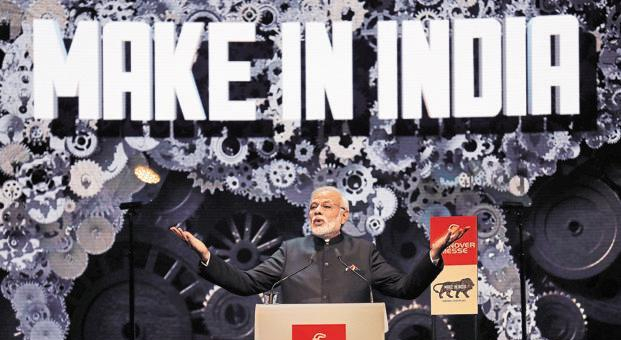
But realistically this is a big “if”, especially in light of a slothy, shadowy and highly protectionist parliament in Delhi that is decades out of date with today’s global economy. And, it is the Parliament which with Modi will have to deal to get reform legislation passed. In truth, it is also the case there is skepticism about the extent of Modi’s own belief in the power of market incentives to drive and sustain needed domestic reforms within the rubric of his “Make in India” banner.
The number of reforms implemented by Modi is sizeable. While not all are breathtaking, it would be unreasonable to not be impressed with what has been accomplished to date. Some of the more notable reforms include:
(i) enacting a revised law on bankruptcy to facilitate freer flows of capital and the flexibility for them to be invested in their highest value in use;
(ii) introducing a nationwide sales tax to integrate an otherwise excessively complicated disparate system of different state and federal taxes;
(iii) eliminating subsidies for diesel fuel to help plug a fiscal hole and more importantly create disincentives for using an energy source that adds to pollution—a severe problem in Indian cities;
(iv) removing regulations that forced companies to repetitively renew their business licenses at an artificially high frequency;
| BE HEALTHY
|
BEST PRODUCTS FOR BEST LIFE
BE HOT
|
BE SMART
|
(v) relaxing rules that reserved specific sectors to SMEs even if large firms could produce the goods or deliver the services at lower cost and create economies of scale; and
(vi) opening investment in the railway network to majority foreign ownership.
Without question, the most widely publicized reform that Modi has implemented—and for which he has been criticized most heavily—is the decision to take out of circulation large bank notes. The measure was announced with little warning, and once executed, caused havoc in local markets around the country. Modi’s team did do a poor job explaining the rationale for the measure in a way that the working and middle class might understand. But to be frank, if experience in other countries is any guide–including the U.S.–that can be an elusive goal.
The reform did exact costs. But these costs had to be faced sooner or later. Any way you cut it, there would be a backlash. In fact, most economists would agree that the longer a needed reform is put off into the future, the costs of reform will get only larger and larger. And no matter when the reform takes place, the benefits would not come immediately, and moreover, they would be diffused economy-wide.
Modi’s announce rationale for this move was to reduce opportunities for corruption (which largely come about through informal cash exchanges). But the real driver behind Modi’s re-monetization policy was broader: he is intent on moving the subcontinent to become a market characterized by economic integration and uniformity, and ideally increasingly cashless.
These are exactly the critical planks under which a geographically huge country such as India can not only begin to build economic clusters that have the scale to reduce production costs, but also to foster vibrant internal trade among India’s 29 states and 7 union territories and ultimately enhance the country’s competitiveness in the world marketplace. The economic history of the U.S. building its large internal economic space is clearly in Modi’s mind.
Of course, this does not mean that more reforms by Modi could have been implemented. Indeed, by all accounts he is intent on doing much more.
However, with his poll numbers currently softening, he is on a knife’s edge as to how to secure the opportunity from Indian voters to be able to continue his work. Will he now be forced to turn his policies into a more populist direction in the remaining period before the election? Luckily for Modi, manna does seem to have fallen from heaven.
Against the backdrop of already strong trade tensions with the U.S.—primarily over U.S. steel and aluminum imports from India and Washington’s tightening of H1 visas; and Delhi’s requirements for foreign firms to use domestic payment networks and Indian tariffs on Harley Davidson motorcycles and whiskey—on March 4th, U.S. President Trump’s announced the U.S. would unilaterally hike tariffs on Indian imports by demoting India from the favorable treatment the U.S. has accorded it under Washington’s Generalized System of Preferences (GSP) program. This may have given Mr. Modi just the gift he needed to obviate making a concocted campaign pivot. Indeed, despite the obvious convenience of using Trump as a scapegoat, Modi would be wise not go overboard on this score and refrain from making substantive protectionist policies in retaliation for the proposed GSP change.
Why? Because most of India’s exports to the U.S. fall outside of GSP, and those where it does pertain, are low value Indian goods that account for less than US$200 million per year—hardly significant compared to the US$127 billion of annual Indian-US trade flows. Moreover, GSP is not a reciprocal program under the WTO, and thus Modi would have no legal basis on which to retaliate against the U.S. Indian workers, businesses and consumers would see through this tactic. Worse, the U.S. will likely urge them on. Thus, any move by Modi on this score will likely backfire.
But if Modi is as clever as he seems, he won’t go down this road. After all, such a change in trade policy would jeopardize India’s growth trajectory. Modi will not want to risk that. Instead, he would be wise to just judiciously turn up the rhetoric for campaign purposes. That’s just the kind of strategy that could earn him another term in office.
| BE HEALTHY
|
BEST PRODUCTS FOR BEST LIFE
BE HOT
|
BE SMART
|
Disclaimer: RSS has been taken from their official website.
20.593684
78.962880




 Mar 31, 2019







 india politics 2019
PM Modi to address three rallies in Odisha, Telangana and Andhra Pradesh today
The Prime Minister will be visiting three states today — Odisha, Telangana and Andhra Pradesh — to address rallies after he kicked off his poll campaign with three rallies yesterday. Stay tuned on our website for updates on his rallies.
‘Delhi as important to me as other states of the country’
On being asked if he’s now become a part of Lutyens Delhi, PM Modi says, “I’ve found my family in as well as out of Delhi. I’ve taken Delhi outside, and the capital is as important to me as Chennai, Bhubaneshwar and Gujarat. Whether Delhi accepts me or not, I’ve taken Delhi to every corner of the country.” As the interview concludes, PM Modi seizes the opportunity to urge people to come out in numbers and vote during the upcoming Lok Sabha elections.
BE HOT
“I remained calm and addressed rally over phone”, recounts PM Modi after receiving information on Pulwama attack
PM Modi to Republic Bharat: “I was in Uttarakhand on a pre-scheduled visit on the day Pulawama attack happened. I got the information about the attack and decided to address the rally over the phone but restrained myself from immediately mentioning about the incident of such magnitude.”
Country is supreme and law will take care of anything that is threat to the country: PM Modi
On being slammed by Maoists, militant groups for his actions, PM Modi says: “The country is supreme and anything that is threat to the country, the law will take care of it. If people want to accuse me, they engage in the mud-slinging. ”
PM Modi to Republic Bharat:It is Congress’ tactic to keep repeating the ‘poverty scheme’ ideology before polls
“Nehru ji spoke about poverty, so did Rajiv ji, and then Sonia Gandhi followed suit and now even Rahul Gandhi, the fifth generation from their family is doing the same. It is their ideology that they keep repeating whether in 2004, then again in 2009. Look at their tactic; it is about repeating the same agenda over and over again.”
PM Modi responds to accusations of trying to control top institutions of the country
“Those who have seen my tenure as CM of Gujarat in the past 13-14 years, they won’t accuse me of trying to control the judiciary and parliament. I’ve been silent all this while but should I question as to who ordered for the Emergency? Who jailed political leaders? Who stabbed their own father in law? Please not make me open my mouth.”
PM Modi to Republic Bharat: Dynastic politics is not my problem, but a threat to Indian democracy
Commenting on dynastic politics, PM Modi said, “It is not my problem, but dynastic politics is a major threat to India’s democracy. The parties which are run by families, the country cannot function out of the families control. The party which works as a personal company where no one else can come in as President, this is wrong. It is the responsibility of media houses like you to bring out such dynastic political families.
‘People have suffered for 30 years and enjoyed in the past 5 years, hence we are confident of the upcoming polls’
PM Modi to Republic Bharat: “There are three points we are sure of- 1. We will come in full majority; 2. NDA and BJP will come in power in more seats; 3. As a responsible citizen, and as a prime minister for the past 5 years, I would say I want to work with whoever becomes victorious. In politics, everyone must work together. The people of this country suffered for 30 years but enjoyed in the past 5 years which makes me confident of the upcoming polls.”
People of the country have decided to give us full majority, then how can Opposition keep us out?: PM Modi on Mahagatbandhan
PM Modi to Republic Bharat: Regarding the Mahagatbandhan, PM Modi says, “In Bengal, Kerala and Odisha, has there been any understanding between the Opposition parties then how is the gatbandhan working? It is not yet happening. If people of this country have decided to give us the majority, then who can keep us out even if they decide to ally up after the polls are done? The country has made its decision to ensure full majority and reinstate the NDA government, no one can question that.”
PM Modi to Republic Bharat:”We could have taken political route on Robert Vadra, but we decided to let the legal system work its way”
On Robert Vadra’s investigation, “In India, there is a proper system of law. Congress has received a number of notices from the Court, but they take their own sweet time to respond. If we had to take the political route, we could have but we cannot and we have to ensure we follow the judicial system and it will the investigation is working at the right pace.”
Because of our strict action, the fugitives have had to flee. They have become bankrupt: PM Modi on Nirav Modi, Vijay Mallya
PM Modi to Republic Bharat: On fugitives, Nirav Modi, Vijay Mallya and Mehul Choksi fleeing, PM Modi says, “The Opposition is slamming us on the basis of these fugitives but it is because of our strict actions in the country that they have had to flee. But do you realise, we have come down severely on their assets, and they have had to run because of our actions. During Opposition rule, you would not have even known the names of such fugitives, leave alone know what happened to them and what action was taken against them.
For people to decide if they want someone who owns 250 pair of clothes or has Rs 250 crore in account: PM Modi
Recounting one of the accusations against him by the Opposition about owning 250 pair of clothing, he says, “I had a public meeting that day which could mean the 0 was wrong, or 5 was wrong or 2 was wrong. Even if their accusations are wrong, I want to accept it. I’ve heard your relatives and you have earned Rs 250 crore and now the public can make your choice if they want Rs 250 crore leader or a leader who owns 250 pair of clothing.”
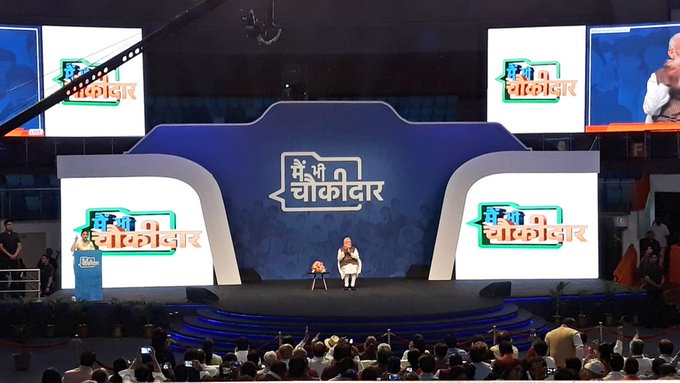
On ‘Main Bhi Chowkidar’ campaign, Modi says: ‘Not a Chowkidar literally, but in spirit’
On the PM Modi’s ‘Main Bhi Chowkidar’ campaign, PM Modi to Republic Bharat: “I’ve been the longest serving Chief Minister of Gujarat. Yes, I’m a chaiwala and my past was never spoken about during my tenure as chief minister. But when I was elected as the Prime Minister, they started raising these issues while I proudly said that I was a chaiwala. As far as Chowkidar is concerned, it is a word I used for myself during 2011-2012 poll campaign too. Mahatma Gandhi also during his time had qualities of being a Chowkidar, not literally but in the spirit to ensure safety and security of the country.”
PM Modi to Republic Bharat: Pakistan assured us they will take action, but we have hardly seen anything happen from their end
Regarding PM Khan trying to contact PM Modi, he says, “Pakistan has constantly tried to assure that they will take action, but we hardly see anything happening from their end. So I’ve stopped responding to their assurances. Regarding the 26/11 attacks, we had given them a detailed dossier, but there was no response again. When PM Khan was elected, I congratulated him and I’ve taken steps for cordial talks but where is the action? It’s good that PM Khan is doing good things for his citizens, but what is necessary right now is for Pakistan to come out of terrorism.”
PM Modi takes a swipe at the Opposition
BE HOT
PM Modi attacks Opposition and says, “We can debate on the gas connections provided, house built and bank accounts opened with the Opposition. When I speak on progress, they change the topic and pick other issues. We are the government that works 24 hours and these are issues that matter to us but they keep talking about the same thing over and over again. It is unfortunate that when Abhinandan Varthaman was detained in Pakistan, the Opposition started questioning the Balakot air strike and regarding his return. It was their plan and they were going to bring out a ‘candle light march’ for it.”
I was awake throughout and in constant touch with the jawans during Balakot air strike, shares Prime Minister
PM Modi to Republic Bharat: On Balakot air strike, Modi says, “It is my behaviour, where there is a risk to the jawans of India, I’m constantly involved it. There is no expectation from their end, but I could not sleep and I was aware of what was happening.” Regarding the Opposition’s ‘personal attack’ and saying the Pulwama attack, as well as Balakot air strikes, was ‘match fixing’ between PM Khan and PM Modi, he says: “No one can question my patriotism for my country. Everyone was aware of how big the attack was, but you should question the Opposition regarding such personal attacks. If they are sure of what they are blaming us for, they can go ahead with this as their agenda for the polls.”
We are successful because of the trust Indians place in us: PM Modi
PM Modi to Republic Bharat: “Whatever we have been able to successfully execute in the past 5 years, it is because of the trust Indians place in us. We came into power with a sweeping majority, which shows the consent of the people and as of what I understand of politics, people have understood what Modi can do for them, what are the changes our government can bring in, how BJP can help the country progress. There are some spheres where India feels we lack, but we are sure that Indians won’t let us down.”