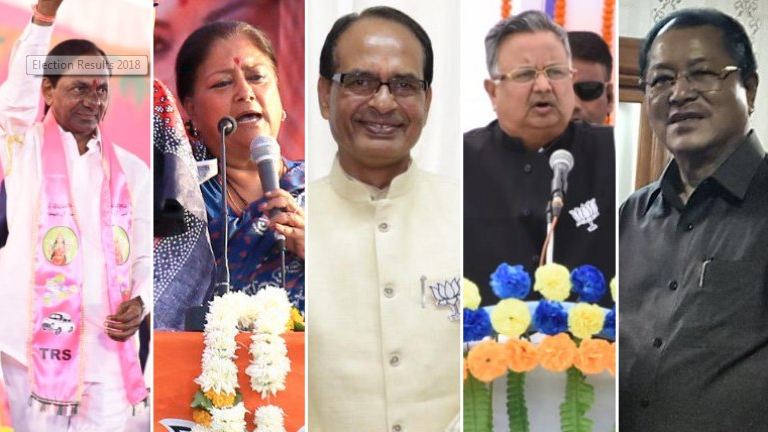
Election Results LIVE 2018 – Madhya Pradesh, Telangana, Rajasthan, Chhattisgarh, Mizoram

@ 5.45 p.m

This slideshow requires JavaScript.

–Congress looks strong in Rajasthan, leading in 20 seats. With lead in 17 seats, TRS consolidates position in Telangana.

–30 minutes into counting, TRS ahead in early leads – Jogu Ramanna leads in Adilabad


14.JPG

Close fight between the BJP and Congress in Chhattisgarh and Madhya Pradesh. Congress takes big early lead in Rajasthan. TRS leads in Telangana.


The results for assembly elections to five states – Madhya Pradesh, Rajasthan, Telangana, Mizoram and Chhattisgarh – will be declared tomorrow. The time of the start of vote counting is 8 am. Election trends will start coming out soon. The election results 2018 are important as it may impact 2019 general elections. All the major political parties would want to end the year on a winning note.

The Election Commission of India has made all the necessary arrangements for the poll results. In Telangana, the Chief Electoral Officer said necessary arrangements have been made for the counting day and the strongrooms, where voting machines are kept, are secured with central paramilitary forces providing. Here are the answers to some of the questions related to assembly election results.

Election result date: The election results 2018 will be announced on December 11.

Election results time: The counting will begin at 8 am. The results will be declared in the evening.

Where to watch election news coverage: Election Coverage starts when counting begins

The Telangana election results, the Madhya Pradesh election results, theRajasthan election results, the Chhattisgarh election results and Mizoram election results will announced tomorrow by the Election Commission.

Exit polls for five states in elections have predict a worrying outcome for the BJP in three heartland states, Madhya Pradesh, Chhattisgarh and Rajasthan. An aggregate of exit polls shows the BJP’s winning streak is set to end in Madhya Pradesh and Chhattisgarh, both heading for hung verdict.


Disclaimer: RSS has been taken from their official website.

Rajasthan Elections LIVE : Final Voter Turnout Of 74.21 Per Cent

10.30 a.m

4


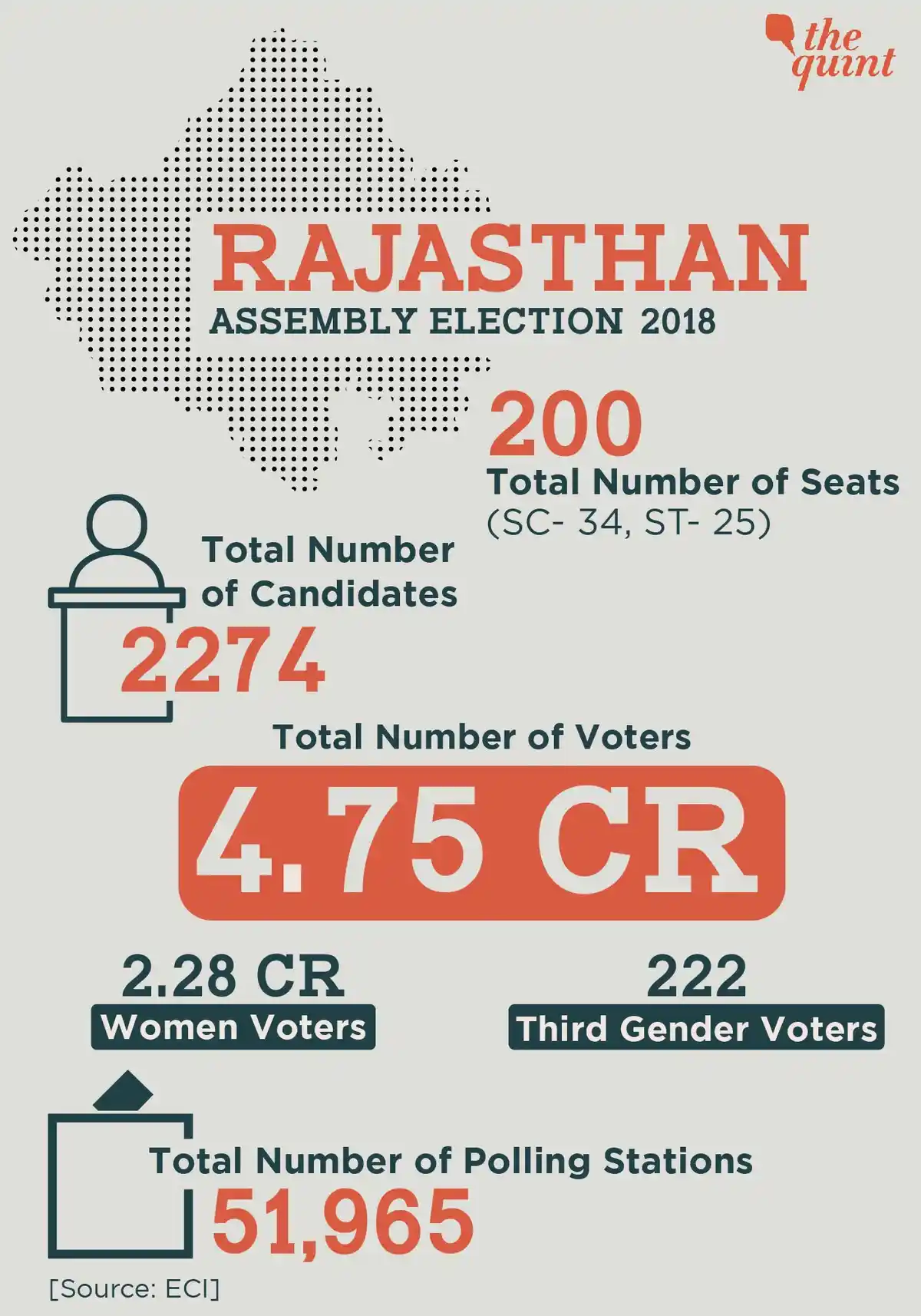
Voting for 200 seats in the Rajasthan assembly election will start at 8 am. The Bharatiya Janata Party (BJP) is facing a major challenge as the northern state has always voted out the incumbent government for more than two decades. Chief Minister Vasundhara Raje, however, is looking to hold on to power by riding on her government’s schemes and the work it has done for the people of Rajasthan. The Congress is counting on anti-incumbencyto win in Rajasthan. In the last round of by-elections in February, the Congress wrested the Ajmer and Alwar Lok Sabha seats and the Mandalgarh assembly seat from the BJP. The votes for Rajasthan will be counted on December 11 along with Mizoram, Madhya Pradesh, Telangana and Chhattisgarh.

Here are the live updates for Rajasthan assembly election:

Final Voter Turnout Of 74.21 Per Cent

59.43% voter turnout in Rajasthan till 3pm

District wise voter turnout till 3.00 pm

Ajmer: 56%
Alwar: 60%
Barmer: 59%
Bharatpur: 62%
Bikaner: 59%
Chittorgarh: 67%
Churu: 58%
Jhalawar: 62%
Tonk: 57%
Udaipur: 60%

41.37 per cent voter turnout in Rajasthan till 1pm

22.01 per cent voter turnout till 11am across Rajasthan

Voter turnout in Rajasthan till 9am is 6.11 per cent

Vasundhara Raje casts her vote, slams Sharad Yadav for body-shaming
“I am extremely shocked,” she said on Bihar politician Sharad Yadav’s comment on her weight that was seen as body-shaming. “It is very important that Election Commission takes notice of the remark. I feel insulted. Women are insulted,” Rajasthan Chief Minister Vasundhara Raje said after casting her vote at pink polling booth No. 31A at Jhalrapatan constituency in Jhalawar.
Rajasthan Chief Minister Vasundhara Raje of the BJP is scheduled to cast her vote at 8:15 am for the Rajasthan assembly election. She is counting on her government’s programmes to fetch her a large number of votes, enough to keep her in power for another term. The Congress is hoping anti-incumbency will work in the northern state.

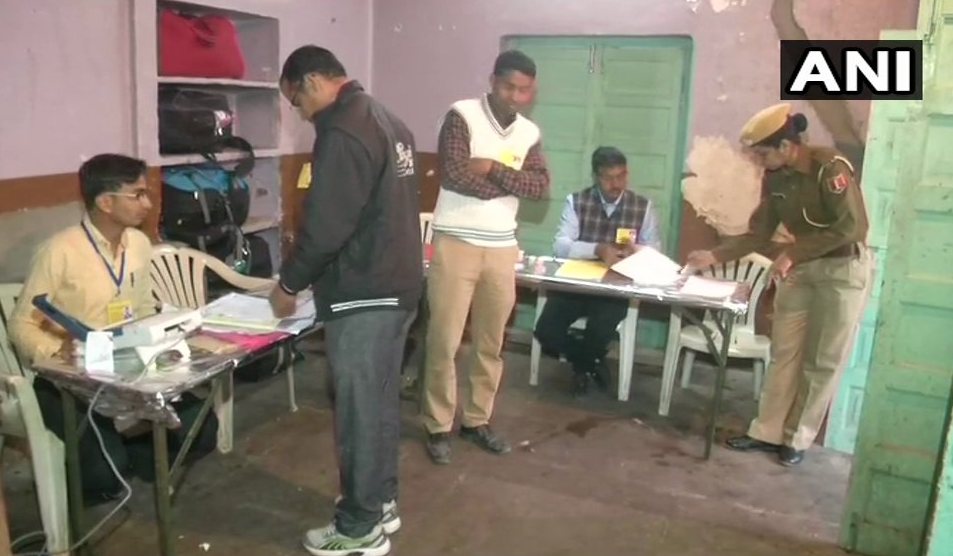
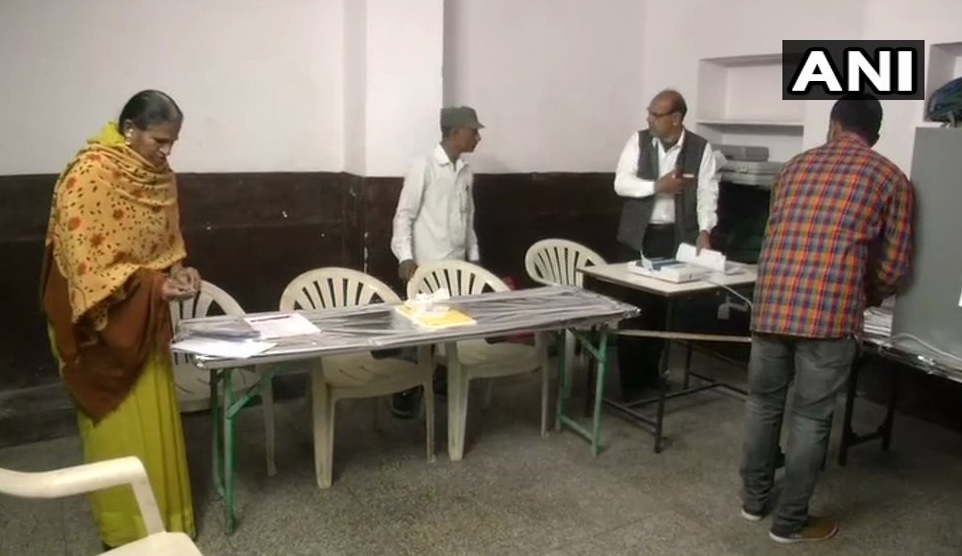
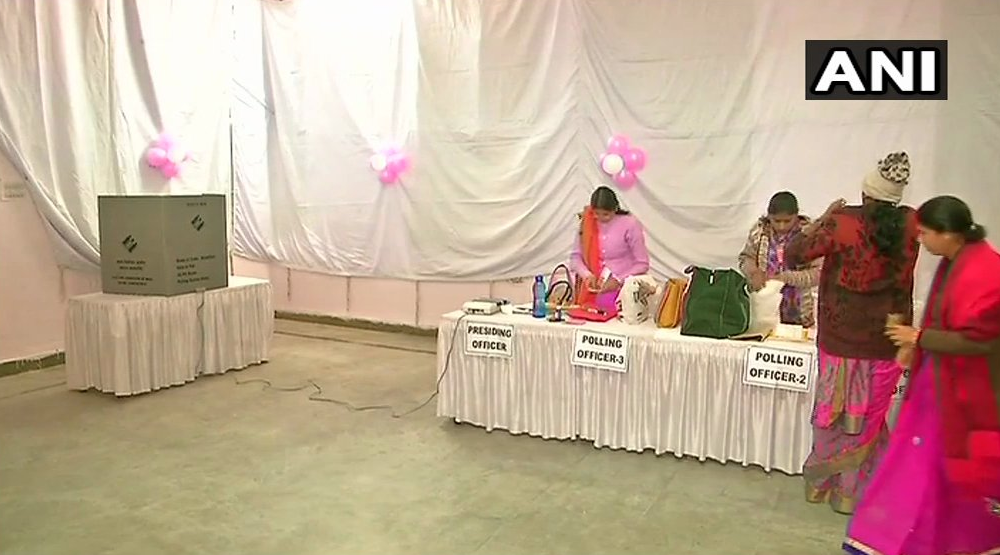
Mock polling being conducted at booth No. 106 in Jodhpur’s Sardarpura constituency. Voting for the Rajasthan assembly election will start at 8 am.

Election official prepare to receive voters at a polling booth in Jodhpur. Voting for the Rajasthan assembly election will start at 8 am.

The counting of votes will take place on December 11. The results of three other states – Madhya Pradesh, Chhattisgarh and Mizoram – will be announced on the same day.


No chief ministerial candidate in Congress
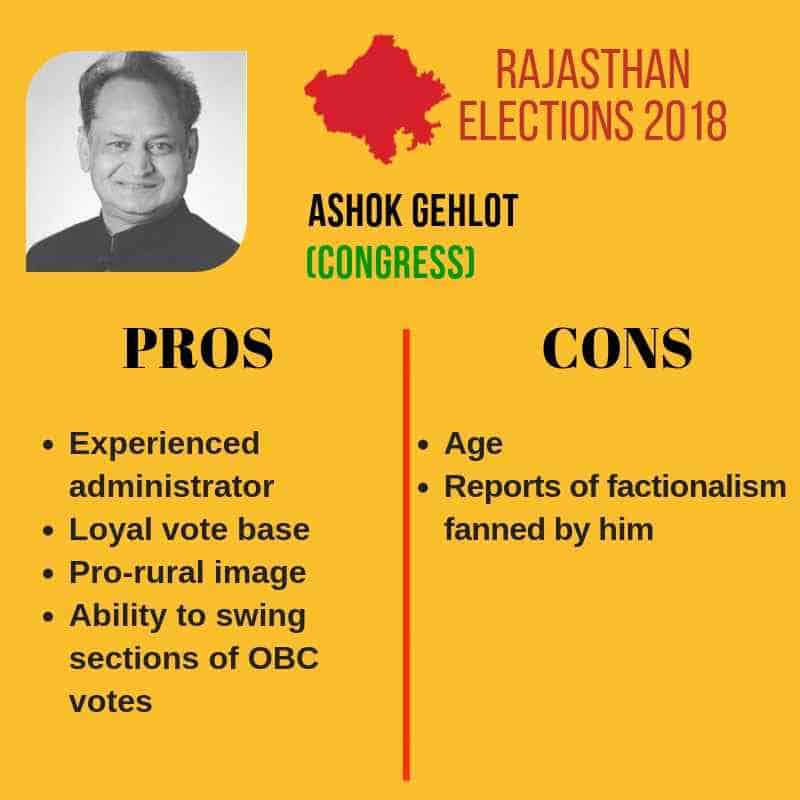
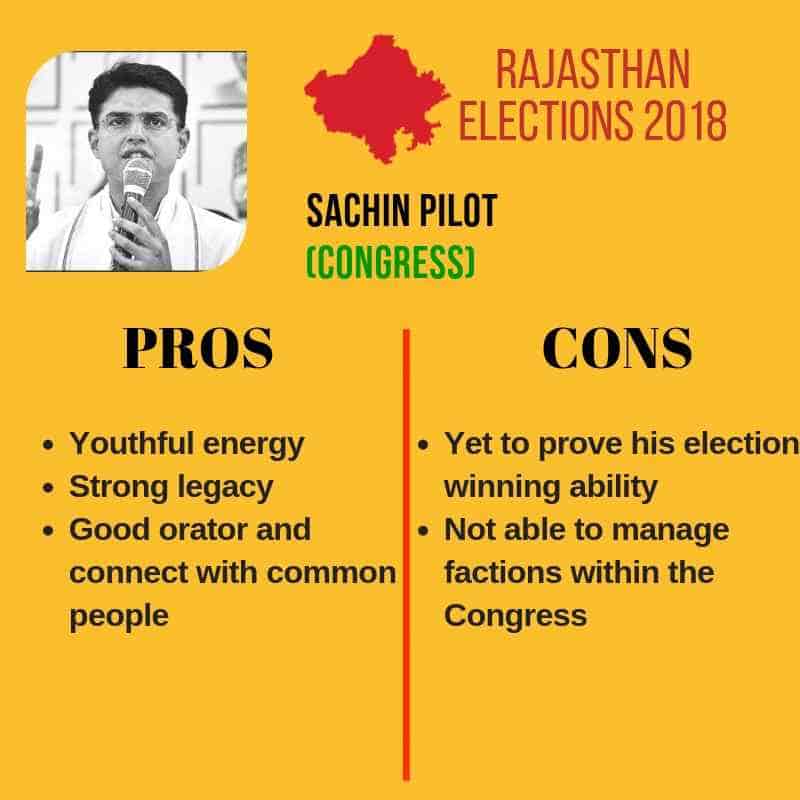
The Congress is yet to announce a chief ministerial candidate in Rajasthan. Its election in-charge Sachin Pilot and former chief minister Ashok Gehlot are seen as front-runners for the top job if the party wins.
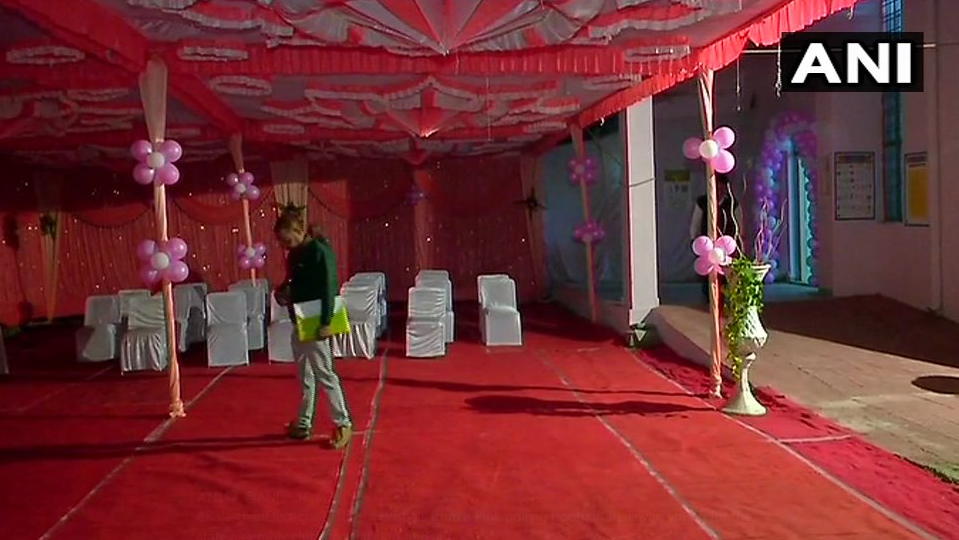
Voting in the Rajasthan assembly election will start at 8 am. A “pink polling booth” in Jhalawar.


Prominent candidates in Rajasthan assembly election: Congress
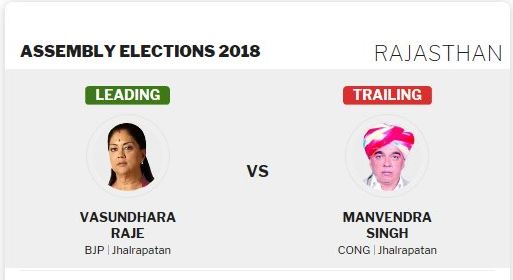
Heavyweight candidates from Congress include State Chief Opposition Leader  and famous Jat leader Rameshwar Lal Dudi from Nokha, State Party Chief Sachin Pilot from Tonk, Former Chief Minister and State General Secretary of AICC Ashok Gehlot from Sardarpur, Senior Congress Leader and former Revenue Minister Hemaram Choudhary from Gudha Malani, State Vice President and former Cabinet Minister Mahendra Jeet Singh Malviya from Bagidora, Former State Home Minister Shanti Dhariwal from Kota and Son of Jaswant Singh and former MP Manvendra Singh from Jhalrapatan.
Prominent candidates in Rajasthan assembly election: BJP
From Bharatiya Janata Party (BJP), State Rural Development Minister Rajendra Rathore from Churu, State Party President and Mayor of Jaipur Ashok Parnami from Adarsh Nagar, State Women and Child Welfare Minister Anita Bhadel from Ajmer South, State Home Minister Gulab Chand Kataria from Udaipur, and Chief Minister Vasundhara Raje from Jhalrapatan are the prominent candidates.

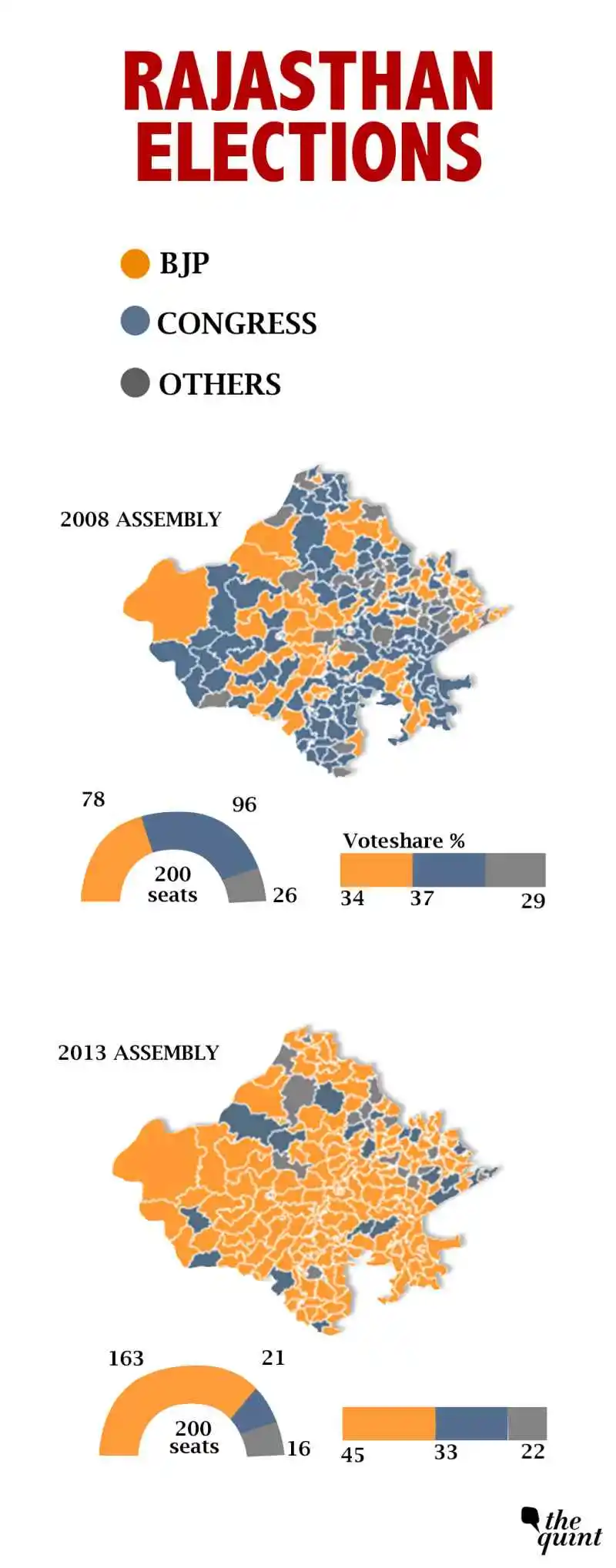
In the last five elections since 1993, Rajasthan has swung between the BJP and the Congress. But the Congress, which won only 21 assembly seats in 2013 against the BJP’s 161, would need an 8 per cent swing in its favour to win the election.

A “pink polling booth” at Jhalawar in Rajasthan. Voting for the Rajasthan assembly elections will start at 8 am.


The election for the 200-member Rajasthan Assembly, scheduled to be held on Friday, 7 December, is largely being seen as a bipolar contest between the Bharatiya Janata Party (BJP) and the Congress.

The Assembly elections in five states are being termed a litmus test for the Narendra Modi-led NDA government ahead of the 2019 Lok Sabha elections.

Rajasthan Elections: All You Need to Know

Will Rajasthan see a break in the 25-year trend of alternating between the BJP and the Congress governments every consecutive term, as the state goes to polls on 7 December?

In Rajasthan, the BJP is fighting anti-incumbency to retain power though no party has been repeated after one term in the last 20 years. With the poll surveys predicting that Congress was ahead, the BJP has made persistent efforts over the last few days to shore up its prospects with Modi, the main vote getter for the BJP, addressing around 12 rallies.

Disclaimer: RSS has been taken from their official website.

‘Take this BJP pamphlet, but vote for TRS’: Telangana election campaigns just another work opportunity for rally-goers

The money spent by political parties for the Telangana Assembly elections can be palpated in the alcoholic breaths of several flag-bearing men at the political rallies in and around Hyderabad. The money offered at the rallies — around Rs 300 per rally — is over Rs 100 more than Telangana’s rate under the Mahatma Gandhi National Rural Employment Guarantee Scheme (MNREGS) and close to the daily wage in many parts of the state. For the labouring poor, who are generally employed temporarily and often work under MNREGS, the elections are just another job, a source of income, except that most of the money spent is unaccounted for.

The State Election Commission of Telangana seized over Rs 112 crore — Rs 90 crore in cash — till this week. The figure touched Rs 104 crore after income tax officials found Rs 51 lakh in cash at the farmhouse of S Shridhar Reddy, brother-in-law of Narender Reddy, a candidate of the Telangana Rashtra Samithi (TRS) contesting from the Kodangal constituency.

A notebook the I-T department found in the farmhouse reveals the magnitude and methods in which money is being spent on the elections in Telangana. “Pages 1, 2 and 3 (of a diary) have notes from 27 November when a search took place. The total of all the entries comes to around Rs 1.2 crore,” I-T sleuths told the Telangana Chief Electoral Officer in a letter. The notebook also reveals that money was being spent on political campaigns, or “to get political favours by distributing money to various leaders”.

I-T sleuths also found that several pages of the notebook were regularly torn in an attempt to cover their tracks. A loose page found in the farmhouse contained details of wine distributed across 26 gram panchayats.

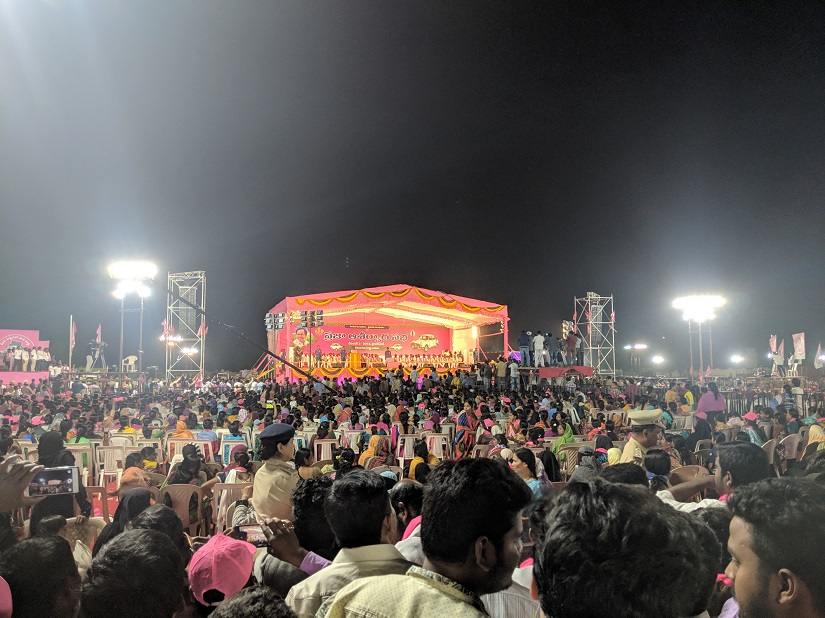
Furthermore, scores of enthusiastic men cheering at political rallies in Hyderabad are often inebriated. I can vouch for this from the two political events I attended in Hyderabad on 2 and 3 December — a mega TRS rally held at Parade Grounds that Telangana chief minister K Chandrashekhar Rao attended and a roadshow by the “Prajakutami”, the alliance of the Congress, Telugu Desam Party (TDP), Telangana Jana Samithi (TJS) and Communist Party of India (CPI), attended by Andhra Pradesh chief minister Chandrababu Naidu.

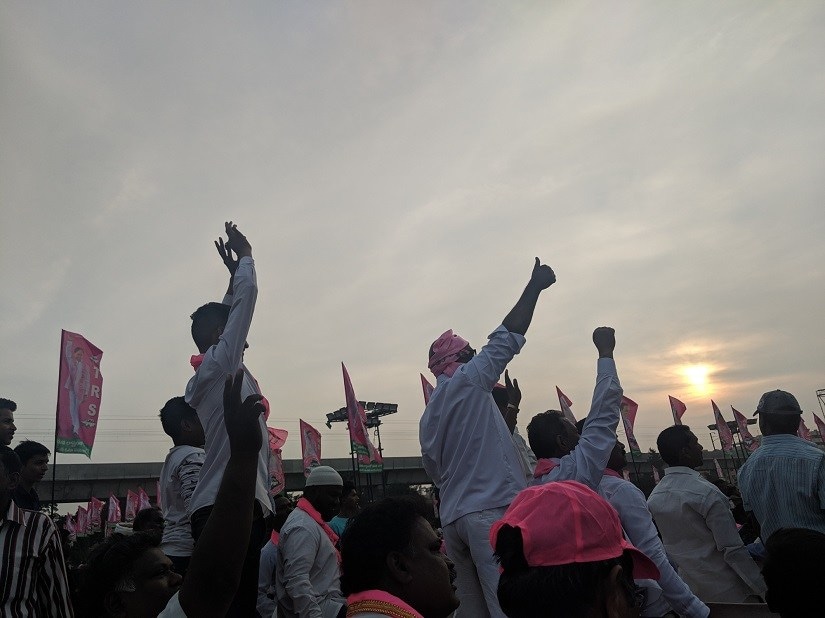
A TRS rally for the Telangana elections at Parade Grounds, Hyderabad. Image Courtesy: Rahul M

“Look at them!” a traffic police signaled to me as I took photos of school vans that were being used for the TRS election rally. “Not the vans, the people inside them.” I could see a few young men lying inside a school van. The traffic police said that they were too drunk to get out of their vehicles.

Alcohol is a theme that perhaps unites people at many election rallies across Telangana. “We were given flags and brought here. Most men have gone to work, which is why there are several women here,” a drunk labourer said, holding onto me for support. A few attendees at the rally said they would be paid around Rs 300 after the event.

While the drunks at KCR’s rally enjoyed themselves dancing to the TRS’ songs and munching on snacks, those at Naidu’s rally were either waiting to leave or cheering the Andhra chief minister merely to pass the time. “Mujhe Telugu nahi aata (I don’t know Telugu),” said a young man who kept cheering for Naidu as he made jabs at KCR. After Naidu left, groups of women waited for vehicles arranged for them.

An auto driver, working as a TRS activist, asked a few women why they were attending the alliance’s rally. “The earnings of a husband and wife are different,” a woman replied, “but I will obviously vote for the car (TRS).”

While the TDP, BJP and Congress are seen as outsiders in Telangana, KCR is seen as one of them. TRS has even successfully appropriated various Andhra songs to his party’s advantage. At the rally, the audience danced to an altered version of a popular Telugu song from the movie Rangasthalam, which unfolds in the context of coastal Andhra of the 1980s. The lyrics of the TRS version of “Aa Gattu Kosthava Ranganna Eegattu Kostava” (will you stay on that side of the bank, oh Ranganna, will you come to this side) asks the electorate for whom they will vote — the good represented by KCR and his policies and the evil represented by the Prajakutami and BJP.

Furthermore, the Congress is likely to have an advantage in districts such as Nalgonda, where it had traditionally held power. The votes of landless labourers and tenant farmers could add to the Prajakutami vote share in many areas since these sections have not been able to avail any benefits of KCR’s “Rythu Bandhu” farmers’ investment support scheme.

“I have only half an acre,” said Ramulamma, a street vendor at Choutuppal in Nalgonda district. “Only the haves are getting fatter.”

A flower seller at the same junction in Choutuppal can’t decide for whom to vote. “They haven’t done much work in our area. But my mother gets pension regularly.”

In areas where the contest is close between the TRS and Prajakutami, the pink party might get an upper hand because of the welfare schemes it has implemented. In constituencies where BJP candidates are contesting, the goodwill the TRS has harvested through welfare schemes might help them win. Also, the BJP seems to have an unspoken arrangement with the TRS in many places.

“Take this,” a woman said, handing me a BJP pamphlet. “But vote for car (TRS).” She lives in Nalgonda town and gets paid around Rs 200 to distribute pamphlets.

S Latha, another women employed by the BJP to distribute pamphlets said, “We can run our lives only by doing labour work. How can we not go?”

For these women, election campaigns are just another opportunity for employment.

Scores of enthusiastic men cheering at political rallies in Hyderabad are often inebriated. Image Courtesy: Rahul M

Although the unemployed help political campaigns, or attend rallies for money, they see a deeper meaning in the election process. They hold trust in the democratic process and will most likely leave for their respective constituencies on the day of the election or the day before.

However, not everyone attending these rallies necessarily see the elections as a meaningful process. The teenagers who attended the TRS rally were, perhaps, the most disinterested. One of them even had his headphones on. Many of them recently graduated from school. The two I spoke to weren’t interested to vote for any party even if they were given a chance.

“They are all the same,” said a teenager who would be eligible to vote in four years. He said he and his friends were attending the rally because it was a Sunday and there was no college to attend. “We are 20 of us. And your leader brought us here. We will get money after the meeting. ”


Disclaimer: RSS has been taken from their official website.

Nitin Gadkari confident of BJP forming govt in Chhattisgarh, MP & Rajasthan

Road Transport and Highways Minister Nitin Gadkari on Wednesday exude 100 percent confidence that the Bharatiya Janata Party (BJP) will form its government in the current elections in Chhattisgarh, Madhya Pradesh and Rajasthan. While talking about what the BJP government has done and it is doing for the development of Rajasthan, Nitin Gadkari said, “I have toured Chhattisgarh, Madhya Pradesh and Rajasthan and I am very confident that the BJP will form the Government again in all three states with majority.”

MP polls: Rajnath Singh takes dig at Congress manifesto; says party ‘holding on to cow’s tail’ for survival in state

Union home minister Rajnath Singh said on Sunday that the Congress in Madhya Pradesh has now latched onto the cow for its survival.

The Congress, in its manifesto for the 28 November Assembly elections, has promised to build cow shelters across the state.

“Congress leaders are now doing temple-hopping as they know that the party cannot achieve anything on its own. They are kneeling before God and holding onto cow’s feet,” Singh said, addressing campaign rallies in Sagar, Morena and Gwalior region. They are holding on to the cow’s tail and promising to build shelter homes for cows,” he said.

“For us (the ruling BJP) cow is not an election issue. Temple and cow are crucial parts of our culture,” he added.

Saying that chief minister Shivraj Singh Chouhan is the first choice of people, the senior BJP leader alleged that the “Congress does not like him as he is born in a simple family.”

The opposition party is yet to choose its chief ministerial candidate while the BJP has renominated Chouhan, Singh said.

When he campaigned in the state during 2003 elections, “there was darkness under the regime of then chief minister Digvijay Singh, now there is brightness (electricity) in each household,” he said.

Under the Congress rule from 1993-2003, agricultural grown rate of the state was three percent, which has now soared to 20 percent, while the per capita income has risen to Rs 80,000 from Rs 15,000, the Union minister said.


Disclaimer: RSS has been taken from their official website.

Madhya Pradesh Assembly election results will tell us more about 2019 than all other four states, here’s why

Madhya Pradesh has emerged as the most coveted prize to bag among the three north Indian states due to elect their new Assemblies this year. This is because Madhya Pradesh mirrors the big Indian story of agrarian distress, economic disruptions caused by demonetisation and the Goods and Services Tax, and social conflict. Should the Bharatiya Janata Party (BJP) still win the state for the fourth time in a row, the Congress will seem a ship doomed to sink in the whirlpool of the 2019 Lok Sabha elections. Conversely, a Congress victory will have the party set sail its flotilla for capturing power in Delhi.

Among the three north Indian states, Chhattisgarh’s national significance is limited as it sends only 11 MPs to the Lok Sabha. By contrast, Madhya Pradesh has 29 Lok Sabha seats, just three more than Rajasthan’s 26. Yet Rajasthan has been relegated in importance because a Congress triumph here will be par for the course. Ever since the BJP formed the government in Rajasthan in 1993, the power there has alternated between it and the Congress every five years. A Congress victory, therefore, cannot be taken as a reflection of the political mood in north India.

By contrast, the BJP won 165 out 230 Assembly seats in Madhya Pradesh in 2013, 143 in 2008, and 173 in 2003. More significantly, it polled 44.87 percent of votes in 2013, 37.64 percent in 2008, and 42.50 percent in 2003. In fact, in the 2014 Lok Sabha elections, the BJP’s vote share ballooned to a stunning 54.03 percent, a rarity in India.

“In the aftermath of the fall of the Congress nationally, there are not many states where the dominance of one single party has been shaping so clearly. In Madhya Pradesh, the Congress is not only kept out of power, but the BJP has also established its domination beyond electoral politics,” wrote Yatindra Singh Sisodia in Electoral Politics in Madhya Pradesh: Explaining the BJP consolidation, a paper he authored in 2014.

Based on the post-poll survey he conducted for the Centre for the Study of Developing Societies, Delhi, Sisodia, quite significantly, added, “It (BJP) has also been able to spread its support base across social sections… While the leadership (Prime Minister Narendra Modi and Chief Minister Shivraj Singh Chouhan) factor that contributed to the electoral success may have limitations in the long run, the fact that the BJP has wider social base and that it is seen as a party that may perform better than its rivals, will surely remain more dependable factors in this consolidation.”Shivraj Singh Chouhan and Narendra Modi. AFP file image

Not only has the Congress been kept out of power in Madhya Pradesh for 15 years, it lags far behind the BJP. For instance, it polled 36.38 percent of votes in the 2013 Assembly elections, nearly nine percent less than the BJP. Yet the hopes of the Congress have risen because of the social and economic tumult in the state, making it believe that the moment is propitious to overcome the massive lead the BJP has over it. Only a Congress win or photo finish in Madhya Pradesh will provide proof whether anti-incumbency, of even indeterminate magnitude, has set in against Modi and the BJP.

Yet the task of beating the BJP in Madhya Pradesh is formidable. For instance, agrarian distress in the state has been grabbing headlines, mostly notably when five farmers died in police firing last year. Traditionally, the BJP is considered an urban-centric party. Yet, in 2013, out of 194 constituencies in the state where urban population is less than 50 percent, the BJP won as many as 132, against the 55 that the Congress won. These comparative figures show the BJP has roots deep enough in rural Madhya Pradesh to limit the outfall of the discontent among farmers.

The challenge before the Congress to eat into the BJP’s rural base can also be perceived from the perspective of caste. The largest segment of agriculturists in the state belongs to the Other Backward Classes (OBCs), which account for around 42 percent of the electorate. Chouhan is a Dhakad, an OBC community engaged in agriculture and constituting about 3 to 4 percent of the state’s electorate.

The BJP’s OBC base is formidable – 67 percent of Yadavs voted for it in 2013 as against 25 percent of them for the Congress. The chasm between the two parties was less when it came to the support of non-Yadav OBCs – 45 percent of them voted for the BJP and 35 percent for the Congress. Given that the Dhakads are not numerically preponderant, it can be argued that Chouhan’s OBC identity will not stem the BJP’s slide because of agrarian distress.

However, Chouhan has refrained from harping on his OBC identity, choosing instead to project himself as the “son of a farmer.” He has repeatedly projected the Congress as the party of “raja (Digvijay Singh), maharaja (Jyotiradita Scindia) and udyogpati (industrialist).” In this context, it will be interesting to see whether agrarian distress will drive farmers to desert one of their own fighting to save his chief ministerial chair.

Should the BJP’s support among OBC farmers crack in a state that is its stronghold, it will be to the benefit of Opposition parties anchored among middle castes. In north India, the gains will not accrue to the Congress, whose upper caste leadership structure has always shied away from courting the OBCs on the basis of their caste identity.

As such, in Madhya Pradesh, both the upper castes and OBCs have been railing against the BJP for reversing the Supreme Court judgment that was seen to have diluted the Scheduled Castes and Scheduled Tribes (Prevention of Atrocities) Act.

In 2013, the BJP won 28 out of 35 seats reserved for SCs and 31 out of 47 seats reserved for STs. The anger among the upper castes and OBCs could, quite surprisingly, adversely impact the BJP in the SC reserved seats. This is because in 30 out of 35 such seats, the OBCs and the upper castes together account for as much as 60-65 percent of votes. Should they decide to not support the BJP, its 2013 tally of 28 seats would likely dip.

Comprising less than 16 percent of the electorate, the upper castes have been die-hard supporters of the BJP in Madhya Pradesh – 57 percent of Brahmins, 60 percent of Rajputs and 43 percent of other upper castes voted for the BJP in 2013. In comparison, only 22 percent of Brahmins, 25 percent of Rajputs and 25 percent of other upper castes did for the Congress.

Is the disaffection of the upper castes against the BJP strong enough to propel them in decisive numbers to the Congress? The answer to this question will determine whether the Congress will continue to play the soft Hindu card, such as indulging in its own brand of politics over the cow and projecting its leader Rahul Gandhi as the janeu-dhari Brahmin. Madhya Pradesh could very well have the Congress redefining its self – and becoming a pole to which the upper castes, particularly Brahmins, could decide to flock.

In hindsight, one reason why the Congress did not stitch an alliance with the Bahujan Samaj Party (BSP) was perhaps because it feared such a decision would alienate the upper castes and OBCs-farmers. In 2013, 36 percent of SCs voted for the BJP in 2013, 33 percent for the Congress and 22 percent for the BSP. What the Congress could have gained from aligning with the BSP, it hopes to more than make up with the votes of the upper castes and farmers.

Yet it might become a problem for the Congress if the BSP’s vote-share among Dalits increases exponentially and the upper castes and OBCs don’t desert the BJP in significant numbers. In 2013, out of 57 constituencies having SC population of 20 percent and above, the Congress won just eight seats and the BJP a whopping 46. Then again, out of 80 seats in which STs constituted 20 percent or more of the population, the BJP won 49 seats and the Congress 29.

Much has been written on Madhya Pradesh’s economic woes arising from demonetisation and the Goods and Services Tax. In 2013, the BJP polled 42 percent of votes of the upper income group, 46 percent of the middle income group, 45 percent of the lower income group, and 44 percent of the poor. By contrast, the Congress polled 27 of votes of the upper income group, 34 percent of the middle income group, 38 percent of the lower income group, and 44 percent of the poor.

In other words, the BJP was voted by as many poor as was the Congress, traditionally the principal recipient of their votes. Let alone the poor, in case the BJP loses substantial ground among the middle and lower income groups, the Congress would cite this as proof of the backlash against the Modi government’s economic policies. It could arm the Congress to mount an attack on the BJP before the 2019 Lok Sabha elections.

Creating credible narratives in electoral politics is undoubtedly important. But Madhya Pradesh’s significance goes far beyond that – it will tell us whether the BJP has the skills to resolve the animosities its own social policies have triggered among its large support base; and whether it can pacify those who have been cut by its economic policies. On the other hand, the fall of the BJP’s impregnable fortress of Madhya Pradesh will recast Congress’ personality into a mould that will have an upper caste polish to it, apart from encouraging its leaders into believing that anti-incumbency has started to work against the BJP and that they have hit upon the right strategy to take advantage of it.


Disclaimer: RSS has been taken from their official website.

Rajasthan Poll Campaign LIVE: Modi accuses Sonia Gandhi-led Congress of laundering Rs. 90,000 cr from national treasury

“The BJP government under Vasundhara Raje in Rajasthan has replaced wooden ‘chulhas‘ with gas connections and at a subsidised cost. People now have been ridden of the fatal smoke that the women and children were exposed to in a household that could only afford a wooden chulha. The BJP government has given gas connections to 12 crore households in the four years that it came to power,” said Prime Minister Narendra Modi, while addressing a rally in Kota, Rajasthan

“55 crore people have been given health services through the Ayushman Bharat Yojana. In the two months after its launch, 3 lakh people have gotten surgeries and organ transplants done. Imagine the scale it will soar to in due course of time. The government will bear the expense of Rs. 5 lakh crore for this scheme”, said Prime Minister Narendra Modi, while addressing a rally in Kota, Rajasthan

“In four years the Congress gave broadband connection to 59 villages. Modi gave broadband connection to 1 lakh villages in the same time”,said Prime Minister Narendra Modi, while addressing a rally in Kota, Rajasthan


  • “Those who laundered that Rs. 90,000 crore were investigated by Modi. And, that is why the Congress is attacking me. But you can stop this by one vote. You need to choose,” said Prime Minister Narendra Modi, while addressing a rally in Kota, Rajasthan

    “One vote can stop the stealing of 90,000 crore from the tax payer’s money. You made be the Prime Minister. Modi investigated into bogus [deals of the Congress] when someone[Sonia Gandhi] was remote-controlling the government. Subsidies of food, gas and health facilities were given to fake identities at the expense of the national treasury which is the taxpayer’s money” ,said Prime Minister Narendra Modi, while addressing a rally in Kota, Rajasthan

    Congress has made a similar poll promise in Madhya Pradesh. A number of farmers in Madhya Pradesh have stopped repaying loans after Gandhi made the promise to waive loans up to Rs 2 lakh if the Congress government comes to power.

    Gandhi has reaffirmed that Congress will waive farmer loans within 10 days of coming to power.

    Speaking in Jalore, Rahul Gandhi has attacked the prime minister over the issues of corruption, demonetisation and the Rafale deal.

    Congress President Rahul Gandhi is addressing a rally in Jalore.

    Prime Minister Narendra Modi has concluded his address in Banswara. He is expected to address another rally in Kota later toda

    1.25 crore houses were built, keys were distributed, people celebrated Diwali too. Seven lakh homes in Rajasthan, one lakh in Banswara. Your vote will bring BJP to power and poor will be benefit: PM Modi

    Congress talks about farmers… But, naamdar does not know if Chana (chickpeas) grow on a tree or a plant. They do not know the difference between Moong (mung bean) and Chana and they talk about farmers’ welfare: PM Modi

    By 2022, every family will have a house. Not only walls, but water, electricity and gas connections as well: PM Modi

    Rahul Gandhi has concluded his address in Pokhran. He is exected to address rallies in Jalore and Jodhpur next.

    Tribal communities have existed for thousands of years. Did they not make sacrifices during the freedom struggle? Did they not contribute in the nation’s development? You know this, I know this, history knows this but Congress does not know this: PM Modi

    Meanwhile, Rahul Gandhi has hit out at PM Modi and the BJP over issues corruption and black money.

    Congress never thought about welfare of the tribal communities. It was only under Atal Bihari Vajpayee ji’s leadership that a dedicated Ministry of Tribal Affairs was created: PM Modi

    Meanwhile, Prime Minister Narendra Modi is addressing a rally in Beneshwar Dham, Banswara.


         Disclaimer: RSS has been taken from their official website.

Congress cannot fight me, that is why abusing my mother: PM Modi

Hitting out at the Congress, Modi today said that the people of Madhya Pradesh will give a befitting reply to the party for abusing his mother in the coming assembly elections.


HIGHLIGHTS

  • Raj Babbar had compared devalued rate of rupee to PM’s nonagenarian mother
  • Congress has disrespected my mother, Modi said
  • He also accused Congress of indulging in caste politics

Prime Minister Narendra Modi on Saturday lambasted the Congress for making a personal attack on him. Referring to Congress leader Raj Babbar’s recent remark, Modi said the Congress is rattled by the good work of the Bharatiya Janata Party (BJP).

“For the past 18 years, I have been defeating the Congress at every single opportunity, and today it has fallen to the level that it has dragged my mother in elections. Congress cannot fight Modi, that is why it is now abusing my mother,” said Modi while addressing a rally in Madhya Pradesh’s Chhatarpur.

Congress leader Raj Babbar had recently compared the devalued rate of the Indian rupee to the PM’s nonagenarian mother, who is around 97 years old. “He [Modi] used to say that the rupee has fallen so much against the dollar that it was nearing the age of the then prime minister [Manmohan Singh]. Today, the rupee’s value has dropped so low, that it is inching closer to your [Modi’s] beloved mother’s age,” Babbar had said on Thursday at a rally in Indore.

Hitting out at the Congress, Modi today said that the people of Madhya Pradesh will give a befitting reply to the party for abusing his mother in the coming assembly elections.

He also said that corruption is the culture of the Congress. “Those who are out on bail in corruption cases are now unnerved. Coffers of banks were emptied for rich during madam’s [Sonia Gandhi] government, but we opened banks’ doors for needy youth,” he said.
Accusing the Congress of indulging in caste politics, Modi said, “People had voted Congress out of power in Madhya Pradesh 15 years ago because of its divisive politics.”

Earlier, Congress president on Friday had targeted Modi alleging that he created a cobweb just like the Bollywood villain Mogambo to “loot” the armed forces and that the Rafale scam is one of his many adventures which will be exposed soon.

In a tweet in Hindi, Rahul said PM Modi has created a “cobweb”, just like Bollywood villain Mogambo, to “loot” India’s armed forces. He alleged the Rafale scam was “one of his many adventures” that will be exposed soon.

The 230 member-Madhya Pradesh assembly will go to polls on November 28. It will be only clear on December 11 as to who the people of the state have blessed with their votes after the EVM’s are opened for counting on this day.


Disclaimer: RSS has been taken from their official website.

Rajasthan Polls 2018: At Alwar rally, PM Modi blames Rahul Gandhi for personal attacks by Congress leaders

Launching the BJP’s poll campaign in Rajasthan, prime minister Narendra Modi on Sunday sharply criticised the Congress for what he described as the party’s ‘jatiwadi mansikta’ (caste mentality).

Modi’s criticism came two days after a video of Congress leader CP Joshi was circulated on social media in which he can be heard raising questions about the PM’s caste at an election rally in Nathdwara. Modi used this to attack the Congress several times during his 48-minute speech at Alwar’s Vijay Nagar ground on Sunday.

Koi ma ko gali deta hai, koi meri jati ko lekar sawaal poochta hai… bolne wala koi bhi ho, bolwane wala to namdaar hi hai (Someone abuses my mother, someone questions my caste. I know whosoever may be saying it but he’s saying it at the behest of naamdar),” he said, adding that the Congress in Rajasthan had no vision for the state’s welfare.

Modi said that the Congress was resorting to “jatiwaad ka zeher (the poison of caste)” since they had nothing to compare their achievements to that of the BJP government.

In his response to CP Joshi, Modi quoted both Kabir and Saint Ravidas to drive home the point that humans were one despite their caste.

Quoting Kabir, he said, “Kabira kuan ek hai, pani bhare anek/ Bhaande hee mein bhed hai, pani sub mein ek (O Kabir, the well we all fill our vessels from is the same/ The jars are different, but the water from that one source is same).”

He also quoted Ravidas and said, “Jaat paat mat poochiye, ka jaat aru paat/Ravidas poot sab prabh ke, kou nahi jaat kujaat (Don’t ask anyone caste because everyone is a child of God and no caste is bad).”

Modi said when the prime minister of the country goes abroad, no one asks his caste. “Duniya ko to sawa sau karore Hindustani dikhte hain (People see 1.15 crore Indians),” he said.

The PM also dubbed the Congress as anti-Dalit and anti-backwards as he recounted the cases of Dalit atrocities in 2010 in Haryana’s Michipur village, in 2005 in Sonepat’s Sonaha and in 2000 in Karnataka, saying there were Congress governments in these states when these crimes occurred.

“Jab Mandal commission ki report par charcha ho rahi thi tab namdaar Rajiv Gandhi ne uske khilaaf jo zeher ugla tha, jo alochana ki thi, wo aaj bhi Parliament ki diwaro me goonj rahi hai (Rajiv Gandhi’s opposition and condemnation to reservation for the backward castes during a debate on the Mandal Commission report still reverberates in Parliament),” he said.

Modi said four members of one family got Bharat Ratna but Ambedkar did not get the country’s highest civilian award.

“Dalit, shoshit, gareeb, pidit aur kamzor ke prati nafrat ka bhaav Congress ki rago me bhara pada hai (Hatred for Dalits, the oppressed, the poor and the weak runs through Congress’ veins),” Modi said, adding that whenever anyone from these groups challenges the ‘naamdar’, they get annoyed.

Modi said the Congress had pulled out all stops to defeat Ambedkar in elections, and said that everyone knew what the party had done to Jagjivan Ram when he tried to challenge the family.

Talking about Congress in Rajasthan, Modi referred to a video of BD Kalla where he is seen stopping a man shouting Bharat Mata Ki Jai and telling him to say ‘Sonia Gandhi ki jai’, and said for the Congress, “Bharat Mata se koi aur mata badi hai (There is a mother bigger than Mother India for the Congress).”

Modi also talked about Congress spreading canards about its leader Nawal Kishore Sharma, who later became Governor of Gujarat when Modi was the CM. The PM took snipe at confusion in the party over the CM candidate and said it had “gali gali me mukhyamatri (a CM in every lane).

Praising the work done by Vasundhara Raje government in 5 years, Modi said Raje opened as many higher secondary schools and medical colleges in 5 years as Congress did in 50 years, and added that for the amount of development that happened in Raje’s rule, people would have had to wait for 50 years if there was a Congress government.

In his speech, Modi did not name Rahul Gandhi even once, and referred to his father Rajiv Gandhi and mother Sonia Gandhi only once. For the rest of his address, he kept calling them ‘naamdar’.


Disclaimer: RSS has been taken from their official website.

How Upper Caste Anger on Dalit Atrocities Act May Impact Madhya Pradesh Elections

To take the case of Malwa region only, in Mandsaur, Ratlam and Ujjain lakhs of upper castes marched across towns to register their anger against the BJP, led by small, disorganised outfits like Karni Sena and Samanya Pichhda Alpsankhyak Kalyan Samaj (SAPAKS).


In September, one month after the NDA overturned the dilution in SC/ST Atrocities Act by the Supreme Court, protests led by upper castes and OBCs broke out all across Madhya Pradesh.

To take the case of Malwa region only, in Mandsaur, Ratlam and Ujjain lakhs of upper castes marched across towns to register their anger against the BJP, led by small, disorganised outfits like Karni Sena and Samanya Pichhda Alpsankhyak Kalyan Samaj (SAPAKS).
While the visible anger against the BJP, which is trying to win a fourth term in MP, has subsided, this substantial section of society, which in recent elections voted overwhelmingly in favour of the BJP, is looking to exact its ‘revenge’.

“Jab Thawarchandji [Gehlot] hamare paas aaye vote maangne, humne unse kaha ki jab aapne hamare bacchon ke baare mein nahi socha to hum aapke bacche ke baare mein kyun sochein?” says Bhairav Singh Solanki, a regional Karni Sena leader.

Union Social Justice minister Thawarchand Gehlot is facing huge backlash from the small but influential section of Rajput voters in Alote, where his son Jitendra Gehlot is fighting for a second term.

Thawarchand has been campaigning here for his son for past several days. On Monday, he welcomed UP Chief Minister Yogi Adityanath to a rally in Taal, in an attempt to assuage the popular dissent. In his speech Adityanath, who himself is a Rajput and has on several occasions talked glowingly about “Rajput pride”, talked about bringing in “Ram Rajya” and invoked “Ram Janmabhoomi”.

However the widespread anger against the government which is being seen by the upper castes and OBCs as having sided with the SC/ST community is far from over.

“Jab Supreme Court ne ek baar is Act ko sahi kar diya to fir aapko kya zarurat thi usmein ched chad karne ki? Iska seedha matlab to yahi hai ki aapko ek jaati vishesh ke hi vote chahiye. To fir unhi se vote mangiye na,” Rajpal Singh Dodia says in Alote.

Gehlot’s son has been prevented from entering several Rajput dominated villages here like Negrun, Pipliya Sisodia, Babuniya, Lasudiya. In these villages Rajputs have put up signboards asking BJP candidates to stay away. Such no-entry villages can be spotted not just in Ratlam’s Alote but across the Malwa region.

Although it may be premature to predict that the upper castes and OBC leaders are getting automatically polarised towards the Congress. “Hame yaad hai jab sansad mein SC/ST Act pe BJP sanshodhan laa rahi thi tab Digvijaya khamosh the aur Scindia Jee table baja ke uska swagat kar rahe the,” says Vijender Singh Solanki, a Raput, in Ratlam town. A lot of local journalists and businessmen too privately express similar emotions.

In some seats like Jaora and Ghatiya, upper castes have decided to show their anger against both the BJP and the Congress by supporting strong Independent candidates as well.

There are 82 reserved seats in MP’s 230 seat strong Assembly. In the rest of the seats, the upper castes and OBCs command great influence. It was perhaps with this in mind that CM Shivraj Singh Chouhan prevented release of the film Padmavati, later Padmaavat, and wrote on his official Twitter account the misuse of the SC/ST Atrocities Act will not be allowed.

Around 10 km away from Bhuda, in Mandsaur, a Rajput dominated village called Kittukheri came into limelight earlier this year, when, like several other Rajput dominated villages it put up posters saying they will vote NOTA in the upcoming elections angered by the BJP’s support to the stringent provisions of the SC/ST Atrocities Act.

“Amit Shah says in Chhattisgarh that till the BJP is in power reservation will not go. If this is the case we have clearly no future under the BJP regime,” says Dharampal Singh Rajawat.

“We all voted for Narendra Modi in 2014 because he said he will bring back black money, he will deposit money in our accounts, he will build Ram mandir. What happened to all those promises? If they can ban currency notes why can they not build Ram mandir?” asks Upender Singh.

“And what happened to the Kashmir problem? At least 40-45 people from our village are working in the Army most of who are posted in Kashmir. Does Modi think that Rajputs are born only to be posted on the border and die? We were also part of the Kisan andolan in Mandsaur last year we saw what their police did to our farmers,” says Karu Singh Hada.

There are around 7,000 Rajput votes spread across Kittukheri, Munderi, Borkheri, Band Pipliya, Jarha and Aakli—nearby Rajputv villages. Locals here say that they’ll do whatever the leaders of Karin Sena ask them to do. “We are not allowing BJP leaders or workers inside our villages. Only Congress people are being allowed and only on the condition that they give us in writing all that they’re planning to give us. So on the voting day we will decide between the Congress and NOTA,” Rajawat adds.

The BJP candidates did not win by a huge margin in 2013, Rajawat further adds. “Even if they lose just 50 voters per village, compared to last time, the BJP will be routed from here. Last time there were 2 families supporting the Congress and eight supporting the BJP. The situation this time could be exact reverse.”

In some sense though, the BJP is suffering a unique, mostly silent anger not just from the upper castes and OBCs but from the SC/ST community as well.

“Look how they treated Chandrashekhar [leader of Bhim Army]. The BJP talks in our favour but have they ever appointed a senior party functionary from our caste? Neither has the Congress actually, but over the past few years one thing we have realised is that “Jai Shri Ram” and “Jai Bheem” don’t go together,” says Vinod Parihar, a local Bhim army leader in Alote.

There is a widespread polarisation of Dalit voters here because cases of atrocities against Dalits are more frequently reported. Dalit grooms who take out their wedding processions are regularly attacked and in some cases not allowed to sit and eat with upper castes. Recently, a Dalit groom went to his wedding wearing a helmet. His photo became popular on social media.

Parihar says that since Dalit parties are not strong in this region, the Dalits have decided to support the the Congress to defeat the BJP.

Upper caste anger against the SC/ST Atrocities Act is also bringing some other smaller players like SAPAKS (Saamanya Picchada Alpsankhyank Kalyan Samaj Sanstha) into the folds of regional politics.

A local journalist who has been reporting on regional politics here says the whole district was chock-a-block with people. “Even national parties here haven’t been able to gather as many people here as this small outfit did. They got huge traction. Which is why being a party focused on upper castes, it is a threat both to the Congress and the BJP.”

Sunil Bansal was a local BJP leader who has now joined SAPAKS that became a political outfit in October this year. He goes from door to door asking for votes but without much fanfare. “My party is batting for the rights of 78% people who suffer from the SC/ST Act and reservation politics. My constituency is the government servants and you don’t find people around me because I’ve told them, for their own good, to sit quietly. We will emerge as the kingmakers here, you’ll see,” Bansal says.

Meanwhile, the RSS is also in full swing here, quietly carrying out a door-to-door campaign while calling it a voter awareness drive.

“There are a couple of things worth noting. After three successive terms of the BJP, people worry about the consequences which is why even those who are fed up of the BJP don’t want to say it overtly, fearing consequences if it comes to power again. Secondly, the RSS we have seen kicking in just 4-5 days before elections. But this time they started their work almost a fortnight ago,” says the local journalist.


Note: RSS Feeds taken from Respective Websites.